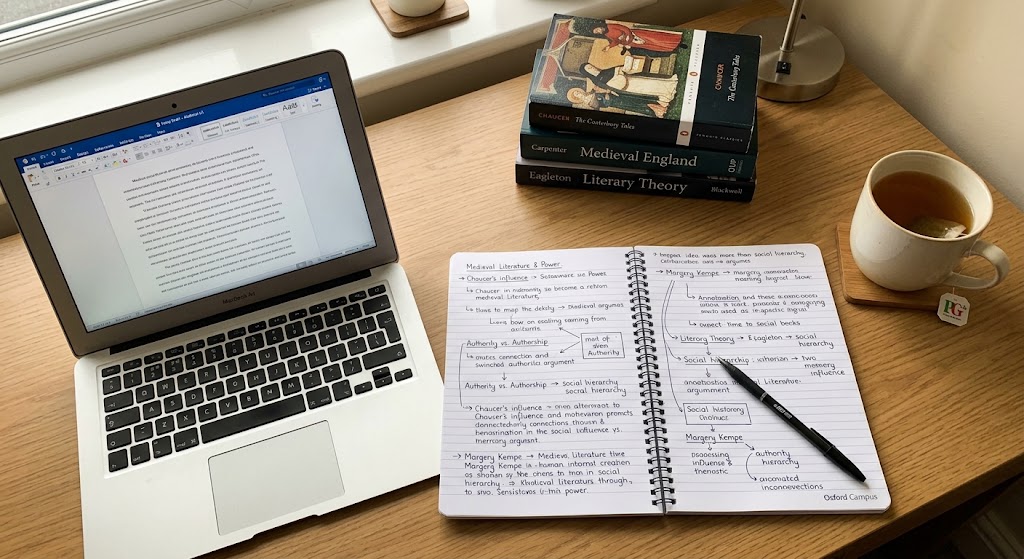
You check the deadline again. Then the word count. Then the clock, as if it might have slowed down since you last looked.
Your document is open, but it is nowhere near finished. There are notes in three different places, a half-written paragraph on screen and more browser tabs than you can remember opening.
If this sounds familiar, you are in good company. Almost every student has been here at some point, usually the night before a submission.
The problem is rarely just a lack of time. More often, every unfinished part of the coursework starts to look equally urgent, and that is what leaves you stuck.
This guide will help you slow the panic down, work out what the assignment actually rewards and spend your remaining hours where they count.
Start With the Question, Not the Clock
The first thing to do is also the thing you will be most tempted to skip. Read the assignment brief again, properly this time.
Look at the question, the learning outcomes, the marking criteria and any rules on structure, evidence, word count or referencing. Then focus on the command word.
Analyse asks you to break something down and show how its parts connect. Evaluate asks for a judgement backed by evidence. Compare needs real similarities and differences, not two separate descriptions.
Here is a real-life example. A business student is asked to evaluate a change-management model, and under pressure they spend three pages explaining how it works.
The explanation is accurate, but it is not an evaluation. The marks sit in questions such as whether the model suits a particular organisation, where it falls short and what other perspectives suggest.
Once you see that, the assignment often feels smaller. You are no longer trying to “finish the coursework”. You are answering one specific question.
Why Pressure Makes You Less Productive
Deadline stress creates a strange kind of tunnel vision. Finding another article feels urgent, so does fixing the formatting, and even choosing a better title can feel more important than writing the section that carries the marks.
You might spend forty minutes researching and feel productive because you now have six extra sources. But if none of them has helped you build the argument, the assignment has barely moved.
Another trap is waiting until you understand everything before you start writing. Academic writing rarely works in such a tidy order.
You may write a paragraph and realise your evidence does not support the point you wanted to make. That is useful, because it shows exactly where the argument needs to change.
Writing is part of thinking, not just the final step after the thinking is done.
Be Honest About Shortcuts
When time is tight, you will probably find yourself searching late at night and coming across phrases such as Buy Coursework. It is an understandable moment of weakness, because anything that promises to remove the problem can look tempting.
But there is a real difference between getting legitimate academic support, such as help understanding a difficult concept or improving your study skills, and handing in work that is not your own.
Most UK universities treat submitting someone else’s work as academic misconduct, and the consequences can be far more serious than a late penalty.
A missed deadline can usually be dealt with through your university’s extension or mitigating-circumstances process. A misconduct case is much harder to undo.
So if you are genuinely stuck, the safer and smarter route is to speak to your tutor, your library skills team or your students’ union advice service.
Separate Information From Reasoning
The most useful mental shift is to separate what you know from how you use it. Knowing what a theory says is knowledge. Questioning it, comparing it or applying it to a situation is reasoning.
Suppose you are discussing a theory of employee motivation. You could explain its main ideas, add a citation and include two examples.
The stronger question comes next. Does the theory explain the situation well? Which assumptions might not hold? Does another theory explain what this one misses?
Sources work the same way. Each one should have a job, whether that is providing evidence, introducing an opposing view or challenging an assumption.
After each section, ask yourself: “What has this actually helped me establish?” If the answer is only “I have explained the topic”, push the reasoning further.
A Practical Plan for the Time You Have Left
Make the coursework physically smaller. Take a blank page and write the question at the top.
Underneath, note the two or three things your answer must establish, then turn them into rough sections. A useful structure beats a clever one at this stage.
Now sort your research into three groups:
- Evidence I definitely need: material that directly supports your argument.
- Evidence I already have: useful sources you can use straight away.
- Interesting but unnecessary: detail that does not help answer the question.
That last group matters most. Coursework is not an encyclopaedia entry, and a fascinating fact can still be irrelevant.
Then follow this order: brief, priorities, evidence, argument, references, review. Each stage answers a different question, which keeps you moving instead of circling.
Record citation details as you go. Thirty seconds now saves a twenty-minute hunt at 2am.
Mistakes That Cost Marks
Try to avoid these common traps:
- Including everything you know. More information can bury the argument.
- Mistaking research for progress. Research becomes avoidance when writing feels harder.
- Ignoring the marking criteria. They show you where your limited time is best spent.
- Polishing one section too early. An immaculate introduction will not rescue an empty analysis.
- Leaving referencing until the last minutes. Tired eyes miss absent page numbers and uncited claims.
Most importantly, do not treat a rough first draft as failure. Its job is to make your thinking visible, and a rough paragraph can always be improved. A blank page cannot.
If the Deadline Is Genuinely Out of Reach
Sometimes the problem is not your planning. Illness, bereavement or other serious circumstances can make a deadline unrealistic, and that is a different situation.
Check your university’s official procedures as soon as you can. Extension and mitigating-circumstances rules vary between institutions, so a friend’s experience is not a reliable guide.
Evidence, such as a doctor’s note, is often required, so start gathering it early.
The Next Best Step
A coursework deadline feels frightening when the assignment looks like one enormous unfinished task. Break it apart and it becomes far easier to manage.
Return to the question, find out what the assessment rewards and use the marking criteria to decide where your effort goes. Then gather only the evidence you genuinely need.
Working under pressure does not mean abandoning quality. It means becoming more selective.
So when the clock is running down, stop asking, “What else can I do?” Ask something more useful instead: “What is the next thing that will make this answer stronger?”