Ask a founder where their money came from, and the answer is rarely a single source anymore. A few years ago, the conversation about start up investment in india often began and ended with venture capital. Today it is wider, and the options ask for different things in return.
If you are planning your next raise, it helps to understand the whole map first.
The Money Is Coming From More Places
Founders now have several routes, and each one suits a different stage and goal.
- Angel investors and networks: usually the earliest outside cheques, often tied to the founder’s story and early signals.
- Venture capital funds: larger rounds, with expectations of rapid growth and a clear path to scale.
- Venture debt and revenue-linked financing: for companies with steady income that want funding without selling as much equity.
- Government-backed schemes and incubator grants: often smaller, but frequently non-dilutive.
- Corporate programs: large companies that fund pilots and proofs of concept with startups whose technology they could actually use.
None of these is the “right” one. The useful question is which one fits where your business is today.
What Each Source Usually Wants to See
| Source | Typically looks for | What you give up |
| Angels | Founder strength, early idea or prototype | Equity |
| Venture capital | Growth potential, market size, traction | Equity and some control |
| Venture debt | Predictable revenue | Repayment obligations |
| Grants | Fit with the program’s goals | Usually no equity, but conditions apply |
| Corporate programs | Technology that fits the company’s needs | Varies by program |
Treat this as a rough guide, not a rule. Terms differ from one investor and program to the next, so read the fine print before you commit.
Why Non-Dilutive Funding Deserves a Closer Look
Equity rounds get most of the attention. Yet funding that doesn’t dilute your ownership can do something equity can’t: it lets you prove your product before you negotiate valuation.
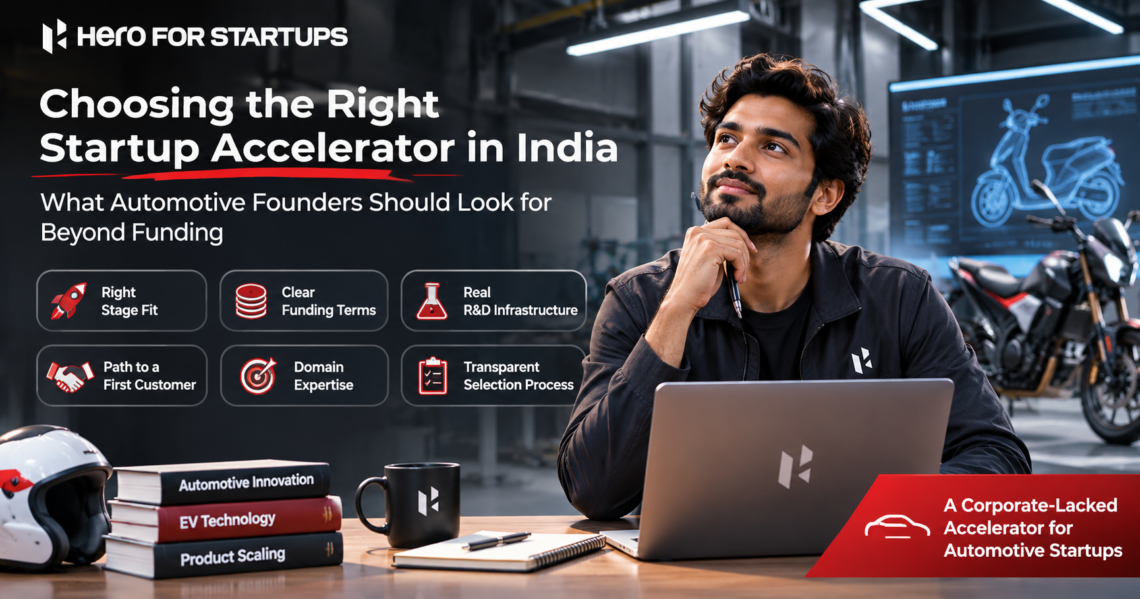
Corporate programs are a good example. Hero For Startups, Hero MotoCorp’s program for mobility, clean-tech and deep-tech startups, offers non-dilutive grants for paid proofs of concept. Startups build the PoC without relinquishing equity, with access to R&D facilities in India and Germany. A successful PoC is then assessed for integration into Hero’s product lines and operations.
It won’t replace a venture round for every company. But for a startup that already has a working product, it can turn a pilot into evidence, and evidence makes every later conversation easier.
Investors Want Proof, Not Just Promise
Whichever route you choose, one theme keeps coming up: investors and partners are looking for evidence. Traction, revenue and a tested product tend to carry more weight than a good pitch alone.
That matters when you set out to find investors for startup growth, because the right investor is the one who understands your sector and your stage. A battery company and a consumer app need different backers, and sending the same deck to both will rarely work.
Some practical steps help here:
- Write down your stage honestly: idea, early revenue or scaling.
- Shortlist funders who have backed similar companies.
- Gather proof points: customers, pilots, test results, revenue.
- Ask each funder what happens after the money arrives.
Funding Is Only Part of the Picture
Capital solves one problem. It doesn’t build a test environment, open a buyer’s door or teach a team to scale. When comparing offers, look at what comes with the cheque: mentorship, infrastructure, customer access and a clear route to commercial deployment.
Programs that pair capital with real operating access can be especially valuable for hardware and deep-tech founders. Hero’s, for instance, includes executive mentorship, testing vehicles and manufacturing facilities for product validation, along with bootcamps on technology, business and sustainability.
It is selective by design. Hero For Startups is meant for growth-stage startups with existing traction, revenue and product funding, and applicants go through a three-level evaluation that ends with a jury pitch. If you are earlier than that, an incubator or angel round may be a better first step.
A Simple Way to Think About Your Next Raise
Match the money to the milestone. If you need to prove technology, look for funding tied to validation. If you need to grow fast, look at equity. If you need working capital against steady income, consider debt. Many founders end up combining two or three.
The landscape for startup financing will keep shifting, but the principle holds: the best funding fits your stage, supports your next milestone and doesn’t force a trade-off you haven’t weighed.
Want to know more about non-dilutive funding for growth-stage mobility startups? Visit the Hero For Startups website to explore the program, focus areas and selection process.