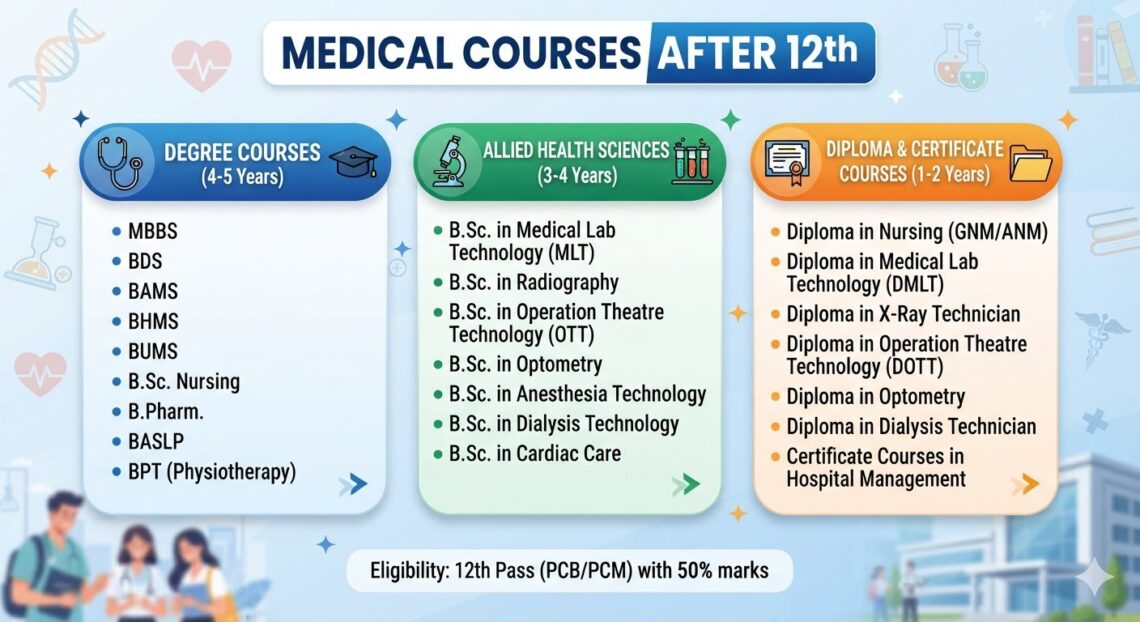
Explore 10+ professional medical courses after 12th for 2027 with eligibility, duration and careers, plus advanced medical coding interview questions.
The best professional medical courses after 12th include MBBS, BDS, BAMS, BHMS, BSc Nursing, BPT, B.Pharm, BMLT, optometry and medical coding. Most clinical degrees need Physics, Chemistry and Biology (PCB), and many require NEET-UG. Choose based on eligibility, budget, course length, and whether you prefer patient care, diagnostics or healthcare technology.
What Students Really Want to Know
Most students searching for professional medical courses after 12th are asking three things: Which courses exist beyond MBBS? What do I need to qualify? Where can each one lead?
This guide answers all three. It also covers medical coding, a fast-growing non-clinical path, including the advanced interview questions employers ask. Exam dates, cut-offs and seat numbers change every year, so confirm them on the official websites of NTA, NMC, NCISM, NCH, the Indian Nursing Council and your state counselling authority.
Quick Comparison of Medical Courses After 12th
| Course | Typical Duration | Usual Stream | Entrance Route |
|---|---|---|---|
| MBBS | 5.5 years (incl. internship) | PCB | NEET-UG |
| BDS | 5 years (incl. internship) | PCB | NEET-UG |
| BAMS / BHMS / BUMS | About 5.5 years | PCB | NEET-UG |
| BSc Nursing | 4 years | PCB | Varies by state/institute |
| BPT (Physiotherapy) | 4.5 years (incl. internship) | PCB | Varies by state/institute |
| B.Pharm | 4 years | PCB or PCM | State CETs / merit |
| BMLT / BSc MLT | 3–4 years | Mostly PCB | Merit or institute test |
| B.Optom | 4 years | PCB | Varies |
| Medical Coding (certificate) | 3–6 months | Any stream (biology helps) | No entrance exam |
Durations and routes vary by institute and state. Treat this table as a starting point, not a final rule.
Top 10+ Professional Medical Courses After 12th
1. MBBS (Bachelor of Medicine and Bachelor of Surgery)
The classic route to becoming a doctor. Admission is through NEET-UG, and the course includes a compulsory rotating internship. Graduates can practise after registration and may specialise through NEET-PG.
2. BDS (Bachelor of Dental Surgery)
For students interested in oral health, dental surgery and orthodontics. It also runs through NEET-UG. Graduates can open private clinics or specialise through MDS.
3. AYUSH Degrees: BAMS, BHMS, BUMS
These cover Ayurveda, Homeopathy and Unani medicine. Admission is generally through NEET-UG with separate AYUSH counselling. They suit students drawn to traditional and integrative healthcare.
4. BSc Nursing
Nursing offers steady demand in hospitals, community health and teaching. Eligibility and entrance rules differ by state, so check the Indian Nursing Council and your state’s notification before applying.
5. Bachelor of Physiotherapy (BPT)
BPT trains you to treat movement problems and support rehabilitation. Career settings include hospitals, sports clinics and private practice.
6. B.Pharm (Bachelor of Pharmacy)
A good fit if you like drug science more than direct patient care. Roles include hospital pharmacy, regulatory affairs, quality control and manufacturing.
7. BMLT / BSc Medical Laboratory Technology
Lab professionals run the diagnostic tests that doctors rely on. It suits students who prefer technical work to bedside care.
8. Optometry (B.Optom)
Optometrists assess vision, prescribe corrective lenses and detect eye disorders. Opportunities exist in hospitals, retail and clinics.
9. Radiology and Imaging Technology
Technologists operate X-ray, CT, MRI and ultrasound equipment. Look for NCAHP-recognised programmes with hospital training.
10. Operation Theatre, Anaesthesia and Cardiac Care Technology
These allied health degrees prepare you to work alongside surgeons and critical care teams. Clinical exposure matters most, so compare hospital tie-ups.
11. Medical Coding and Health Information Management
Not every medical career involves treating patients. Medical coders translate diagnoses, procedures and services into standard codes used for billing and records. Short certificate programmes exist, and you can start after 12th, although a biology background and attention to detail help. Employers often prefer recognised credentials such as AAPC’s CPC or AHIMA’s CCS.
Other Options Worth Exploring
- Clinical research and pharmacovigilance
- Public health and hospital administration
- Nutrition and dietetics
- Biotechnology and bioinformatics
How to Choose the Right Course
- Decide your role: patient care, diagnostics, research or healthcare operations.
- Check eligibility: subject combination, minimum marks and age limits.
- Verify recognition: confirm the college is approved by the relevant council (NMC, DCI, NCISM, NCH, INC, PCI or NCAHP).
- Compare real costs: tuition, hostel, internship and exam fees.
- Review clinical exposure: hospital attachment and internship quality matter more than brochures.
- Plan a backup: apply to more than one pathway before counselling begins.
Advanced Medical Coding Interview Questions (With Practical Answers)
If medical coding interests you, expect advanced medical coding interview questions that test code-set knowledge, compliance, and judgement.
1. What are the main code sets a coder uses?
ICD-10-CM for diagnoses, CPT for procedures and services, and HCPCS Level II for supplies, equipment and certain services. Inpatient facility procedures use ICD-10-PCS.
2. What is the difference between Excludes1 and Excludes2 notes?
Excludes1 means two conditions generally cannot be reported together. Excludes2 means the conditions are not included in the code, but both may be reported if the patient has both.
3. When would you use modifier 25?
When a significant, separately identifiable evaluation and management service is provided on the same day as a procedure. Documentation must support it.
4. What does modifier 59 indicate?
A distinct procedural service, used to show that two procedures normally bundled together were performed separately. Use it only when documentation justifies it, because it is a common audit target.
5. What is upcoding, and why is it risky?
Reporting a higher-paying code than the documentation supports. It can trigger audits, repayment demands and legal consequences.
6. What is unbundling?
Billing components of a procedure separately when one comprehensive code exists.
7. What would you do if documentation is unclear?
Send a compliant query to the provider. Never assume a diagnosis or pick a code based on guesswork.
8. How do you ensure HIPAA compliance?
Access only the minimum patient information needed, use secure systems, and never share protected health information casually. (HIPAA applies to US healthcare data; Indian employers may follow other data protection rules.)
9. How do you stay current with code changes?
Review annual updates from the code-set owners and your certifying body, and attend refresher training.
10. Describe a coding error you caught.
Use a real example from training or work. Explain the error, how you found it and what you changed afterwards. Interviewers value honesty and process over perfection.
FAQ’s
Which medical course after 12th is best?
There is no single best course. MBBS suits aspiring doctors, nursing and physiotherapy suit hands-on caregivers, and B.Pharm or medical coding suit non-clinical interests.
Can I study medicine without NEET?
MBBS, BDS and AYUSH degrees require NEET-UG. Many allied health, pharmacy and coding courses do not, though rules vary by institute and state.
Are there medical courses after 12th without Biology?
Some options accept PCM or other streams, such as B.Pharm in many states, health informatics and hospital administration. Medical coding certificates usually have no strict stream requirement.
Which are the best short-term medical courses after 12th?
Certificates and diplomas in medical coding, phlebotomy, emergency medical technician training and first aid are common. Verify the provider’s recognition first.
Is medical coding a good career?
It can be, particularly if you value desk-based, detail-oriented work. Demand and pay depend on credentials, specialty, location and employer, so check current job listings.
Do I need a certification to become a medical coder?
Not legally in most cases, but employers often prefer credentials like CPC or CCS.
What is the difference between allied health and clinical courses?
Clinical degrees such as MBBS train doctors who diagnose and treat. Allied health courses train specialists in diagnostics, therapy and technical support.
Which medical course is best for girls after 12th?
Suitability does not depend on gender. Choose based on interest, aptitude and career goals.
How do I check whether a college is recognised?
Search the relevant regulator’s official list, such as NMC for MBBS or INC for nursing, and confirm with your state counselling authority.
Can I switch from a medical to a non-medical career later?
Yes. Many graduates move into healthcare management, research, health-tech or education, though some switches need additional training.
Conclusion
The right medical course after 12th depends on your marks, subjects, budget and the kind of work you enjoy. Start with eligibility and recognition, shortlist three realistic options, and read official admission notices before applying. If you prefer a non-clinical route, medical coding rewards accuracy and continuous learning, and the interview questions above give you a head start.