Introduction
Misty Copeland has become one of the most recognizable figures in the world of ballet, not simply because of her remarkable talent, but because of what her journey represents. For generations, ballet has often been associated with tradition, exclusivity, discipline, and a very specific image of what a ballerina should look like. Copeland entered that world and challenged many of those expectations through her talent, determination, physical strength, and willingness to remain true to herself. Her rise from a relatively late start in ballet to becoming the first Black woman promoted to principal dancer at American Ballet Theatre is a story of perseverance and transformation click here.
Her career has helped broaden the public understanding of what ballet can look like and who can belong within it. She has demonstrated that grace does not mean fragility and that strength does not diminish elegance. Instead, the two qualities can exist together, creating a form of artistry that is both powerful and deeply expressive. Through her performances, writing, advocacy, and public presence, Copeland has encouraged countless young people to see possibilities where they might previously have seen barriers.
The significance of Misty Copeland’s story extends beyond the stage. Her life illustrates the importance of persistence when circumstances are difficult, the value of representation, and the power of challenging assumptions. She has become a symbol of achievement for many people while continuing to emphasize the hard work behind every accomplishment. Her story is therefore not only about ballet. It is about identity, confidence, resilience, opportunity, and the courage required to enter spaces where people may not expect you to succeed.
Discovering Ballet at an Unexpected Age
One of the most remarkable aspects of Copeland’s journey is that she did not begin ballet as a very young child. She discovered ballet as a teenager, an age when many aspiring professional dancers have already spent years developing their technique. In the highly competitive world of classical ballet, beginning at thirteen might appear to be an enormous disadvantage.
Yet Copeland’s natural ability quickly became apparent. She demonstrated an unusual combination of physical coordination, musicality, determination, and emotional sensitivity. Rather than allowing the late start to define her limitations, she approached ballet with an extraordinary commitment to learning.
Her early experience is important because ballet training traditionally begins during childhood. Young dancers often spend years developing posture, balance, flexibility, strength, and technical precision before they are old enough to pursue professional careers. Copeland had to make up for years of training while also adapting to an environment that demanded discipline and consistency.
Her progress showed what can happen when natural ability is matched with intense dedication. Talent alone was not enough. Ballet requires repeated practice, physical endurance, concentration, and an acceptance that improvement often comes gradually. Copeland’s willingness to work through those demands became one of the defining characteristics of her career.
Her beginning also offers an encouraging lesson to people who believe they have started too late. Although professional ballet remains an exceptionally demanding field, Copeland’s story demonstrates that a person’s starting point does not necessarily determine the limits of their ambition.
Breaking Through Barriers
Copeland’s journey took place within a ballet tradition that had historically offered limited visibility to Black dancers. For many years, the classical ballet world was shaped by conventions concerning appearance, body type, culture, and presentation. Black dancers often faced additional obstacles, including limited representation and expectations about how a ballerina was supposed to look.
Copeland did not simply enter this tradition; she became one of the people helping to change its image.
Her success at American Ballet Theatre was particularly significant. When she was promoted to principal dancer in 2015, she became the company’s first Black female principal dancer. The achievement was personal, professional, and symbolic at the same time. It demonstrated that someone who had once been an unexpected presence in classical ballet could reach one of the highest positions in the field.
Representation matters because young people often imagine their futures partly through the examples they see around them. When certain groups are rarely visible in prominent roles, young members of those groups may have difficulty imagining themselves occupying those positions. Copeland’s visibility has helped change that picture.
Her achievements have therefore carried meaning beyond individual success. She has become a visible example of what can happen when ability and opportunity meet. At the same time, her career has highlighted how important it is for institutions to create opportunities for talented people from a wider range of backgrounds.
Grace as Strength
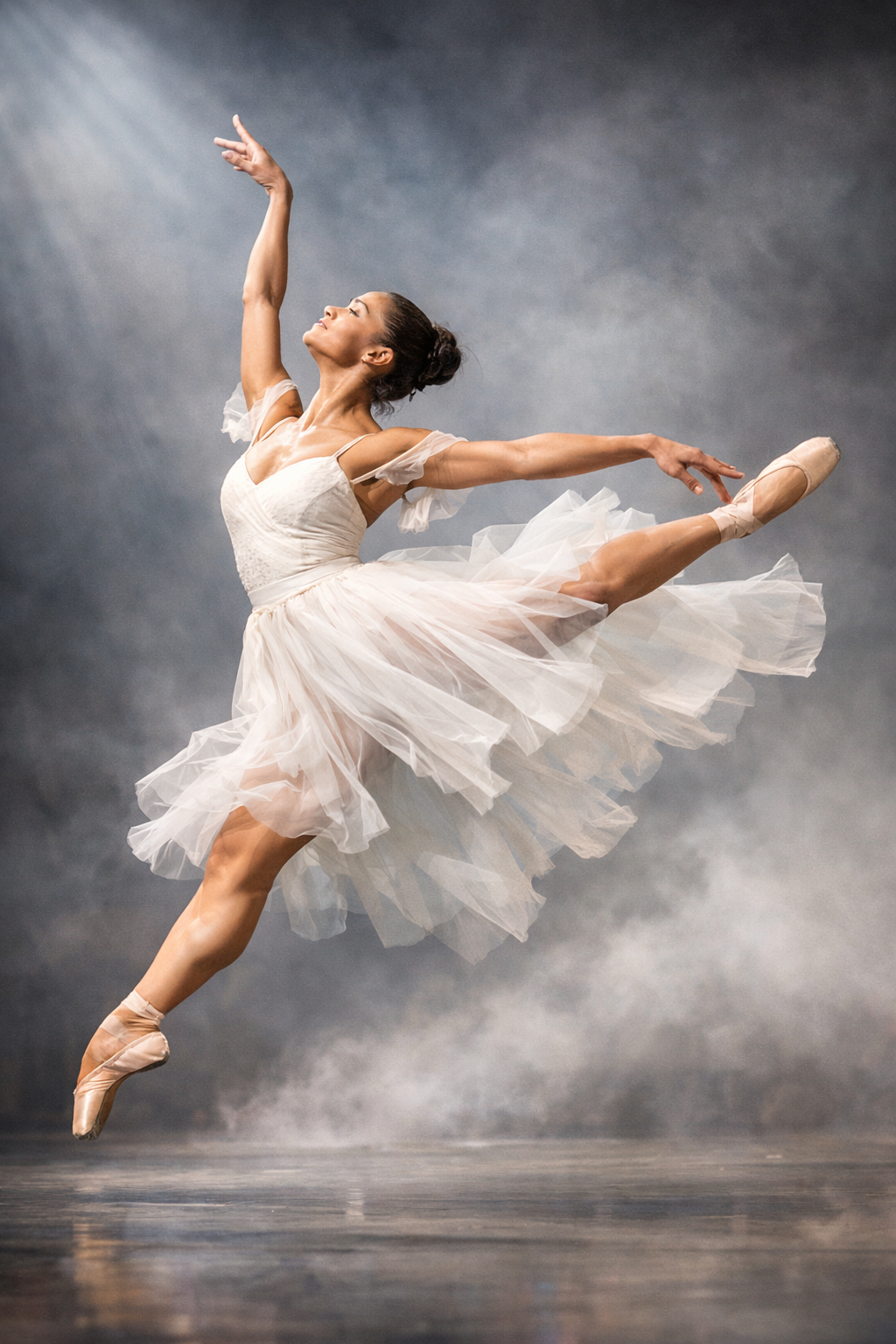
The title “Redefining Grace and Strength” captures something central to Copeland’s artistry. Ballet is often perceived as an art form based on delicacy. Dancers appear weightless as they leap, turn, extend their limbs, and move across the stage. But behind that apparent lightness is tremendous physical strength.
Copeland has helped make that strength more visible.
A professional ballerina needs powerful legs, a strong core, exceptional balance, precise coordination, and extraordinary endurance. Every movement that appears effortless is usually the result of years of physical conditioning and technical practice. The ability to hold an elegant position requires muscular control. The ability to leap requires explosive power. The ability to repeatedly perform difficult choreography requires stamina.
Copeland’s dancing illustrates how strength can support rather than oppose grace. Her physical presence can be powerful without sacrificing refinement. Her movement combines athletic ability with musicality and emotional expression.
This combination has helped challenge the idea that femininity and strength are opposites. A ballerina can be strong, muscular, athletic, and commanding while still embodying elegance. Strength can make grace possible.
That idea extends beyond dance. It can influence how people think about confidence, physical ability, and personal identity. Strength does not always have to be loud or aggressive. Sometimes it appears through control, discipline, balance, and the ability to continue moving forward when circumstances are difficult.
For more information check now.
The Importance of Representation
Misty Copeland’s influence cannot be separated from the importance of representation. Seeing someone who shares aspects of your identity succeed in a field can have a profound effect on how you imagine your own future.
For young Black dancers, Copeland’s presence on major stages has offered an example that was not always readily available. Her success has helped demonstrate that classical ballet is not reserved for one racial or cultural group.
Representation also matters for audiences. When people see a broader range of dancers performing leading roles, their understanding of ballet itself can change. The art form becomes more inclusive and more reflective of the diversity of the people who watch and participate in it.
Copeland has frequently spoken about the importance of young dancers seeing themselves represented. Her public work has encouraged children to consider ballet as something that can belong to them too.
Her influence is particularly meaningful because representation is not simply about placing a different face on a stage. It can also challenge deeper assumptions about who is expected to succeed. Copeland’s career has encouraged conversations about access, opportunity, body image, race, and the traditions that shape professional dance.
Discipline Behind the Spotlight
Public success can sometimes make achievement appear effortless. A dancer performs on a major stage, receives applause, and becomes celebrated around the world. What audiences do not always see is the enormous amount of work taking place away from the spotlight.
Copeland’s career demonstrates the importance of discipline. Ballet demands daily attention to technique and physical condition. Dancers must repeat movements until they become precise and dependable. They must learn choreography, respond to corrections, maintain their physical health, and perform despite the pressures of professional competition.
There is also an emotional side to that discipline. Dancers must cope with mistakes, criticism, injuries, uncertainty, and the knowledge that careers in professional dance can be relatively short. They must continually adapt while maintaining confidence.
Copeland’s story is therefore not simply a story of natural talent. It is a story of sustained effort.
That distinction is important because it makes her accomplishments more meaningful. Admiring talent is easy. Understanding the work behind talent provides a deeper appreciation for achievement. Copeland’s career reminds audiences that excellence is often built through thousands of small decisions to practice, improve, recover, and continue.
Challenging Traditional Ideas of the Ballerina
Ballet has long maintained strong traditions concerning the appearance and physical characteristics of dancers. Copeland’s career has encouraged a broader conversation about those expectations.
She has spoken openly about body image and the challenges of fitting into an industry where dancers have historically been expected to maintain particular physical proportions. Her presence has helped demonstrate that athletic strength can be part of a ballerina’s identity.
This is especially important because young dancers can be deeply affected by the standards they encounter during training. The desire to achieve a particular appearance can sometimes overshadow the more important goals of developing strength, technique, artistry, and healthy physical habits.
Copeland’s example offers another perspective. A dancer’s body is not merely an object to be shaped according to an external ideal. It is an instrument capable of extraordinary movement.
Her physicality has become part of her artistic identity. Rather than hiding her strength, she has shown how strength can become an essential element of beauty.
The Power of Storytelling Through Dance
Ballet communicates without relying primarily on spoken language. Dancers use movement, expression, timing, posture, and physical relationships to tell stories and convey emotion.
Copeland’s performances have demonstrated the ability of dance to communicate ideas about passion, vulnerability, confidence, struggle, and triumph.
Her artistry is not simply about executing difficult steps correctly. Technical precision is essential, but great performance also requires emotional connection. A dancer must make an audience feel something.
This ability to communicate through movement is one reason ballet remains powerful despite its long history. Each generation of dancers brings its own experiences and interpretations to the art form.
Copeland has brought her identity and experiences into a tradition that has sometimes struggled with inclusion. In doing so, she has shown that classical art can remain connected to the present while respecting its history.
Becoming an Inspiration Beyond Ballet
Although Copeland is best known for her achievements as a dancer, her influence has extended far beyond the ballet community.
She has written books, appeared in public campaigns, supported educational initiatives, and used her visibility to encourage young people. Her story has become a source of inspiration for individuals pursuing goals in many different fields.
What makes her example powerful is that her success did not come from having an obvious or easy path. She encountered obstacles associated with starting ballet later than many dancers, entering an industry with longstanding traditions, and becoming a visible Black woman in a field where representation had historically been limited.
Her accomplishments therefore speak to people who may face barriers in their own areas of interest.
The lesson is not that every obstacle can be overcome simply through determination. Opportunities, mentorship, resources, and institutional support also matter. Copeland’s story instead shows the importance of combining perseverance with opportunity and support.
Inspiring Young Dancers
Perhaps one of Copeland’s most lasting contributions is the inspiration she provides to young dancers.
A child watching a professional ballet performance may dream of standing on the same stage one day. When that child sees someone who looks like them occupying a leading role, the dream can become more tangible.
Copeland has helped make that possibility visible.
For young dancers, her story can communicate several important lessons. First, beginnings do not always have to look perfect. Second, progress requires patience. Third, rejection or difficulty does not necessarily mean that a dream should be abandoned. Finally, individuality can be an asset rather than something that needs to be hidden.
Young dancers also benefit from understanding that success does not happen overnight. Copeland’s career developed through years of training and professional experience. Her accomplishments are best understood as the result of a long process rather than a single breakthrough moment.
The Meaning of Perseverance
Perseverance is one of the strongest themes in Copeland’s life.
Starting ballet later than many aspiring professionals meant that she had significant ground to cover. The expectations of professional ballet were demanding, and the competition was intense. Yet she continued developing her skills.
Perseverance does not mean ignoring obstacles. It means acknowledging them without allowing them to determine the entire story.
Copeland’s journey also demonstrates that perseverance can take different forms. Sometimes it means practicing one difficult movement repeatedly. Sometimes it means accepting criticism and using it to improve. Sometimes it means continuing to pursue a goal after experiencing disappointment.
Her example shows that resilience is often built through ordinary actions repeated over time.
Redefining Success
Copeland’s accomplishments could easily be measured through titles and milestones. Becoming a principal dancer at one of the world’s leading ballet companies is an extraordinary achievement. Yet her broader legacy suggests that success can be measured in other ways as well.
Success can mean opening doors for people who come after you. It can mean changing the way an industry sees talent. It can mean encouraging a child to take a first ballet class. It can mean demonstrating that strength and elegance can exist together.
Copeland’s career has therefore expanded the meaning of professional achievement. Her significance lies not only in the roles she has performed but also in the conversations her presence has created.
She has shown that an individual can succeed within a traditional institution while also contributing to changes in how that institution is understood.
A Legacy of Courage and Possibility
Misty Copeland’s legacy continues to develop, but several elements already stand out. She has become an important figure in American ballet, a prominent representative of Black dancers, and an inspiration to people who have felt excluded from traditional definitions of beauty or success.
Her story encourages a broader understanding of possibility.
It reminds us that talent can appear in unexpected places. It reminds us that physical strength can be beautiful. It reminds us that traditions can evolve without losing their artistic value. Most importantly, it reminds us that representation can influence dreams.
When a young dancer sees Copeland on stage, that dancer is not simply watching a performer. They are seeing evidence that a particular path can exist.
That evidence can be powerful.
The Lasting Influence of Misty Copeland
Misty Copeland’s influence is likely to remain connected to both ballet and the wider cultural conversation about representation. Her career has helped bring classical dance to audiences who may not previously have felt connected to it.
She has also demonstrated that an artist can have an identity beyond the institution where they work. She is a dancer, author, advocate, public figure, and role model. These different aspects of her career have allowed her to reach people far beyond traditional ballet audiences.
Her influence is especially meaningful because she has not presented success as something that happens without struggle. The challenges are part of the story. So are the hours of training, the uncertainty, the discipline, and the need to keep learning.
That honesty makes the story relatable.
People do not need to become professional dancers to find meaning in Copeland’s journey. Anyone pursuing a difficult goal can recognize the value of persistence, courage, and self-belief.
Conclusion
Misty Copeland has helped redefine what grace and strength can mean in ballet. Her journey from discovering dance as a teenager to becoming a principal dancer at American Ballet Theatre represents far more than an individual professional accomplishment. It reflects determination, discipline, representation, and the willingness to challenge expectations.
Her success has helped broaden the image of the ballerina. She has shown that elegance can exist alongside athletic power, that physical strength can enhance beauty, and that individuality can enrich a traditional art form. Through her visibility and accomplishments, she has also given young dancers new examples of what their futures might look like.
Perhaps the most powerful part of Copeland’s story is that her achievement does not end with the applause of a performance. Her influence continues through the people she inspires. Every young dancer who feels encouraged to begin, every person who becomes more confident in their identity, and every audience member who sees ballet differently contributes to the continuing impact of her work.
Misty Copeland’s story is ultimately a story about possibility. It is about entering a world that may not have been designed with you in mind and demonstrating that there is room for you within it. It is about understanding that grace is not weakness and strength is not the absence of elegance. They can exist together, each making the other more powerful.
Through her career, Copeland has transformed more than the way many people see ballet. She has expanded the conversation about who gets to be seen, who gets to lead, and what beauty can look like. Her journey stands as a reminder that barriers can be challenged, traditions can evolve, and dreams can take unexpected paths.
Misty Copeland’s legacy is therefore not only found in the roles she has danced. It lives in the doors she has helped open, the assumptions she has challenged, and the generations of dancers who can now look toward the stage and imagine themselves there. In that sense, her greatest contribution may be the simple but powerful idea that grace and strength have never truly been opposites. Together, they can become a force capable of changing both an art form and the people who experience it.