Key Takeaways
- Dubai’s system handles identity, not your hotel stack. Guests register ID and biometrics once, but your PMS, payments and door locks still need to be connected.
- Efficiency: Sync reservations, payments and room access so reception handles exceptions instead of every routine arrival.
- Guest experience: Design the failure paths (unreadable ID, failed face match, room not ready) before launch, not after the first complaint.
- Staying competitive: Repeat visitors make up nearly a quarter of Dubai’s arrivals. The hotel that makes the second stay effortless earns the third.
- Compliance: Biometric data is a sensitive category under UAE law. Settle consent, retention and vendor roles with qualified advisers early.
- Proof: Capture a baseline now, then track completion rates, front-desk interventions and upgrade conversion after rollout.
Picture a Friday at 3:40 p.m. Two flights have landed within twenty minutes, a tour group of 38 is crowding the lobby, and a guest who registered his passport and face on his phone last week is standing at the desk anyway. The PMS never received his confirmation.
That’s the gap this article is about.
In December 2025, Dubai’s Department of Economy and Tourism (DET) announced a citywide, one-time contactless check-in capability for hotels and holiday homes. It’s a genuine step forward for the emirate’s 820 hotels and hotel apartments. But the announcement answers only one question: how a guest proves who they are. It says nothing about whether your booking engine, PMS, payment gateway and room-access system will talk to each other on arrival day.
So this isn’t another announcement recap. It’s a working checklist for hotel owners, operators and IT managers: what to connect, what tends to break, and what to verify before a single guest relies on it.
What Dubai’s Contactless Hotel Check-In Initiative Means for Hotels
How Dubai’s DET-Backed Contactless Check-In Works
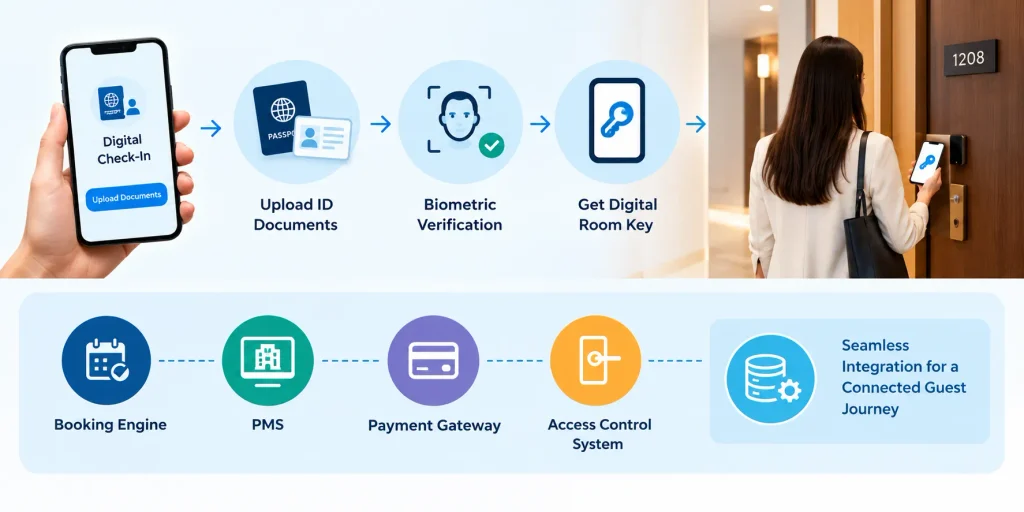
The initiative lets guests upload identification documents and biometric data through their mobile phones before they arrive. The check-in formalities are completed remotely, and at participating properties the guest can skip the usual desk procedure and head toward their room.
Two details matter for planning. First, enrolment is one-time: according to DET-related reporting, the registration stays valid until the ID used for it expires, so repeat visitors can authenticate with a quick facial scan on later stays. Second, the capability is offered through several independent technology providers, not a single vendor. DET also said it can plug into existing hotel apps and web platforms, and officials have floated future uses such as car rentals using the same profile.
For hotels, that last point is the strategic one. A verified identity that travels between services is the start of a connected guest journey, not just a faster lobby.
Why Existing Hotel Systems Still Matter
Here’s the catch. “Integrates with existing apps and web platforms” describes the design intent. It doesn’t mean your specific PMS version, payment setup and lock system are already wired in.
Your identity provider will confirm who the guest is. Someone still has to make sure the booking reference matches, the room is assigned, the deposit has cleared and the digital key opens the right door. Each of those handoffs is an integration point, and each can fail quietly.
That’s why many properties bring in experienced system integrators in Dubai early, to map what their PMS, booking engine, payment gateway and access-control software can actually exchange before anything is built. Confirm provider arrangements and property-specific technical requirements directly with DET.
Why Dubai Hotels Need a Pre-Arrival Integration Strategy in 2026
Managing Peak Arrival Times Without Compromising Service
Dubai’s volumes explain the urgency. The city welcomed 15.70 million international overnight visitors in the first ten months of 2025, up roughly 5% on the year before, and those guests generated 36.71 million hotel room nights.
Arrival pressure isn’t evenly spread. It clusters around flight banks, group transfers and the standard afternoon check-in window. A digital process that depends on manual data entry, or that fails whenever a flight is delayed and a room isn’t ready, just moves the queue from the desk to the staff’s phones.
Moving Beyond Faster Check-In to a Connected Guest Journey
Speed is the visible win. The bigger one sits upstream.
Once identity, reservation and payment data move cleanly into one workflow, the pre-arrival window becomes useful. You can confirm flight timing, offer a paid early check-in or a room upgrade, collect dietary or accessibility needs, and brief housekeeping before the guest lands. That’s the practical case for hotel workflow automation Dubai properties can measure: every manual re-key you remove is a delay and an error you stop paying for.
It also changes how staff spend their day. Fewer people typing passport numbers means more people greeting guests and solving real problems.
The Hotel Contactless Check-In Integration Checklist
Every item below follows the same pattern: what to integrate, what can go wrong, and what to verify before launch.
1. Connect the Hotel PMS With the Reservation System
What to integrate: booking references, guest profiles, stay dates, room assignments and reservation status, flowing between your booking engine, channel manager and PMS. Decide which system is the source of truth for room and stay data (in most hotels, that’s the PMS) and make every other system defer to it.
What can go wrong: duplicate guest profiles, amended reservations that don’t update the check-in record, cancellations that leave a live digital key, and last-minute room changes that never reach the guest.
Verify before launch: test a new booking, a modified reservation, a cancellation and a room reassignment end to end. Confirm that sync errors are logged and that someone is alerted. If your PMS exposes limited endpoints, an API development company Dubai operators hire can build a middleware layer that normalises data between systems rather than forcing a PMS replacement.
2. Build a Secure Pre-Arrival Guest Check-In Portal
What to integrate: a mobile-friendly journey inside your hotel app, website or booking emails where guests review arrival instructions and finish required steps. Keep it short. Show progress. Support the languages your guests actually speak, and meet accessibility standards.
What can go wrong: forced app downloads, repeated data entry, and forms that time out on a patchy airport connection.
Verify before launch: run the full journey on common iOS and Android devices, on slow and interrupted connections, and with a guest who abandons halfway and returns the next day.
3. Integrate Identity Document Verification
What to integrate: the document-verification capability of your chosen provider, matched against the reservation. Confirm which document types and verification methods the provider supports, since Dubai receives guests carrying passports and IDs from nearly everywhere.
What can go wrong: unreadable scans, expired documents, name-order mismatches between the passport and the booking, and verification outages.
Verify before launch: test valid, expired, unreadable and mismatched documents in a controlled environment. Define a secure route for cases that can’t be resolved automatically, so staff can step in without asking guests to start over.
4. Implement Biometric Authentication With Appropriate Safeguards
What to integrate: the biometric enrolment and repeat-authentication flow supported by your DET-aligned provider, including liveness detection and account recovery.
What can go wrong: a failed facial match caused by lighting, a new haircut or a poor camera; a guest who doesn’t want to use biometrics; staff who can’t resolve the exception without seeing more identity data than they need.
Verify before launch: document exactly what happens after a failed match and confirm a trained employee can take over. Establish an alternative route for guests who can’t or won’t use the biometric option, subject to applicable requirements and what your provider supports.
5. Connect Consent, Privacy Notices and Data Retention Controls
What to integrate: plain-language notices explaining why identity and biometric data are processed, consent capture where it’s required, and technical controls for access, encryption, retention and deletion.
What can go wrong: unclear data ownership between hotel and provider, indefinite retention, and no process for a guest’s access or deletion request.
The UAE’s federal personal data protection law (Federal Decree-Law No. 45 of 2021) treats biometric data as a sensitive category, and it can require organisations processing sensitive data at scale to appoint a data protection officer. Free zones such as DIFC run their own regimes alongside it, and some processing falls outside the law’s scope. Which rules apply to your property depends on its location and its data-processing arrangement.
Verify before launch: confirm who controls the data, who can access it, where it’s hosted, and how a deletion or access request is handled. Have qualified legal advisers review the answers.
Quick Question: “Does the hotel or the provider own a guest’s biometric data?”— It depends on the contracts and on who decides why and how the data is used. Don’t assume. Write down, before go-live, which party is the controller and which is the processor, and make sure your privacy notice matches.
6. Integrate Mobile Room Keys and Physical Access
What to integrate: your lock hardware, access-control software and mobile-key technology, with clear rules on when a key is issued, activated, changed and revoked. Room moves and checkouts must update permissions automatically.
What can go wrong: locks that don’t support the mobile-key standard you’ve chosen, keys that stay active after a room change, and a guest with a dead phone at midnight.
Verify before launch: test a room reassignment, an expired key, a lost phone and an access-system outage. Keep a staffed fallback and physical keys available at every stage.
7. Connect Payments, Deposits and Additional Charges
What to integrate: payment authorisation and deposit status, tied to the PMS folio and the arrival workflow. Decide when the guest is allowed to proceed (card authorised? deposit paid?) and how incidental charges, refunds and failures are handled.
What can go wrong: a declined card discovered at the room door, a deposit that shows as pending in one system and paid in another, and card data passing through systems it shouldn’t touch.
Verify before launch: test a declined card, an incomplete deposit and a booking with outstanding charges. Keep payment processing inside the security controls your payment provider and acquirer require.
8. Design a Front-Desk Exception and Staff Escalation Workflow
What to integrate: a clear playbook for when digital check-in fails or the room isn’t ready, with named responsibilities across reception, housekeeping, IT and security.
What can go wrong: staff improvising under pressure, guests repeating the whole process at the desk, and nobody owning identity mismatches, group arrivals, special requests or accessibility needs.
Verify before launch: run a simulated arrival during a busy shift with a failed identity check and a room-assignment problem at the same time. Time it. Then fix what slowed it down.
9. Connect Guest Messaging and Pre-Arrival Personalisation
What to integrate: automated confirmations, reminders, arrival instructions and completion notices, plus optional preference capture that helps staff prepare. Offer upgrades and dining options without interrupting the required check-in steps.
What can go wrong: messages that quote an outdated room or time, reminders sent after the guest has already finished, and marketing pushed to guests who opted out.
Verify before launch: follow one sample booking from confirmation to arrival and check that every message reflects the latest reservation status and the guest’s communication preferences.
10. Set Up Integration Monitoring and Performance Analytics
What to integrate: monitoring for failed API calls, sync delays, verification errors and key-issuance problems, alongside business metrics such as completion rate and manual interventions. Attribute upgrade and ancillary revenue to the pre-arrival journey.
What can go wrong: silent failures that surface only as guest complaints, and recurring faults with no owner.
Verify before launch: build one dashboard that operations and IT review together, and name an owner for investigating repeat failures.
How to Implement Contactless Check-In Without Disrupting Hotel Operations
Phase 1: Audit Existing Hotel Software and Processes
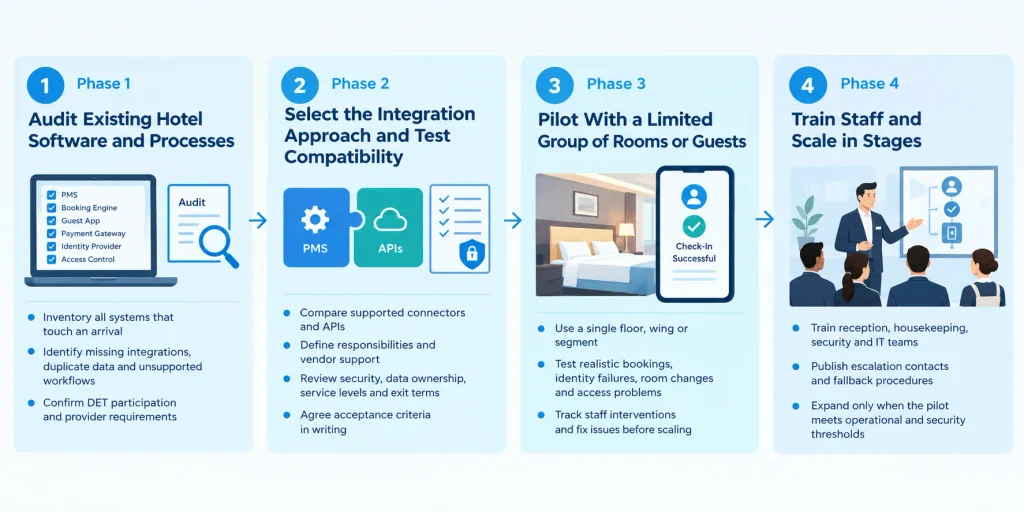
Inventory every system that touches an arrival: PMS, booking engine, guest app, payment gateway, identity provider and access control. Note missing integrations, duplicated data and workflows no system currently supports. Confirm your DET participation status and what your chosen provider requires.
Phase 2: Select the Integration Approach and Test Compatibility
Compare supported connectors and APIs, who is responsible for which part of the build, and the level of vendor support. Review security controls, data ownership, service levels and exit terms. Some groups work with a SaaS development agency Dubai hotels can brief on a custom guest portal, while others rely on their PMS vendor’s modules. Either way, agree acceptance criteria in writing before development or configuration begins.
Phase 3: Pilot With a Limited Group of Rooms or Guests
Start small. Use a single floor, wing or guest segment, and test realistic bookings, identity failures, room changes and access problems. Track how often staff have to step in, and fix operational problems before expanding.
Phase 4: Train Staff and Scale in Stages
Train reception, housekeeping, security and IT on the new workflow and, just as important, on the fallback. Publish escalation contacts. Expand only when the pilot meets the operational and security thresholds you set at the start.
Quick Question: “How long should a pilot run?”— Long enough to see at least one weekend peak, one quiet midweek stretch and a group arrival. Set your exit criteria first, then let the data decide.
How to Measure the Success of a Contactless Check-In Project
Establish your own baseline before launch. Compare against it after rollout. Resist any vendor promise of a fixed percentage improvement, because every property’s starting point is different.
Operational KPIs Hotels Should Track
- Pre-arrival completion rate: the share of guests who finish the digital steps before arriving.
- Identity verification success rate: how often verification passes without human help.
- Arrival-to-room-access time: from walking in to opening the door.
- Front-desk interventions per 100 arrivals: your most honest measure of how connected the systems really are.
- Room-key failure rate and resolution time.
Guest Experience and Revenue KPIs
- Arrival experience satisfaction from post-stay surveys.
- Abandoned or incomplete check-in journeys, which point to friction in the portal.
- Pre-arrival upgrade conversion rate.
- Incremental ancillary revenue attributable to the digital journey.
Review these monthly with both operations and IT in the room. A number that looks fine to one team often hides a problem the other sees daily.
How SISGAIN Can Support Hotel Software Integration in Dubai
Connecting Hotel Systems Around Business Requirements
If you’re looking for a software development company Dubai hotels can talk to about custom integration work, SISGAIN Technologies offers software integration, API development, software development and digital product engineering. A typical engagement starts with a system audit, moves to integration planning, and produces a prioritised implementation roadmap, so you know what to connect first and why.
SISGAIN’s role sits on the hotel side of the connection: linking your PMS, booking, payment, messaging and access-control systems around your requirements. Which identity provider you use is a separate decision made through DET’s process.
Building a Scalable Digital Guest Experience
The goal is fewer duplicate workflows and better visibility across the guest journey, from booking to checkout. Scope always depends on your existing infrastructure, your providers’ APIs, your security requirements and your commercial priorities, so there’s no one-size package.
If you’d like to talk through your current hotel technology stack and integration needs, get in touch with the SISGAIN team for an initial conversation.

Frequently Asked Questions
It’s a citywide capability developed by DET and offered through independent technology providers. Guests upload identification documents and biometric data once, via their phones, and at participating properties can bypass conventional front-desk formalities.
DET has said the capability is designed to work with existing hotel apps and web platforms. Actual compatibility depends on the provider you choose, your PMS version and the integration methods available, so confirm the supported configuration before you commit.
The model is one-time enrolment followed by repeat authentication, with registration valid until the ID expires. The exact workflow, and what alternatives exist for guests who don’t use it, should be confirmed with your provider and compliance advisers.
DET’s initiative covers hotels and holiday homes. Operational and integration needs differ by property type. A single-unit holiday home has no front desk or lobby staff, so key handover and exception handling look very different from a 400-room hotel.
Plan for staff-assisted verification, a physical-key or staffed-access alternative, and a documented exception process. Train your team so a guest who can’t use the digital route isn’t made to feel like the problem.
Look at supported systems, security controls, data handling and hosting, access-control compatibility, support arrangements and who is responsible for each part of the implementation. Ask for named references where possible, and get the exit terms in writing.