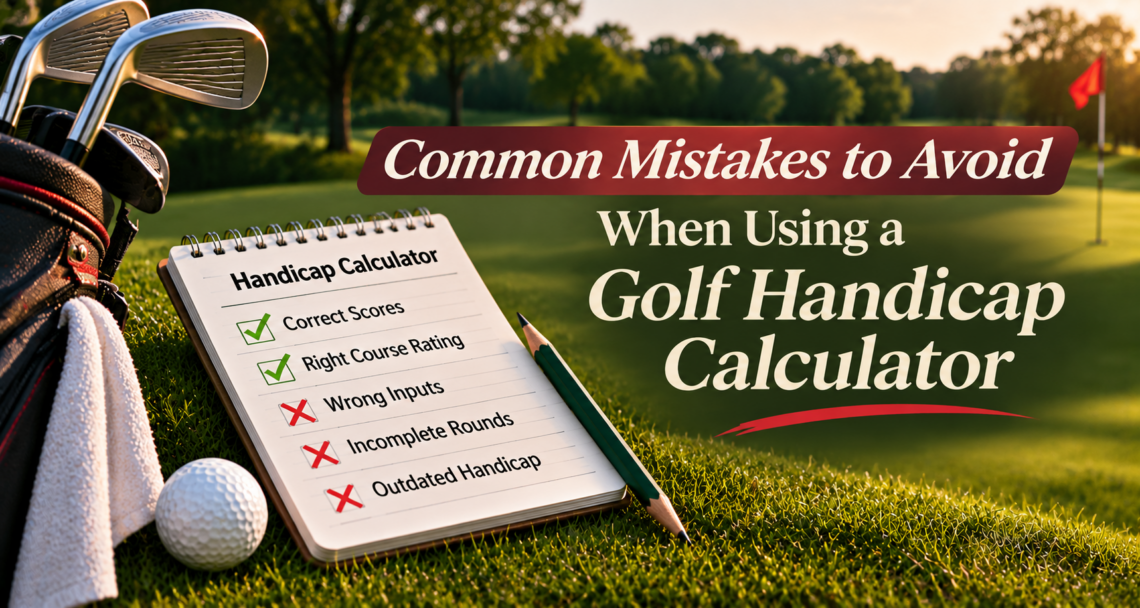
You shoot a gritty 92 at your home course on a windy Saturday, race to the clubhouse, and type the score into an online handicap calculator. The number that comes back feels off. Too low, or maybe too high. You shrug and move on.
That shrug is where trouble starts.
A golf handicap calculator is a simple tool, but it only works as well as the information you feed it. One wrong tee box, one forgotten adjustment, one round you quietly left out, and the result stops reflecting your real game. Under the World Handicap System, your Handicap Index comes from the best 8 of your last 20 score differentials, so every entry matters.
In this guide, we will walk through the mistakes golfers make again and again, from beginners to club regulars. You will see real examples, simple fixes and a checklist you can use after every round.
Mistakes With Your Score Entries
Everything starts with the scores you type in. A calculator cannot tell whether a number is honest, complete or properly adjusted. It simply does the math. That is why most handicap errors happen before you even click the calculate button. If you only record the rounds you feel proud of, or enter raw scores without adjustments, the result drifts away from your true ability, and that drift usually grows over a season.
Posting Only Your Good Rounds
Let’s say you play ten times this summer but only enter the four rounds where you broke 90. Your index will look sharper than your game really is. Then you show up to a tournament and the numbers bite back. Post every eligible round, good or ugly.
Using Your Raw Score Instead of Adjusted Gross Score
A blow-up hole can wreck a scorecard, and handicap rules know it. For handicap purposes, each hole is capped at net double bogey, which is par plus two plus any strokes you receive. If you made a 9 on a par 4 with no stroke, record it as a 6.
Forgetting 9-Hole Rounds Count Too
Many golfers think a quick nine after work does not matter. It does. Nine-hole scores can be posted and are combined into an 18-hole score differential. Skipping them means fewer data points and a slower, less accurate picture of your game, especially during busy months.
Mistakes With Course Data
Two golfers can shoot the same 90 and deserve very different results. The difference lies in how hard the course played for that tee. Course Rating and Slope Rating describe that difficulty, and every calculator relies on them. Enter the wrong numbers, or the wrong tee, and your score differential will be wrong from the very start. This is one of the easiest errors to make and one of the easiest to fix.
Choosing the Wrong Tees
You played the white tees but selected blue in the calculator because it was the first option. Blue tees usually carry a higher rating and slope, so your differential looks better than it should. Always match the tee on the scorecard.
Guessing the Course Rating and Slope
Here is a real example. Course Rating 71.2, Slope 125, Adjusted Gross Score 92. The formula is (113 divided by Slope) multiplied by (Score minus Course Rating), which gives roughly 18.8. A guessed slope of 135 would give 17.4. That gap adds up fast.
Ignoring Playing Conditions
A brutal wind or soaked fairways can make a course play much harder than normal. Under the World Handicap System, a Playing Conditions Calculation adjusts differentials when scoring conditions are unusual. Most official apps apply it automatically, but many basic online calculators do not, so check before you trust the result.
Mistakes With Calculator Choice and Results
Not every calculator is built the same. Some follow the current World Handicap System, others still lean on old formulas, and a few are just rough estimators wrapped in a nice design. Even with a good tool, golfers often misread what the number actually means. Knowing which tool you are using and what its output represents will save you from awkward surprises on the first tee.
Using an Outdated or Unofficial Tool
Older calculators averaged your best 10 scores or used different caps. The current system uses the best 8 of your last 20 differentials. If your tool still mentions the old method, switch to your national golf association app or an official source.
Confusing Handicap Index With Course Handicap
Your Handicap Index is portable, but your Course Handicap changes by course. With an index of 16.4, a Slope of 130, a rating of 72.1 and par 72, the result is 16.4 times 130 divided by 113, plus 0.1, which rounds to 19. Same player, different number.
Rounding Too Early
Some golfers round every differential to a whole number before averaging. That throws off the final index. Keep the decimals through the whole calculation and round only at the end. Small shortcuts feel harmless, but they compound across 20 rounds.
Mistakes With Habits and Mindset
The last group of mistakes has little to do with math. It is about how you treat the process. A handicap is a living number that moves with your form, and it only stays honest if you update it regularly and play fair with it. Golfers who treat it casually often end up frustrated, either by a number that feels unfair or by a reputation they did not want.
Updating Too Rarely
If you post three rounds in March and nothing until August, your index will be stale. Your swing has changed, the course conditions have changed, and the number no longer fits. Post scores soon after each round while the details are fresh.
Sandbagging on Purpose
Some players hold back scores to keep a higher handicap for weekend events. Everyone in your group notices eventually. It also defeats the purpose of the system, which is fair competition. An honest number earns respect, and trophies feel better too.
Expecting the Calculator to Fix Your Game
A calculator measures. It does not coach. If your index stays stuck at 18, the answer is on the range, the putting green and in your course management, not in a different app. Use the number as a mirror, not as an excuse.
A Simple Checklist for Accurate Results
Good habits beat clever tricks. Run through these steps after every round and your calculator will stay honest without much effort. It takes about two minutes, and it keeps your index trustworthy when it matters most.
- Write down every hole score, then apply net double bogey where needed.
- Confirm the exact tee you played.
- Check the Course Rating and Slope Rating on the scorecard or in your club app.
- Note unusual weather or course conditions.
- Post both 9-hole and 18-hole rounds.
- Use an official or up-to-date calculator.
- Keep decimals until the final step.
Conclusion
A golf handicap calculator is only as good as the person using it. Most mistakes come from small habits: leaving out bad rounds, picking the wrong tee, skipping adjustments or trusting an outdated tool. None of them are hard to fix.
Start with your next round. Record every hole honestly, check the course data and use a calculator that follows the current rules. Over a few weeks, your Handicap Index will settle into a number that actually matches your game. That is when handicap golf becomes fun, because every match, big or small, feels fair.
Frequently Asked Questions
1. How many scores do I need to get a Handicap Index?
You need a minimum of 54 holes, which can be three 18-hole rounds or a mix of 9-hole and 18-hole rounds. Once you submit them, your Handicap Index can be issued.
2. How is a Handicap Index calculated?
Each round becomes a score differential using your adjusted gross score, Course Rating and Slope Rating. Your index is the average of the best 8 differentials from your most recent 20 rounds.
3. Do online golf handicap calculators give official results?
Not always. Many are useful for estimates, but only your national golf association or authorized club can issue an official Handicap Index. Use calculators for practice and planning.
4. What is net double bogey and why does it matter?
It is the maximum hole score used for handicap purposes: par plus two plus any handicap strokes you receive on that hole. It stops one disaster hole from hurting your index.
5. Why is my Course Handicap different from my Handicap Index?
Your Course Handicap adjusts your index for the difficulty of the course and tees you play. A harder course with a higher Slope Rating gives you more strokes.
6. How often should I post my scores?
Post every eligible round as soon as possible after you finish. Quick posting keeps details accurate and your index current.