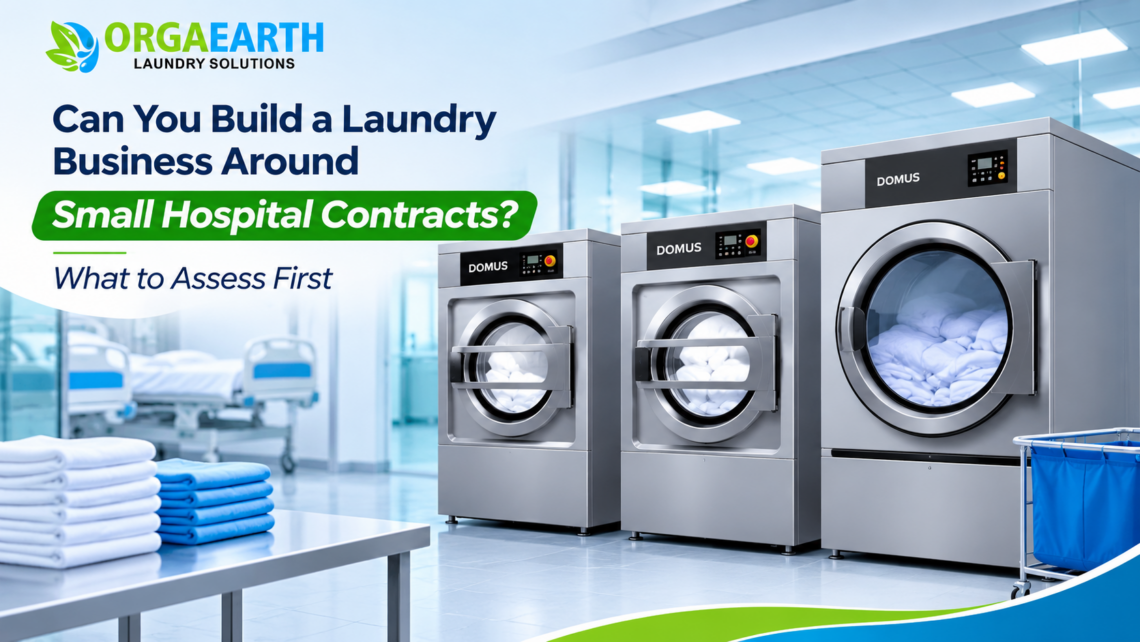
Starting a commercial laundry business doesn’t always mean opening a retail shop or serving hundreds of individual customers.
Another opportunity is providing regular linen-cleaning services to smaller hospitals and healthcare facilities.
Hospitals require clean bedsheets, patient gowns, towels, and staff uniforms for daily operations. Some facilities maintain their own laundry departments, while others outsource processing to professional laundry providers.
For entrepreneurs, these requirements may create opportunities for recurring service contracts.
However, healthcare laundry involves stricter handling procedures than ordinary household washing. Before investing in hospital laundry machines, you need to understand linen volumes, hygiene requirements, operating costs, and customer expectations.
Explore professional hospital laundry solutions to understand the equipment available for healthcare linen processing.
This guide explains what to assess before starting a laundry business focused on smaller hospital contracts.
Is a Small Hospital Laundry Business a Practical Opportunity?
A healthcare laundry service can operate as a business-to-business model.
Instead of collecting individual household orders, you may provide scheduled linen processing for hospitals, nursing homes, and eligible healthcare facilities.
Potential customers include:
- Small private hospitals.
- Nursing homes.
- Speciality healthcare centres.
- Day-care surgical facilities.
- Rehabilitation centres.
The opportunity depends on whether these facilities need an external processing partner and whether your business can meet their operational requirements.
A hospital may prefer outsourcing when maintaining an in-house laundry is impractical or when an external provider offers suitable processing arrangements.
However, securing contracts requires more than offering a competitive price.
Hospitals must consider linen hygiene, availability, handling practices, and delivery reliability when selecting a service provider.
How Much Laundry Can a Small Hospital Generate?
Before purchasing equipment, estimate the actual dry-linen volume your prospective customers produce.
For illustration, consider a 30-bed hospital generating an average of 3 kg of washable linen per bed daily.
Estimated daily workload:
30 beds × 3 kg = 90 kg per day
If your laundry serves three similar hospitals:
90 kg × 3 = 270 kg daily
This is a hypothetical planning example, not a verified average for all Indian hospitals.
Actual quantities depend on bed occupancy, linen replacement frequency, clinical departments, patient-care requirements, and the hospital’s collection arrangements.
Some textiles may need specialised handling or processing that your proposed facility is not equipped to provide.
Request actual linen-weight records or conduct a controlled workload assessment before finalising equipment capacity.
Which Hospital Laundry Machines Will You Need?
The correct equipment depends on daily processing volume, textile categories, and hygiene requirements.
A professional healthcare laundry setup may include several types of machinery.
Commercial Washer Extractors
Washer extractors perform washing, rinsing, and moisture extraction.
Choose machines according to their dry-load capacity, available programmes, operating hours, and utility requirements.
Barrier Washer Extractors
A barrier washer has separate loading and unloading sides.
When installed within a suitable facility layout, this arrangement helps maintain physical separation between soiled and clean laundry areas.
Whether this configuration is necessary depends on customer requirements, infection-control procedures, and the facility’s design.
Commercial Tumble Dryers
Suitable drying equipment is required to complete processing without creating delays between washing and dispatch.
Flatwork Ironers
Hospitals processing large quantities of compatible bedsheets and pillowcases may benefit from professional flatwork ironing equipment.
Chemical Dosing Systems
Appropriate dosing equipment helps deliver controlled quantities of cleaning chemicals according to the approved washing programme.
Additional requirements may include dedicated trolleys, sorting areas, packaging stations, and clean-linen storage.
The machines should be selected as a complete processing system rather than individual products.
What Hygiene Requirements Should You Assess First?
Healthcare linen must be handled according to the hospital’s infection prevention and control procedures.
A commercial laundry serving hospitals should establish suitable systems for:
- Collection and containment of soiled textiles.
- Segregation according to the approved linen policy.
- Safe handling by trained employees.
- Appropriate washing and disinfection processes.
- Separation of soiled and clean handling areas.
- Clean linen packaging and protected transportation.
- Storage that prevents recontamination.
The facility must also have procedures for identifying textiles requiring special treatment or exclusion from ordinary laundry processing.
Do not assume that all contaminated materials can be accepted as routine washable linen.
Confirm hospital-specific instructions and applicable waste-management requirements before accepting contracts.
How Much Processing Capacity Should You Install?
Suppose you plan to process 270 kg daily for three hospitals.
Consider a hypothetical 50 kg washer extractor operating under these assumptions:
| Operating Factor | Illustrative Value |
| Rated machine capacity | 50 kg |
| Average usable load | 40 kg |
| Washing and extraction | 60 minutes |
| Loading and unloading | 10 minutes |
| Operating shift | 8 hours |
One batch requires approximately 70 minutes.
Six complete batches would provide an estimated washing output of:
40 kg × 6 = 240 kg
That is below the assumed 270 kg daily demand.
Your facility may therefore require additional capacity, longer operating hours, or a different combination of machines.
These calculations are illustrative. Actual loading and cycle duration must follow the selected equipment’s specifications and approved healthcare washing procedures.
Drying, finishing, quality checks, and dispatch capacity must also be considered.
What Should You Check Before Signing a Hospital Contract?
A hospital laundry contract should clearly define the services and responsibilities of both parties.
Important questions include:
Daily Volume: How much linen will the hospital provide, and how frequently?
Linen Categories: Which textiles are included, and which require separate processing?
Hygiene Requirements: What documented washing, handling, and quality procedures must your facility follow?
Turnaround: When must cleaned linen be collected or delivered?
Transport: Who is responsible for collection, packaging, and delivery?
Rejected Linen: How will damaged, stained, or unsuitable textiles be recorded?
Payment Terms: Is billing based on weight, garment quantity, or an agreed service arrangement?
A written service agreement helps prevent misunderstandings and supports more accurate operational planning.
How Can You Calculate Contract Revenue?
Consider a hypothetical laundry business processing 250 kg of eligible hospital linen daily.
Assume:
- Average billing rate: ₹40 per kg.
- Operating days: 26 monthly.
- Variable processing cost: ₹18 per kg.
Estimated monthly revenue:
250 × ₹40 × 26 = ₹2,60,000
Estimated variable expenses:
250 × ₹18 × 26 = ₹1,17,000
Contribution before fixed expenses: ₹1,43,000
This amount must still cover rent, salaries, transport, equipment maintenance, financing, depreciation, and other expenses.
These are hypothetical figures, not verified hospital laundry contract rates or profit estimates.
Actual pricing must reflect the required cleaning procedures, textile categories, transportation, and service obligations.
Should You Start With One Hospital or Multiple Contracts?
Starting with one confirmed hospital contract may help you establish operating procedures and understand actual costs.
However, relying entirely on one customer creates a financial risk if the contract ends or processing volume decreases.
Serving multiple facilities can diversify revenue, but it also increases collection, scheduling, and delivery responsibilities.
Before expanding, ensure your machinery, employees, and transport arrangements can handle the additional workload.
A practical approach is to build dependable service capacity before accepting contracts that exceed your operating capabilities.
What Are the Biggest Mistakes to Avoid?
Purchasing machines before confirming demand: Large equipment investments should be supported by realistic processing requirements.
Ignoring linen segregation: Healthcare textiles require controlled handling and appropriate procedures.
Underestimating transportation: Multiple collection and delivery trips can increase operating expenses.
Choosing equipment only by price: Evaluate capacity, service support, utility requirements, and reliability.
Promising unrealistic turnaround: Delivery commitments must reflect the complete washing, drying, and finishing process.
Failing to document quality checks: Tracking damaged, rejected, and reprocessed linen helps maintain accountability.
Avoiding these mistakes can make contract planning more dependable.
How Orgaearth Can Help You Set Up a Hospital Laundry Business
Starting a professional healthcare laundry requires suitable machinery, capacity planning, and installation support.
Orgaearth Laundry Solutions supplies hospital laundry machines and supporting equipment in India.
Its portfolio includes DOMUS washer extractors, sanitary barrier washing machines, industrial tumble dryers, flatwork ironers, automatic chemical dosing systems, and professional laundry chemicals.
Orgaearth assists businesses with equipment selection, installation requirements, and after-sales support.
Entrepreneurs can also explore commercial washer extractors when evaluating equipment capacities for their expected workload.
Planning to serve hospitals with professional laundry services? Contact OrgaEarth to discuss suitable machinery and equipment requirements.
Conclusion
Building a commercial laundry business around small hospital contracts can provide an opportunity to serve recurring healthcare linen requirements.
However, entering this market requires more planning than purchasing washing machines and finding customers.
Before investing, estimate actual linen volume, understand hygiene procedures, evaluate transportation needs, and calculate the complete processing cost.
The right hospital laundry machines should support your confirmed workload and the handling requirements of your customers.
Start with realistic contracts, suitable equipment, and dependable operating procedures before expanding your facility.
Frequently Asked Questions
1. Can I start a laundry business serving small hospitals?
Yes, provided your facility can meet the hospital’s processing, hygiene, transport, and contractual requirements, as well as applicable regulations.
2. What hospital laundry machines are needed for a small processing facility?
Depending on workload and requirements, equipment may include washer extractors, barrier washers, tumble dryers, flatwork ironers, chemical dosing systems, and linen-handling equipment.
3. How much laundry does a 30-bed hospital generate?
In an illustrative scenario using 3 kg per bed per day, a 30-bed facility generates approximately 90 kg daily. Actual quantities must be verified.
4. Do hospital laundry businesses need barrier washing machines?
Not every facility uses the same configuration. The need depends on infection-control requirements, customer specifications, and plant layout.
5. How should hospital laundry contracts be priced?
Pricing should consider actual processing volume, approved wash procedures, chemicals, utilities, labour, transportation, maintenance, and other operating expenses.
6. Where can I buy hospital laundry machines in India?
Orgaearth Laundry Solutions supplies professional healthcare laundry equipment and assists with machine selection, capacity planning, and installation requirements.
Contact Us:
Orgaearth Laundry Solutions
Plot no 774 Udyog Vihar, Phase 5, Gurugram, Haryana, India-122016
Email: marketing@orgaearth.com
Contact No.- +91 7042912777