There is something quietly compelling about strapping a well-made timepiece to your wrist and knowing it carries centuries of piled-up know-how. When discussing the high end of watchmaking, one phrase consistently emerges—the Swiss watch. This term not only signifies a category of timepieces but also reflects different philosophies related to their assembly and craftsmanship. While they may appear similar on the surface, Swiss timepieces are fundamentally distinguished from other types of timepieces in several significant ways. To get the real gap, you kind of have to dig into history, regulation, how the work is actually carried out, and the whole culture that shaped it all.
The Heritage Behind Swiss Watchmaking
Switzerland’s link with watchmaking goes back to the 16th century. The first watchmaking school opened its doors in 1573, laying the groundwork for a foundation of accumulated knowledge that has been passed down from generation to generation across the globe. The fact that Swiss timepiece makers do not simply learn techniques from manuals is a significant reason for this. They are inheriting skills that moved from families to guilds, then into workshops over centuries, not a decade or two.
That long timeline shaped an entire culture that values precision and this sincere craft pride. As a result of the fact that watchmaking has become an essential component of Swiss national identity, the nation has decided to formalize its standards rather than allowing commercial pressures to gradually erode them.
What the “Swiss Made” Label Actually Means
One of the most clear-cut differences between Swiss timepieces and the wider market is a legal rule, not some marketing whim. A watch earns the Swiss designation only if its movement is Swiss, the movement is cased in Switzerland, the maker conducts final tests in Switzerland, and at least 60 percent of production costs are generated in Switzerland. This isn’t a slogan; it’s a requirement backed by Swiss federal law, and it gets enforced, really.
The label was legally protected in the 1970s, which meant brands could no longer manufacture abroad and simply put “Swiss” on the dial. Genuine accountability was required at every stage, from components to final inspection. There is not a single other country in the world that produces watches that has a regulatory system that is comparable to the scope of Switzerland’s. Not even Japan, Germany, or the United States.
Precision That Other Industries Would Consider Excessive
The mechanical work inside a Swiss timepiece is where the real separation happens. Swiss timepiece makers hand-assemble movements, hold tolerances within microns, and run precision tests over days or weeks. The level of care applied to entry-level Swiss movements would be considered wasteful in most manufacturing sectors. In Swiss ateliers, it is just how the work is done.
This culture of precision kind of produced this independent certification body, the COSC (Contrôle Officiel Suisse des Chronomètres), and yeah, it matters. To earn that certification, each movement has to pass testing over 15 days, in different positions, and with varying temperatures too. Then the COSC basically confirms it’s Swiss, like the movement is Swiss, based in Switzerland, tested there, and made with at least 60 percent Swiss costs. Honestly passing is a real achievement, not some checkbox thing.
Craftsmanship Treated as an Art Form
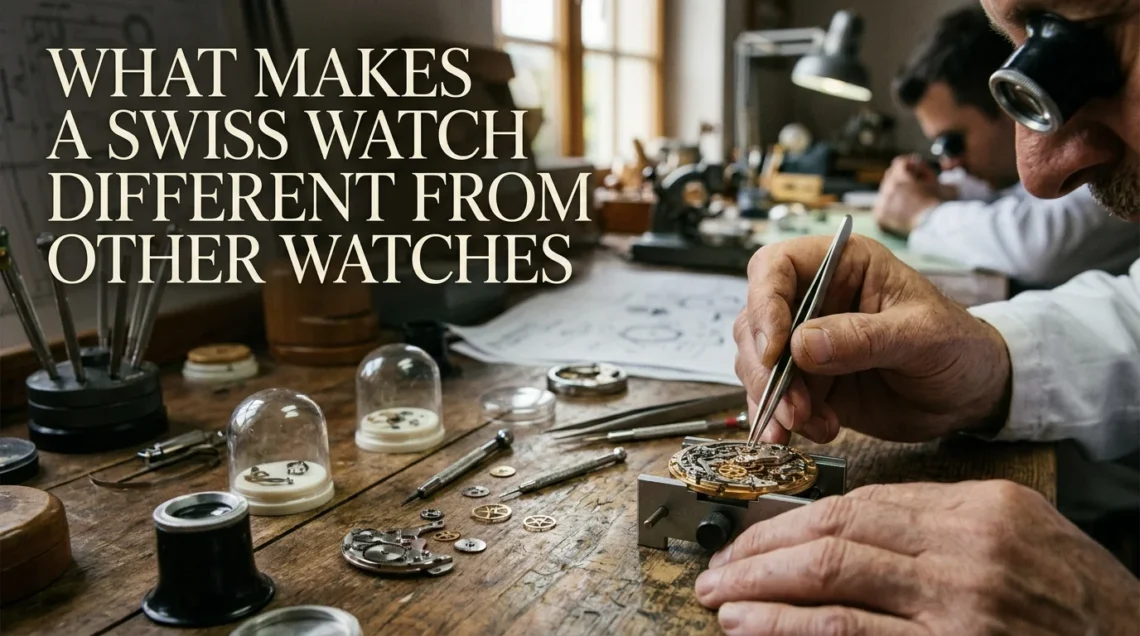
And beyond the technical precision, Swiss watchmaking sort of treats the whole job itself like an art form. A lot of watches get assembled largely by hand rather than by machine, which already tells you something. Things like hand-guilloché—engraving these intricate repeating patterns onto dials with very specific tools—take years of training to get right, and no automated process really reproduces the results, not the same way anyway.
Because of that, every piece carries a human story inside it. Like when a master watchmaker spends hours finishing a single bridge or adjusting the poise of a balance wheel, that effort kind of gets embedded in the object. Owners often feel it, even if they can’t exactly explain it. There’s a certain quality and weight to these watches that communicates intention, not only output, and that comes through in a weirdly immediate way.
Longevity and Long-Term Value
How long these watches last is another pretty major point. With regular servicing, a well-made Swiss mechanical watch can run for decades, sometimes even for generations. And it’s not just vague “heritage” talk; high-quality materials plus careful construction help in practical ways that most fashion watches or budget imports just can’t match.
A properly maintained Swiss mechanic doesn’t simply quit after a couple of years. It gets passed down, it builds sentimental value, and sometimes it even gains monetary value. Vintage pieces from respected Swiss brands at auctions often end up above their original retail prices by noticeable margins. That kind of behavior is not usual consumer-goods energy.
Swiss Versus Japanese Watchmaking
A fair comparison has to admit that Japan makes truly excellent watches. Seiko and Grand Seiko have earned real respect from people who actually follow horology closely. But the difference is mostly about priorities, not some basic quality gap. Swiss houses often lean into mechanical tradition and luxury execution. Meanwhile, Japanese manufacturers have more frequently focused on quartz accuracy and technology-led features.
Both directions are sensible, not random. Swiss watchmaking tends to ask how perfectly a movement can be made by hand. Japanese watchmaking more often asks how precisely technology can handle the timekeeping problem. And yeah, the outcomes end up as genuinely different objects, even when they look similar at first glance.
Why It Still Matters Now
So in a world where a smartphone gives you the time more accurately than any mechanical movement, it’s kind of interesting that people still buy Swiss watches and actively look for them. Nobody really needs one in the basic sense. People buy them because they want a physical connection to skill, tradition, and something that’s built to last.
It’s a choice, deliberate craft over convenience, longevity over speed, and something worth keeping rather than swapping out. The case for that choice doesn’t really get weaker over time either; it just keeps making sense.