
Financial technology is entering a new phase of software engineering. Developers are no longer responsible for writing every line of code manually. AI pair programmers can now generate functions, identify bugs, explain unfamiliar code, prepare documentation and assist with software testing. This shift is changing how fintech companies approach product development, infrastructure and engineering efficiency.
The Fintech Engineering Stack in 2027 combines cloud-native infrastructure, API-first architecture, secure databases, real-time data processing, AI-assisted development and automated testing. However, adopting AI coding assistants does not automatically make financial software faster, safer or production-ready. Architecture decisions, financial accuracy, regulatory compliance and human approval remain essential.
For fintech founders, CTOs and technology leaders, the real opportunity is to combine AI-assisted engineering with a reliable technology foundation that supports business growth without compromising customer trust.
What Is a Fintech Engineering Stack?
A fintech engineering stack is the combination of programming languages, frameworks, databases, APIs, cloud infrastructure, security systems and AI-powered development tools used to build financial software. In 2027, it increasingly includes AI coding assistants, automated testing, intelligent monitoring and human-controlled security workflows.
Key Takeaways
- AI pair programming is transforming fintech development: AI coding assistants help developers generate code, debug applications, prepare documentation and create test cases, but human approval remains essential.
- A modern fintech technology stack needs multiple layers: Frontend frameworks, backend technologies, APIs, databases, cloud infrastructure, AI capabilities and security systems must work together.
- AI coding assistants require careful selection: Tools such as GitHub Copilot, Cursor and Claude Code should be evaluated based on coding capabilities, repository access, data privacy and enterprise security controls.
- AI improves testing and fraud detection: Machine learning can help identify unusual transaction patterns, support risk scoring and improve automated testing, while human analysts remain responsible for reviewing high-risk decisions.
- Security and compliance must be built into the architecture: Encryption, MFA, API protection, access controls, audit logging and applicable UAE regulatory requirements should be considered from the beginning.
- AI-ready workflows need human approval gates: Requirements analysis, code generation, automated testing, security scanning, code review and controlled deployment should form a structured development lifecycle.
- Fintech trends in 2027 will focus on intelligent infrastructure: Agentic AI, real-time payments, embedded finance, tokenisation and cloud-native architecture are expected to influence future financial products.
- AI does not eliminate fintech development costs: Architecture, integrations, security validation, infrastructure, regulatory requirements and ongoing maintenance continue to influence the overall investment.
- The right development partner makes a difference: Fintech-specific experience, secure engineering practices, integration expertise and long-term technical support are important when selecting a development team.
How Is AI Pair Programming Changing Fintech Software Development in 2027?
AI pair programming is changing the way developers approach everyday engineering tasks. Instead of spending significant time writing repetitive code, developers can collaborate with AI coding assistants to generate initial implementations, review existing code, identify errors and create test cases.
For fintech companies, this shift can improve development workflows, particularly when building payment platforms, digital banking applications, lending systems and financial management software.
However, financial software has requirements that go beyond ordinary application development. A small error in an interest calculation, transaction validation or payment-processing function can affect customer funds and business operations. Therefore, AI-generated code must be treated as a development input rather than automatically approved production code.
From Manual Coding to AI-Assisted Engineering
Traditional software development often involves developers manually writing functions, searching documentation, debugging errors and preparing test cases. AI-assisted engineering introduces another layer of support into these activities.
For example, when developing a payment-processing module, an engineer can ask an AI assistant to:
- Generate an initial payment validation function.
- Explain how an existing transaction-processing service works.
- Identify potential errors in payment-status handling.
- Create unit tests for successful and unsuccessful transactions.
- Suggest improvements to code readability and maintainability.
- Prepare technical documentation for other developers.
This allows engineers to spend more time understanding business requirements, designing system architecture and managing technical risks.
AI agents can also assist with repetitive multi-file changes, although their access and permissions should remain controlled.
What AI Pair Programmers Can and Cannot Do
| AI can assist with | Human engineers remain responsible for |
|---|---|
| Code generation | Architecture approval |
| Debugging suggestions | Verifying critical financial logic |
| Documentation | Technical accuracy |
| Test-case generation | Validating test coverage |
| Code refactoring | Reviewing security implications |
| Code explanations | Regulatory and business decisions |
An important distinction is the difference between writing more code and successfully delivering software.
A May 2026 NBER working paper, revised in September 2026, studied more than 500,000 GitHub developers. It found that AI coding tools increased coding activity substantially, but these gains became smaller when measured against completed projects and actual releases. For autonomous coding agents, the reported increase was 240% in coding activity compared with 30% in actual releases. These findings reinforce the importance of reviewing the complete engineering process rather than measuring productivity through code generation alone.
For fintech businesses, the objective should be to release reliable financial products, not simply increase developer output.
What Technologies Should a Modern Fintech Engineering Stack Include in 2027?
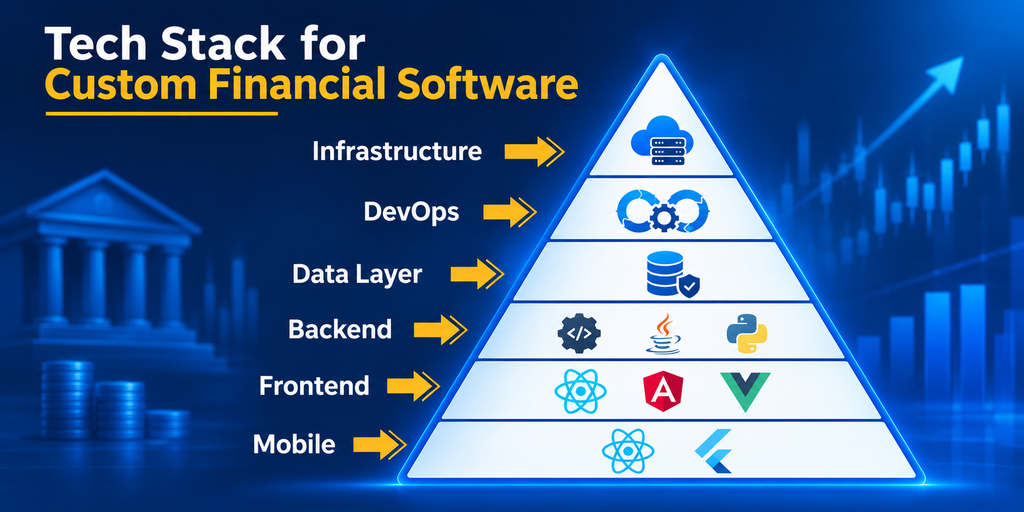
A modern fintech technology stack needs multiple layers working together. Each layer has a specific responsibility, from presenting financial information to customers to processing transactions and protecting sensitive information.
Technology selection should depend on transaction volume, application complexity, response times, integration requirements and regulatory obligations. A startup building a basic payment application does not necessarily need the same architecture as a digital bank processing millions of transactions.
Frontend and Mobile Application Technologies
The frontend is the part of a fintech application that customers and employees interact with. It includes mobile banking interfaces, payment dashboards, investment platforms and account management screens.
Popular technologies include:
- React: Suitable for interactive web applications and financial dashboards.
- Next.js: Supports structured web applications, server-side rendering and performance optimisation.
- Flutter: Allows development teams to build cross-platform mobile applications using a shared codebase.
- React Native: Supports Android and iOS application development using React-based development practices.
For financial applications, frontend development must prioritise more than appearance.
Important capabilities include biometric authentication, secure session management, transaction confirmation, accessible interfaces and clear payment-status notifications.
For example, a digital banking application should allow customers to review transaction details, confirm payment recipients and receive clear notifications when a transaction succeeds or fails.
Backend, APIs and Microservices
The backend handles the business logic that powers financial applications. It manages account information, transaction processing, payment validation, authentication and communication with external financial services.
Common backend technologies include:
- Node.js: Useful for API-driven applications and event-based services.
- Java: Widely used for enterprise applications requiring structured business logic.
- Python: Suitable for data processing, machine learning and financial analytics.
- .NET: Supports enterprise-grade application development and integration.
- Go: Useful for performance-focused services and concurrent workloads.
APIs allow fintech applications to communicate with payment gateways, banking platforms, identity verification providers and other third-party services.
Microservices can separate major functions into independent services, such as payment processing, customer accounts, transaction history and notifications.
However, microservices are not automatically the best choice for every fintech project. They introduce additional operational complexity, including service communication, distributed transactions and monitoring. A modular monolith may be more suitable for an early-stage product.
Businesses planning specialised financial platforms can explore custom software development services in dubai when evaluating architecture, integration and long-term product requirements.
Database and Cloud Infrastructure
Databases store the information that financial applications depend on. Selecting the right database is particularly important because fintech platforms must maintain data consistency and reliable transaction records.
| Technology | Primary purpose |
|---|---|
| PostgreSQL | Relational data and transaction records |
| MySQL | Structured application databases |
| Redis | Caching and fast temporary data access |
| MongoDB | Flexible document-oriented data |
| AWS | Cloud infrastructure and managed services |
| Microsoft Azure | Enterprise cloud and application services |
| Google Cloud | Data processing, infrastructure and AI services |
For financial ledgers, relational databases and appropriate transaction-management mechanisms are especially important.
Cloud infrastructure provides computing resources, storage, networking and managed services. Containers and Kubernetes can support application deployment and scaling, while automated backups and disaster recovery help businesses prepare for infrastructure failures.
AI and Data Engineering Layer
The AI and data engineering layer supports intelligent financial services and AI-assisted development.
It can include Python, machine learning frameworks, model APIs, vector databases and real-time data pipelines.
For example, a lending platform can use machine learning models to analyse approved financial information and support credit-risk assessments. A payment platform can process transaction events to identify unusual activity.
The important consideration is that AI systems must receive appropriate data, operate within defined permissions and undergo continuous performance monitoring.
Why Does Technology Selection Matter?
The right technology stack should support the product’s current requirements without creating unnecessary barriers to future growth.
A fintech company should evaluate:
- Expected transaction volume.
- Application response-time requirements.
- Data storage and consistency requirements.
- Integration with banks and payment providers.
- Security and regulatory obligations.
- Infrastructure costs and maintenance capabilities.
A well-designed architecture provides flexibility while keeping the system manageable as the business grows.
Which AI Coding Assistants Are Most Useful for Fintech Developers?
AI coding assistants are becoming part of everyday software development. They help developers write code, understand complex repositories, refactor applications and prepare automated tests.
However, fintech companies should not select these tools based only on coding speed. Financial applications often contain sensitive business logic, customer information, payment integrations and proprietary source code. Tool selection must therefore consider privacy, security and enterprise governance.
AI Coding Assistants for Everyday Development
Several tools offer different approaches to AI-assisted engineering.
| Tool | Main use case | Fintech adoption consideration |
|---|---|---|
| GitHub Copilot | Code completion, chat and development assistance | Review enterprise data controls and repository permissions |
| Cursor | AI-assisted editing and repository-level development | Evaluate privacy settings and access to sensitive code |
| Claude Code | Agentic coding and multi-file engineering tasks | Apply controlled permissions and human approval |
| Similar AI coding tools | Documentation, debugging and code generation | Assess security, integrations and governance |
GitHub Copilot supports developers with code suggestions, explanations and coding assistance within supported development environments.
Cursor provides an AI-focused coding environment that helps developers understand and modify application code.
Claude Code supports more complex coding workflows, including repository analysis, multi-file changes and command execution under configured permissions.
The best choice depends on the engineering team’s development environment, project complexity and governance requirements.
AI Agents for Complex Engineering Tasks
AI agents go beyond suggesting individual lines of code. They can assist with multiple connected development activities.
For example, an engineering team building a digital wallet could assign an AI agent to analyse a payment module, identify relevant files, suggest code changes and prepare tests.
Before any changes reach production, developers should review the modifications, run security checks and verify financial calculations.
This is particularly important when AI agents can interact with repositories, terminals, development environments or external services.
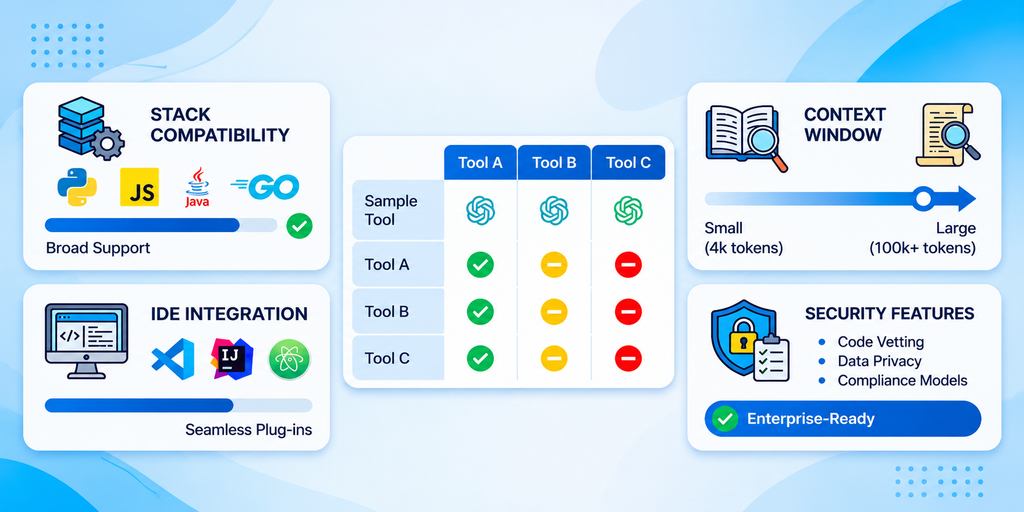
How to Choose an AI Coding Assistant for Fintech Projects
Before adopting a tool, fintech organisations should assess:
- Data privacy: How are prompts, code snippets and repository data processed?
- Retention policies: How long is submitted information stored?
- Access controls: Can developers restrict access to sensitive repositories?
- Compatibility: Does the tool work with existing IDEs and development platforms?
- Auditability: Can teams review AI-generated changes?
- Human oversight: Can developers approve changes before merging or deployment?
For example, GitHub documents different data-retention arrangements for its Business and Enterprise offerings. Companies should review the current terms and configuration applicable to their subscription rather than assuming every AI tool handles source code identically.
How Does AI Improve Fintech Testing, Fraud Detection and Transaction Monitoring?
AI has two important roles in fintech engineering. It can help developers build and test financial applications, and it can also become part of the financial product itself.
Understanding this distinction helps businesses identify where AI delivers value and where additional controls are necessary.
AI-Assisted Testing and Quality Assurance
Software testing is essential for financial applications because even small defects can affect payments, customer balances and account operations.
AI coding assistants can help generate test cases, identify potential edge cases and explain unexpected application behaviour.
Common testing activities include:
- Unit testing: Checking individual functions, such as transaction validation.
- Integration testing: Verifying communication between payment gateways and backend services.
- Regression testing: Ensuring new updates do not break existing functionality.
- API testing: Validating authentication, responses and transaction endpoints.
- Security testing: Identifying weaknesses in application code and dependencies.
Consider a payment application that processes card transactions. AI can help developers generate tests for successful payments, declined transactions, duplicate requests and network interruptions.
However, developers must verify that the tests cover realistic financial scenarios and that the expected results are correct.
AI-Powered Fraud Detection and AML Monitoring
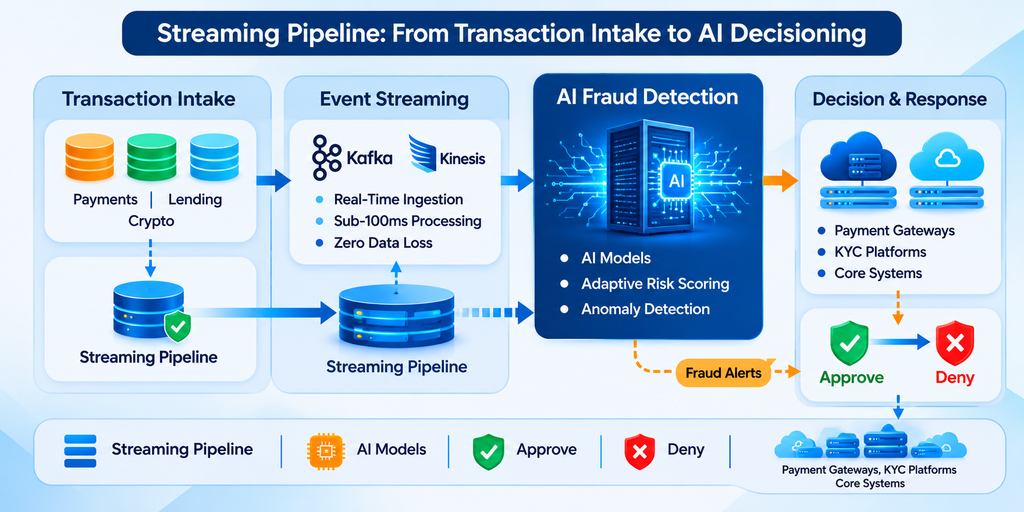
AI embedded within fintech products can analyse transaction patterns and identify activity that differs from established customer behaviour.
For example, consider a customer who generally makes small domestic payments. A sudden series of high-value international transactions may require additional investigation.
A transaction-monitoring system can evaluate several signals:
- Transaction amount and frequency.
- Customer transaction history.
- Location and device information.
- Recipient behaviour.
- Unusual account activity.
- Known risk indicators.
The system can then generate a risk score and send suspicious activity for further review.
AI can help reduce unnecessary alerts when models are properly trained and evaluated. However, false positives and false negatives remain possible.
Building Human Oversight into Financial AI
Financial institutions should not treat an AI risk score as automatic proof of fraudulent activity.
A practical transaction-monitoring workflow looks like this:
Transaction received → Risk analysis → Alert generation → Analyst review → Documented decision
High-risk cases should be escalated according to established procedures. Organisations should also maintain audit trails explaining why a transaction was flagged and how the final decision was reached.
AI should support financial analysts, not remove accountability from the monitoring process.
What Security and Compliance Layers Does a Fintech Stack Need in 2027?
Security must be integrated throughout the fintech engineering stack rather than added after development.
Financial applications process valuable information, including customer identities, account details, payment credentials and transaction records. A security weakness in one component can affect the reliability of the entire platform.
AI-assisted development introduces additional considerations because generated code, dependencies and configuration changes may contain vulnerabilities even when the application appears to function correctly.
Application and API Security
A secure fintech application should include several layers of protection.
| Security control | Purpose |
|---|---|
| OAuth 2.0 | Supports delegated authorisation |
| OpenID Connect | Provides an identity layer over OAuth 2.0 |
| Multi-factor authentication | Adds another verification requirement |
| Role-based access control | Limits access according to user roles |
| Encryption in transit | Protects information during transmission |
| Encryption at rest | Protects stored information |
| API rate limiting | Helps prevent excessive requests and abuse |
| Secrets management | Protects credentials and sensitive keys |
| Audit logging | Records important system and user activities |
For example, a fintech administrator should not automatically have unrestricted access to every customer account or payment operation. Permissions should reflect job responsibilities and business requirements.
Sensitive credentials should be stored in dedicated secrets-management systems rather than hardcoded into application files.
Secure AI-Assisted Development
AI-generated code requires the same security validation as manually written code.
Engineering teams should establish the following controls:
- Run static application security testing (SAST).
- Scan third-party libraries and dependencies.
- Review AI-generated authentication and payment logic.
- Validate input handling and error management.
- Check permissions before using AI agents with repositories.
- Prevent sensitive financial data from being submitted through unapproved AI prompts.
- Require human approval for security-sensitive code changes.
The European Union Agency for Cybersecurity (ENISA) highlights that functional code should not automatically be considered secure code. Its 2026 technical advisory on AI-assisted software development emphasises secure-by-design requirements, verification and review throughout AI-supported engineering activities.
UAE-Specific Fintech Compliance Considerations
Fintech companies operating in the UAE must understand which financial regulations apply to their particular services.
One important example is the Central Bank of the UAE’s Payment Token Services Regulation, C 2/2024, which became effective on 31 August 2024.
The regulation covers three main categories:
- Payment token issuance.
- Payment token conversion.
- Payment token custody and transfer.
It establishes licensing and registration requirements and includes restrictions on certain payment-token activities. Relevant providers must also address applicable risk management and AML/CFT obligations.
For businesses developing payment-token platforms, these requirements can influence:
- Customer onboarding and verification workflows.
- Payment-token transaction records.
- Monitoring and reporting capabilities.
- Custody and transfer controls.
- Audit logs and internal reporting.
- Access management and operational risk controls.
Understanding UAE payment token regulations is important before deciding how payment-token functionality should be designed and implemented.
Similarly, fintech AML compliance should be considered during architecture planning rather than treated as a separate activity after the platform has been developed.
The exact regulatory requirements depend on the financial activity, licensing position, business model and applicable UAE jurisdiction. A technology stack does not automatically make a fintech company compliant.
Fintech Security and Compliance Checklist
Before launching a financial application, teams should verify:
- Strong authentication and access controls are implemented.
- Sensitive information is encrypted appropriately.
- API endpoints are protected and monitored.
- Financial transactions have appropriate audit records.
- AI-generated code undergoes security review.
- Third-party dependencies are regularly scanned.
- Relevant regulatory obligations have been assessed.
- Incident response and recovery procedures are documented.
How Should Fintech Companies Build an AI-Ready Development Workflow?
Adopting AI coding assistants is not enough to transform an engineering team. Businesses need a structured development workflow that explains where AI can contribute, which activities require human approval and how production changes are validated.
The aim is to integrate AI into existing software development practices without weakening quality or security controls.
The AI-Assisted Fintech Development Lifecycle
A practical AI-ready engineering workflow can follow five stages.
Step 1: Requirement Analysis and Architecture Planning
Developers and business stakeholders define the product requirements, transaction workflows, integration needs and security expectations.
AI can assist with documentation and requirement analysis, but engineering leaders should approve the architecture.
Step 2: AI-Assisted Code Generation
Developers use AI coding assistants to generate initial code, explain existing modules and support repetitive engineering activities.
Coding standards and repository instructions help maintain consistency.
Step 3: Automated Testing and Security Scanning
The application undergoes unit, integration, regression and API testing. Security scanners examine dependencies and potential vulnerabilities.
Step 4: Human Code Review and Approval
Engineers verify financial calculations, authentication logic, payment processing and sensitive business operations.
Changes are merged only after the required reviews and checks are completed.
Step 5: Staging, Deployment and Continuous Monitoring
Approved changes are tested in staging before production deployment. Monitoring tools track errors, application performance, transaction behaviour and security events.
What Engineering Teams Must Measure
Companies should measure actual delivery outcomes rather than counting how much code AI generates.
| Metric | What it reveals |
|---|---|
| Lead time for changes | How quickly approved changes reach production |
| Deployment frequency | How regularly software is released |
| Defect escape rate | How many defects reach production |
| Test coverage | How much application logic is tested |
| Security findings | Whether vulnerabilities are increasing or decreasing |
| Production incidents | The reliability of deployed systems |
For fintech organisations, the most useful productivity improvement is the ability to deliver validated features faster without increasing operational risk.
How Business Process Automation Supports Fintech Engineering
AI-assisted development can also connect with broader operational automation.
For example, businesses can review 7 business processes uae companies commonly automate, including customer onboarding, document processing, payment reconciliation and reporting, to identify opportunities for reducing repetitive work.
The important step is to select automation opportunities based on business value, data availability and risk rather than automating every process simply because AI tools are available.
Make Your Fintech Development Workflow AI-Ready
Explore how AI-assisted engineering, automated testing and secure architecture can help your business build reliable financial software.
Which Fintech Software Development Trends Will Shape 2027?
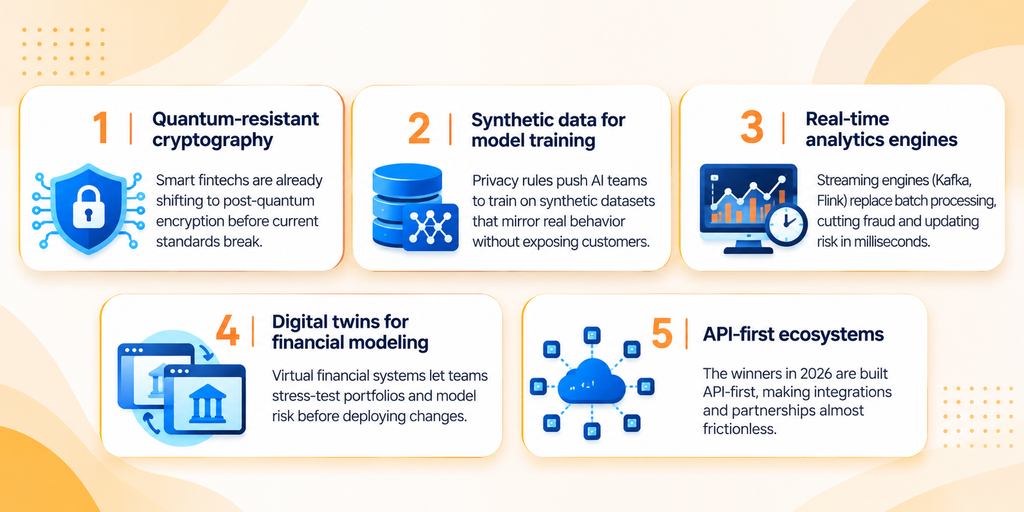
The fintech industry is moving towards more intelligent, connected and automated financial services. However, businesses should distinguish between technologies already being used and developments that are still emerging.
The following trends are likely to influence engineering decisions in 2027.
Agentic AI and Autonomous Engineering Workflows
AI agents are expanding beyond basic code suggestions. They can assist with multi-step development tasks, repository analysis, testing and pull-request preparation.
In financial applications, agentic AI may also support customer service, financial workflows and payment-related operations.
However, organisations need permission boundaries, auditability and human approval for sensitive actions.
Real-Time Payments and Intelligent Financial Services
Customers increasingly expect financial transactions to be fast and transparent.
Real-time payment systems require reliable event processing, transaction validation, monitoring and reconciliation.
AI can support payment routing and fraud detection by analysing transaction patterns and operational signals.
Tokenisation and Embedded Finance
Tokenisation and embedded finance are changing how financial services can be integrated into digital platforms.
Embedded finance allows non-financial businesses to offer services such as payments, lending and financial accounts through integrated solutions.
Tokenisation introduces additional considerations around digital asset representation, custody, transfer and applicable regulatory requirements.
Cloud-Native and API-First Fintech Architecture
Cloud-native systems and API-first architecture allow fintech platforms to integrate with banking providers, payment gateways and third-party services.
Modular applications make it easier to introduce new services without redesigning the entire platform.
However, organisations must manage API security, infrastructure dependencies, service availability and operational complexity.
2027 Fintech Trend Matrix
| Trend | Engineering impact | Business opportunity | Main challenge |
|---|---|---|---|
| Agentic AI | Multi-step automated workflows | Operational efficiency | Permissions and accountability |
| Real-time payments | Event-driven infrastructure | Faster transactions | Fraud and reliability |
| Embedded finance | API-based integration | New revenue channels | Partner and regulatory risk |
| Tokenisation | Digital asset infrastructure | New financial services | Licensing and compliance |
| Cloud-native systems | Modular and scalable services | Flexible growth | Infrastructure governance |
| Intelligent fraud detection | Real-time risk analysis | Better risk management | Model accuracy |
Deloitte’s Future of Payments 2027 research highlights agentic commerce, AI-driven payments, real-time payment infrastructure and evolving payment risks as important industry developments. These are emerging opportunities, not guaranteed outcomes for every financial business.
For fintech leaders, the priority should be to understand how each trend affects their product roadmap, architecture and customer requirements before investing in new technology.
How Much Does It Cost to Build a Fintech Product Using an AI-Enabled Engineering Stack?
The cost of building fintech software depends on the product’s complexity, functionality, integrations, infrastructure and regulatory requirements.
AI coding assistants may reduce repetitive development work, but they do not eliminate the need for experienced engineers, security testing, architecture planning or compliance-related activities.
Factors That Influence Fintech Development Costs
The most important cost drivers include:
- Product complexity: A basic payment application requires a different level of engineering than a multi-service digital banking platform.
- Third-party integrations: Banking APIs, payment gateways, KYC providers and external financial services influence implementation effort.
- Security requirements: Encryption, access management, monitoring and penetration testing add engineering responsibilities.
- Regulatory requirements: Licensing-related workflows, audit trails and reporting capabilities can affect project scope.
- Infrastructure: Cloud hosting, databases, monitoring and disaster recovery contribute to ongoing costs.
- Maintenance: Updates, bug fixes, security patches and technical support continue after launch.
Does AI-Assisted Development Reduce Fintech Development Costs?
AI-assisted development can reduce effort in repetitive coding, documentation, debugging and test preparation.
However, additional resources may be required for reviewing generated code, managing AI permissions, validating financial calculations and maintaining secure development processes.
| Project stage | MVP fintech product | Enterprise fintech platform |
|---|---|---|
| Architecture | Core application design | Complex distributed architecture |
| Integrations | Essential APIs | Multiple banking and financial integrations |
| Security | Foundational security controls | Advanced security and governance |
| Testing | Core functionality and integration testing | Extensive automated and specialised testing |
| Infrastructure | Basic scalable cloud setup | High availability and disaster recovery |
| Maintenance | Regular updates | Continuous monitoring and support |
Businesses planning fintech app development dubai should evaluate the complete delivery lifecycle rather than estimating costs based only on coding hours.
A realistic budget should account for development, validation, deployment, infrastructure and ongoing maintenance.
How Can Businesses Choose the Right Fintech Software Development Partner?
Selecting a fintech development partner requires more than evaluating programming skills. Financial products involve complex integrations, sensitive data, transaction accuracy and regulatory considerations.
A development team should understand how these requirements influence architecture and product delivery.
What to Evaluate Before Selecting a Development Team
Before choosing a partner, businesses should assess:
- Fintech experience: Does the team understand payment systems, digital banking, lending or other relevant financial applications?
- Technical expertise: Can the team work with suitable frontend, backend, database and cloud technologies?
- Integration capabilities: Does it have experience connecting payment gateways, banking APIs and identity verification services?
- Security processes: Are code reviews, vulnerability assessments and security testing part of the development lifecycle?
- AI engineering practices: Does the team have clear rules for AI-generated code, privacy and human approval?
- Post-launch support: Can it provide maintenance, monitoring and future product enhancements?
Businesses evaluating Fintech Software Consulting In Dubai should also consider whether the development partner can help assess technical requirements before committing to a particular architecture.
Why Fintech Architecture Should Start With Business Requirements
Technology decisions should follow business requirements rather than trends.
A startup building a digital wallet may prioritise transaction processing, identity verification and payment integrations. An established financial institution may need more advanced infrastructure, monitoring, security and integration capabilities.
The right partner should help define:
- Product roadmap and expected growth.
- Core financial workflows.
- Integration and data requirements.
- Security and regulatory scope.
- Infrastructure and maintenance strategy.
- Long-term ownership and scalability.
SISGAIN Technologies can be considered for businesses evaluating software engineering and AI development capabilities for financial technology projects.
Relevant expertise in ai development services dubai can also help businesses assess how AI-assisted engineering and intelligent application features fit into their broader product strategy.
Fintech Development Partner Evaluation Checklist
| Evaluation area | What to look for |
|---|---|
| Portfolio | Relevant financial software projects |
| Architecture | Scalable and maintainable solutions |
| Integrations | Banking and payment API experience |
| Security | Documented testing and review practices |
| AI capabilities | Controlled AI-assisted engineering |
| Compliance awareness | Understanding of applicable requirements |
| Support | Ongoing maintenance and technical assistance |
The best development partner is one that understands the business problem, recommends an appropriate technology stack and can support the product beyond its initial launch.
Conclusion: Build a Future-Ready Fintech Engineering Stack for 2027
The future of fintech engineering is not simply about adopting AI coding assistants or replacing traditional development processes. It is about creating a technology ecosystem where AI-assisted development, scalable architecture, automated testing and security work together.
In 2027, fintech companies that combine AI-driven engineering with strong technical governance will be better positioned to develop reliable financial products and respond to changing customer expectations.
However, successful implementation still depends on choosing the right technologies, validating AI-generated code, maintaining financial accuracy and understanding regulatory responsibilities.
For founders and technology leaders, the most important decision is to build a fintech engineering foundation that supports both current business requirements and future innovation.
Frequently Asked Questions About the Fintech Engineering Stack
1. What is a fintech engineering stack?
A fintech engineering stack is the combination of frontend frameworks, backend technologies, databases, APIs, cloud infrastructure, security systems and development tools used to build financial applications such as payment platforms, digital banking systems and lending solutions.
2. How is AI used in fintech software development?
AI supports fintech development through automated testing, code generation, debugging, fraud detection, transaction monitoring, risk assessment and personalised financial services. Its outputs require validation, particularly when they affect financial calculations or customer transactions.
3. Which programming languages are best for fintech development?
Java, Python, JavaScript, Go and C# are commonly used in fintech development. Java supports enterprise applications, Python is useful for AI and analytics, JavaScript supports web applications, and Go can support performance-focused backend services.
4. What are the best AI coding assistants for fintech developers?
GitHub Copilot, Cursor and Claude Code are useful options for AI-assisted development. Businesses should compare repository understanding, coding capabilities, privacy policies, access controls and human-review requirements before selecting a tool.
5. Can AI replace fintech software developers?
No. AI can support coding, debugging, documentation and testing, but developers remain responsible for architecture, financial logic, security decisions, regulatory requirements and production approvals. Human engineering judgement remains essential.
6. How does AI improve fintech application security?
AI can assist with identifying suspicious code patterns, generating security tests and analysing potential vulnerabilities. However, effective application security also requires encryption, access controls, dependency scanning, independent testing and human-reviewed remediation.
7. What are the biggest fintech technology trends in 2027?
Important trends include agentic AI, real-time payments, embedded finance, tokenisation, cloud-native architecture and intelligent fraud detection. Their adoption depends on business requirements, technical readiness and applicable regulatory obligations.
8. How much does fintech software development cost?
Fintech development costs depend on product complexity, integrations, security requirements, infrastructure and ongoing maintenance. AI coding tools may reduce some development effort, but they do not eliminate testing, architecture or compliance-related costs.