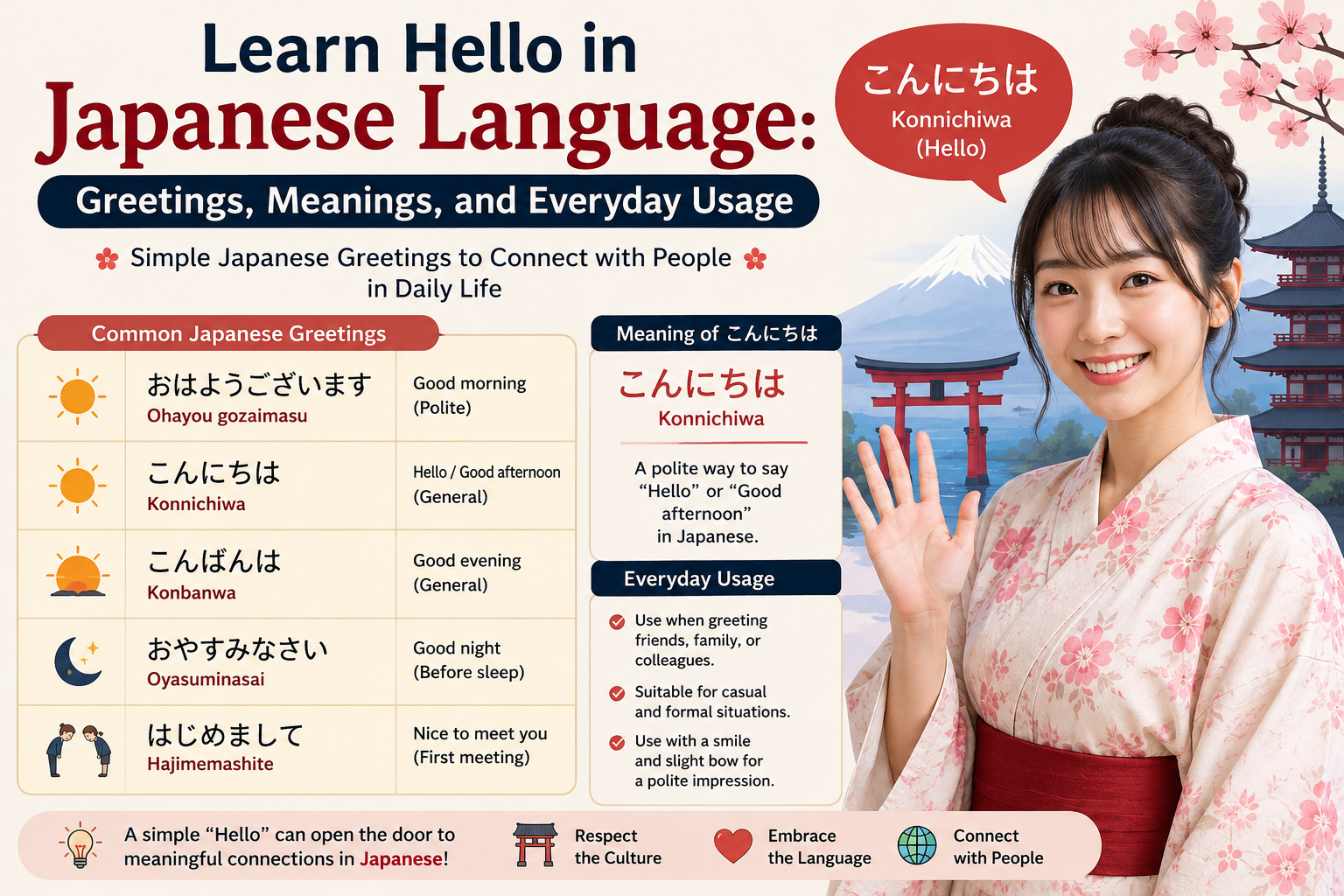
There’s no single word for “hello” in Japanese that works at every hour. Instead, Japanese uses time-specific greetings: Ohayou gozaimasu (good morning), Konnichiwa (hello/good afternoon), and Konbanwa (good evening). Knowing which one fits the moment is the real key to sounding natural.
If you’ve searched for “Say hello in Japanese language” in Japanese and landed on konnichiwa, you’re only partly right. Japanese greetings change depending on the time of day, and using the wrong one, while not offensive, can make you sound like you’re reading straight out of a phrasebook. This guide breaks down exactly what to say, when to say it, and how to sound like you actually know what you’re doing.
Why Japanese Doesn’t Have One Word for “Hello”
English speakers are used to “hello” working at any hour. Japanese greeting culture is built differently it’s tied closely to the time of day, and sometimes to the relationship between speakers. This reflects a broader feature of Japanese communication: context and timing matter as much as the words themselves.
That’s actually good news for learners. Once you understand the pattern, you’ll never be stuck wondering which greeting to use.
The Core Japanese Greetings by Time of Day
| Time of Day | Japanese | Romaji | Literal Meaning |
|---|---|---|---|
| Morning (until ~10–11 AM) | おはようございます | Ohayou gozaimasu | “It is early” |
| Daytime (late morning–afternoon) | こんにちは | Konnichiwa | “As for today” |
| Evening | こんばんは | Konbanwa | “As for tonight” |
| Late night (casual) | おやすみなさい | Oyasuminasai | “Please rest” (used as goodnight) |
Morning: Ohayou Gozaimasu (おはようございます)
This is the most commonly heard greeting in daily Japanese life used in workplaces, schools, and homes every single morning.
- Formal/polite: Ohayou gozaimasu
- Casual (friends, family): Ohayou
Japanese speakers often use ohayou gozaimasu even outside the literal morning hours in specific settings for example, TV presenters or coworkers might use it as a “first greeting of the day” regardless of the actual clock time, especially in entertainment and broadcasting contexts. As a learner, though, stick to using it in the morning until you’re comfortable with these nuances.
Daytime: Konnichiwa (こんにちは)
This is the greeting most people Most How to Learn Japanese first, and it works well from late morning through the afternoon.
A few practical notes:
- It’s polite enough for strangers, acquaintances, and casual situations alike.
- It’s less commonly used between close friends or coworkers who see each other daily in those cases, people often skip greetings entirely or use something more casual.
- It is not typically used at night.
Evening: Konbanwa (こんばんは)
Once the sun goes down, konbanwa takes over. It follows the same grammatical pattern as konnichiwa and is equally polite and versatile.
Nighttime: Oyasuminasai (おやすみなさい)
Technically this means “goodnight,” not “hello” but many learners search for a nighttime greeting and end up here. If you’re greeting someone late at night rather than saying farewell, Japanese speakers often just use konbanwa still, since there’s no separate “hello” for very late hours.
Quick Reference: Which Greeting to Use When
- Before ~10–11 AM → Ohayou gozaimasu
- Late morning to sunset → Konnichiwa
- After sunset → Konbanwa
- Saying goodbye at night → Oyasuminasai
There’s no strict cutoff time Japanese speakers judge it contextually, similar to how English speakers intuitively know when “good morning” starts to feel wrong.
Formal vs. Casual: Matching the Right Tone
Japanese has built-in levels of politeness, and greetings are no exception.
| Situation | Recommended Greeting |
|---|---|
| Meeting a boss, teacher, or stranger | Ohayou gozaimasu / Konnichiwa / Konbanwa |
| Talking to close friends | Ohayou / (often no greeting needed midday) |
| Answering the phone at work | Different set phrases apply (not covered here) |
| Text messages to friends | Casual forms are common |
Tip for learners: When in doubt, default to the polite form. Japanese speakers are generally understanding toward learners, but the polite form is never wrong in a first interaction.
Common Mistakes Learners Make
- Using konnichiwa at night. It sounds like a beginner mistake because it’s tied to daytime.
- Overusing greetings with people you see often. Japanese coworkers or classmates often greet each other once at first contact, not repeatedly throughout the day.
- Forgetting gozaimasu. Dropping the polite ending with people you don’t know well can come across as too casual.
How to Practice and Retain These Greetings
- Set a phone reminder to say ohayou gozaimasu out loud each morning.
- Watch Japanese vlogs or dramas and note which greeting is used at what point in the scene.
- Use spaced repetition apps (like Anki) with example sentences, not just isolated words context helps retention.
- Practice with a language exchange partner so you get real-time correction on timing and tone.
Learning greetings is one of the fastest ways to build early confidence in Japanese, because you’ll use them constantly from day one.
Trending FAQ’s
1. What is the most common way to say hello in Japanese?
Konnichiwa is the most widely recognized, but it’s specifically a daytime greeting, not an all-purpose one.
2. Is konnichiwa formal or casual?
It’s neutral-to-polite appropriate for strangers, acquaintances, and most everyday interactions.
3. Can I use konnichiwa at any time of day?
No. It’s best used from late morning through the afternoon. Use ohayou gozaimasu in the morning and konbanwa in the evening.
4. What do Japanese people say instead of hello to friends?
Close friends often skip formal greetings entirely, or use casual forms like a simple “ohayou” in the morning.
5. Is oyasuminasai a way to say hello?
No, it means “goodnight” and is used when parting ways at night, not as a greeting.
6. How do you say “good morning” casually in Japanese?
Simply “ohayou” (without gozaimasu) among friends or family.
7. What’s the difference between konnichiwa and konbanwa?
Konnichiwa is used during the day; konbanwa is used in the evening and night. They follow the same sentence structure.
8. Do Japanese speakers greet each other every time they meet during the day?
Not always coworkers or classmates who see each other repeatedly often greet once and skip it afterward.
9. Is it rude to use the wrong time-of-day greeting?
It’s not offensive, just noticeably unnatural similar to saying “good morning” at dinner in English.
10. What’s the best way to start learning Japanese greetings?
Practice them in context (time of day, formality level) rather than memorizing them as isolated vocabulary.
Final Thoughts
Saying Say Best hello in Japanese language isn’t about memorizing one word it’s about matching your greeting to the time of day and the relationship you have with the person you’re speaking to. Once that pattern clicks, it becomes second nature, and it’s one of the simplest ways to sound more natural as a Japanese learner from your very first conversation.
Suggested More Blogs:-
- online Japanese language course
- Japanese Courses in Delhi
- Japanese Language Levels
- Japanese language classes
- Japanese Language Course in Kolkata
About the Author
Written by Kazumischool, a Japanese language content specialist with experience teaching beginner-level Japanese and creating learner-focused educational content. Committed to accurate, culturally grounded language guidance for self-study learners.