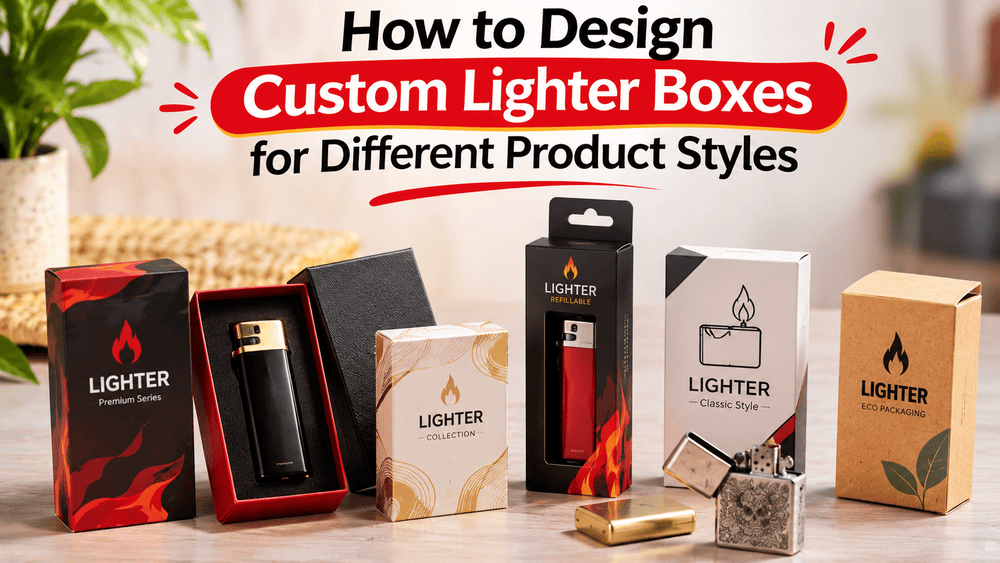
Lighters come in various shapes, sizes, and designs, making standard packaging unsuitable for every product. From compact pocket lighters to rechargeable electric models, each style requires packaging that accommodates its dimensions and functional features. Designing custom lighter boxes allows businesses to improve product presentation, maintain consistent branding, and provide appropriate protection during handling and storage. A well-planned packaging design considers material strength, product fit, labeling requirements, and production costs. Understanding these factors helps manufacturers and retailers develop practical packaging solutions for different product collections.
Understand the Packaging Requirements of Different Lighters
Before designing lighter boxes, identify the product’s physical characteristics, intended use, and distribution requirements. Disposable, refillable, and rechargeable lighters have different packaging needs because their construction and components vary.
A compact pocket lighter may require a simple folding carton, while a rechargeable model may need additional space for a charging cable and instruction manual. Collectible lighters may require packaging that protects decorative surfaces from scratches.
Understanding these differences allows businesses to develop packaging that serves a practical purpose instead of relying entirely on appearance.
Choose a Suitable Box Style for Each Lighter Type
Packaging structure should complement the product’s shape, weight, and storage requirements. Selecting an unsuitable structure can result in wasted material, poor product fit, and unnecessary production expenses.
| Lighter Type | Recommended Box Style | Main Purpose |
| Disposable lighters | Tuck-end boxes | Compact storage |
| Refillable lighters | Two-piece boxes | Surface protection |
| Rechargeable lighters | Folding cartons with inserts | Component organization |
| Collectible lighters | Rigid boxes | Long-term storage |
| Utility lighters | Elongated cartons | Accommodating extended dimensions |
| Multipack lighters | Partitioned boxes | Product separation |
Each lighter box should also accommodate the necessary safety information without compromising readability or structural integrity.
Select Appropriate Materials for Lighter Packaging
Material selection influences packaging strength, weight, printing quality, and manufacturing costs. Businesses should evaluate different paper-based materials according to their product specifications.
Cardstock and Paperboard
Paperboard is commonly used for lightweight retail cartons because it is easy to print, fold, and assemble. It offers a smooth surface for product information and brand graphics.
Kraft Paperboard
Kraft paperboard provides a natural appearance and can suit businesses looking to simplify their packaging designs. Its recyclability depends on coatings, adhesives, and additional components.
Corrugated Cardboard
Corrugated cardboard contains a fluted layer between flat liners, providing cushioning and structural strength. It can be suitable for secondary packaging, subject to applicable transportation requirements.
Rigid Board
Rigid board maintains its shape better than conventional folding cartons. It is commonly considered for collectible products requiring a more substantial storage container.
Measure Product Dimensions Before Designing
Accurate measurements are essential when creating customized packaging. Measure the product’s length, width, and height, including any protruding components or accessories.
Packaging manufacturers use these measurements to develop a dieline, which represents the cutting, folding, and assembly specifications of the box. Businesses should review internal and external dimensions separately because material thickness affects the available interior space.
Requesting a physical prototype before mass production can help identify sizing issues and reduce unnecessary material waste.
Design Functional Lighter Packaging with We Print Boxes
Businesses exploring packaging options through We Print Boxes should prepare a detailed brief covering product dimensions, material preferences, artwork, labeling requirements, and expected order quantities.
Developing Custom Boxes for different lighter collections requires coordination between structural designers and product manufacturers. Providing accurate specifications at the beginning of the project can reduce design revisions and production delays.
Businesses should also communicate any applicable safety and transportation requirements to ensure their Custom Packaging is evaluated against the intended use.
Use Appropriate Printing and Finishing Techniques
Custom printed lighter boxes can communicate product specifications, manufacturer details, and other essential information through organized artwork. Printing methods should be selected according to order quantity, material compatibility, and design complexity.
Common printing and finishing options include:
- Digital printing for smaller production runs
- Offset printing for larger quantities
- CMYK printing for full-color artwork
- Matte coating for a non-glossy surface
- Aqueous coating for surface protection
- Embossing for textured design elements
Businesses using Custom Boxes with Logo should maintain consistent typography and brand identification while prioritizing the visibility of safety warnings and product instructions.
Include Essential Safety Information and Labeling
Lighter packaging requires careful consideration of consumer safety. In the United States, the Consumer Product Safety Commission establishes safety standards for certain cigarette lighters and multipurpose lighters under 16 CFR Parts 1210 and 1212.
Depending on the product and applicable regulations, packaging or accompanying documentation may need to communicate:
- Manufacturer or importer identification
- Product model and specifications
- Relevant safety warnings
- Operating and storage instructions
- Applicable certification information
- Warnings about keeping lighters away from children
Ordinary cardboard packaging should never be considered a substitute for required child-resistant product mechanisms or certified hazardous-material packaging. Businesses must verify the regulations applicable to their specific products before approving packaging artwork.
Consider Transportation and Storage Requirements
Fuel-containing lighters and certain rechargeable models may be subject to hazardous-material transportation regulations. Shipping requirements can vary based on fuel type, battery specifications, transportation method, and destination.
Businesses should consult qualified shipping specialists before transporting these products. Standard retail cartons alone may not satisfy applicable Department of Transportation or carrier requirements.
Storage instructions should also remain clear and accessible, particularly those concerning heat exposure, accidental activation, and unauthorized access by children.
Manage Production Costs with Lighter Boxes Wholesale
Packaging costs depend on material selection, box dimensions, printing methods, structural complexity, and production quantities. Ordering larger quantities can distribute certain setup expenses across more units.
Businesses considering Custom Boxes Wholesale should calculate the complete packaging cost, including sampling, production, delivery, and storage.
Rather than ordering excessive quantities, businesses should estimate their actual inventory requirements. This approach helps prevent unnecessary expenditure when product specifications, safety information, or packaging designs change.
Reduce Unnecessary Packaging Waste
Environmentally responsible packaging begins with efficient material use. Designing appropriately sized cartons can reduce excess cardboard consumption and unnecessary packaging volume.
Businesses can consider recycled-content paperboard, removable paper inserts, and fewer decorative components where appropriate. Avoid making environmental claims that cannot be supported by the material specifications.
Environmental considerations should never compromise required product protection, consumer safety, or regulatory compliance.
Test Packaging Before Final Production
Packaging prototypes allow businesses to evaluate construction quality before approving a complete production run. Samples should be examined for dimensional accuracy, printing clarity, folding quality, and closure functionality.
Any applicable safety and transportation testing should be performed by qualified professionals using the relevant standards. Identifying problems during the sampling stage can reduce rejected inventory and unexpected manufacturing expenses.
Conclusion
Designing custom lighter boxes for different product styles requires a balanced approach to material selection, structural design, product dimensions, cost management, and regulatory compliance. Businesses should evaluate each product individually rather than applying the same packaging design across an entire collection. Accurate specifications, appropriate materials, readable labeling, and professional testing can help manufacturers develop functional and responsible packaging solutions.
Frequently Asked Questions (FAQs)
What are custom lighter boxes?
They are packaging cartons designed according to a lighter’s dimensions, construction, and storage requirements.
Which material is suitable for lighter boxes?
Paperboard, kraft, and rigid board are common options, depending on the product’s packaging requirements.
Can lighter boxes be customized in different sizes?
Yes, manufacturers can produce boxes according to specific product measurements.
Are wholesale lighter boxes cost-effective?
Bulk orders may reduce individual packaging costs depending on materials, quantities, and manufacturing specifications.
Do lighter boxes require safety warnings?
Applicable safety warnings depend on the lighter type, intended market, and relevant consumer protection regulations.