Choosing granite for your kitchen is only one part of creating a countertop that looks finished and works well every day. You also need to decide how the exposed edges of the stone should look. Although an edge may seem like a small detail, it can change the style of your countertop, affect how thick the stone appears, and influence how comfortable the surface feels during daily use.
Your kitchen style should guide this decision. For example, a simple modern kitchen may look better with a clean straight edge. Meanwhile, a traditional kitchen may benefit from a rounded or decorative profile. Therefore, you should consider your cabinets, countertop color, island design, and overall room style before choosing an edge.
You should also think about practical details. Some profiles have sharp-looking lines, while others provide softer curves. In addition, certain edges can make a countertop appear thicker or more detailed. Once you understand these differences, choosing the right profile becomes much easier.
Understand Why Countertop Edges Matter
When you compare granite countertop edges, you will notice that the profile changes more than the outer shape of the stone. A simple edge can keep the countertop visually quiet, while a detailed edge can turn it into a stronger design feature. Therefore, the edge should work with the granite pattern instead of competing with it. You should also think about how the countertop meets the cabinets below it. A heavy decorative edge can add visual weight to detailed cabinetry. However, the same profile may feel too formal when paired with flat-panel cabinets and simple hardware. As a result, choosing the edge as part of the whole kitchen design usually creates a more balanced result.
Key Takeaways
- Choose an edge profile that matches your cabinet style, granite pattern, and overall kitchen design.
- Consider comfort, cleaning, durability, and daily use instead of making the decision based only on appearance.
- Simple edges usually provide more flexibility, while decorative profiles can create a stronger traditional or luxury look.
Start With the Overall Kitchen Style
Before you compare individual profiles, look at the larger design of your kitchen. Your cabinets, flooring, backsplash, hardware, lighting, and appliances already create a particular visual direction. Therefore, the countertop edge should support that direction. A contemporary kitchen usually benefits from cleaner lines. Straight, eased, and lightly beveled edges can maintain the simple appearance that modern spaces often need. Additionally, these profiles allow the natural pattern of granite to receive more attention. Traditional kitchens offer more room for decorative details. Rounded, ogee, or layered profiles may complement raised-panel cabinets, detailed molding, and classic hardware. However, you should still avoid using too many decorative features at once. Transitional kitchens sit between these two styles. Therefore, a slightly rounded or subtle beveled edge can provide enough detail without making the room look overly formal.
Learn the Most Common Granite Edge Styles
Understanding the basic profiles can help you narrow your choices before looking at physical samples.
Straight or Eased Edge
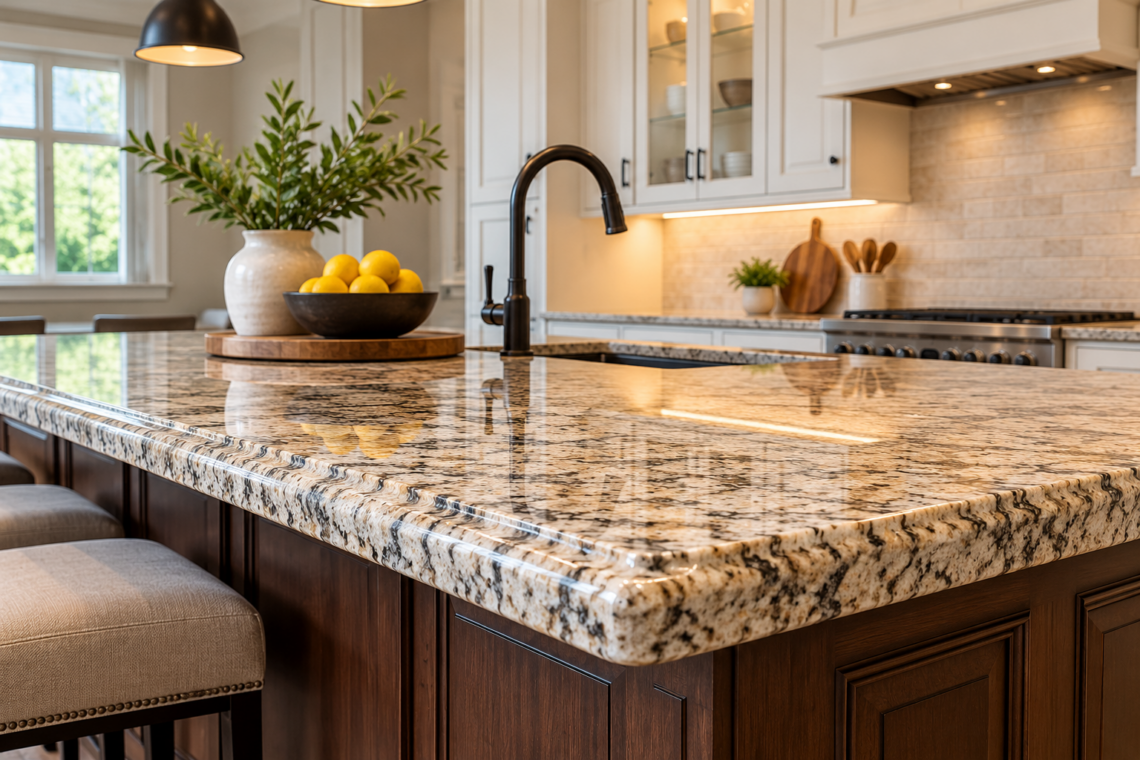
A straight edge provides one of the cleanest countertop looks. However, it is usually not completely sharp. Fabricators often soften the top and bottom corners slightly to make the edge more comfortable. This style works well when you want the granite itself to become the main feature. For example, a slab with strong movement or dramatic mineral patterns usually does not need an elaborate edge. An eased profile can fit modern, transitional, and even traditional kitchens because it remains visually simple. Therefore, it is often a safe choice when you want flexibility.
Beveled Edge
A beveled edge includes an angled cut along part of the countertop edge. This creates a defined line that adds detail without becoming highly decorative. The profile can work especially well with contemporary or transitional cabinetry. Additionally, the angled section can catch light and make the countertop edge more noticeable. You should consider the amount of bevel carefully. A subtle bevel provides a clean finish, while a deeper bevel produces a stronger design statement.
Bullnose Edge
A bullnose edge creates a fully rounded profile. Because there are no sharp-looking corners, it can make the countertop feel softer. This style has been used in many traditional kitchens. However, it can also work in casual or family-oriented spaces where a rounded edge feels more comfortable. One thing to consider is how the curve affects the appearance of the granite. A full bullnose can make the countertop seem slightly thinner because the top and bottom edges curve inward.
Half Bullnose Edge
A half bullnose keeps more visual thickness than a full bullnose because the top edge curves while the lower portion remains more defined. As a result, you get the softer feel of a rounded profile without losing as much visual weight. This can be useful on kitchen islands where you want a comfortable edge while still showing the thickness of the slab.
Ogee Edge
An ogee profile uses a more decorative curve. It often includes an inward curve followed by an outward curve, creating a detailed appearance. Because of its formal character, this profile often suits traditional or luxury kitchens. It can work particularly well with detailed wood cabinetry and classic stone patterns. However, an ogee edge may feel too elaborate in a simple modern kitchen. Therefore, you should consider whether the rest of the room contains enough traditional detail to support it.
Match the Edge to the Granite Pattern
Granite naturally contains movement, mineral deposits, veins, and color changes. Some slabs have quiet patterns, while others contain dramatic movement across the entire surface. If your granite already has a strong pattern, a simple edge may provide better balance. An eased or lightly beveled profile can allow the natural stone to remain the main feature. On the other hand, quieter granite can support a more detailed edge. For example, a subtle stone pattern combined with an ogee profile can create extra visual interest. You should view the slab and edge sample together whenever possible. A profile that looks attractive on a plain sample may feel very different when applied to a highly patterned granite.
Think About Countertop Thickness
The edge can affect how thick the countertop appears. A straight profile clearly shows the actual thickness of the stone. Meanwhile, rounded profiles can make the slab appear slightly thinner because part of the visible material curves away. You can also create the appearance of a thicker countertop through laminated or built-up edge treatments. In this approach, additional stone may be joined along the edge to produce greater visual depth. This can work well on large islands because a heavier edge can match the scale of the surface. However, a thick-looking edge may overwhelm smaller countertops. Therefore, countertop size should influence the profile you choose.
Consider the Kitchen Island Separately
Your island does not always need the same edge as your perimeter countertops. Because an island often becomes the center of the kitchen, you may want to give it slightly more detail. For example, simple perimeter countertops can use an eased edge while the island uses a softer or more decorative profile. However, the two edges should still feel related. Choosing completely different design styles can make the kitchen look disconnected. You should also think about seating. If stools sit beneath an island overhang, a comfortable rounded or softened edge may work better where people regularly rest their arms. In addition, larger islands provide more space for decorative details to make sense visually.
Think About Cleaning and Maintenance
Countertop edges collect crumbs, spills, and dust like other kitchen surfaces. Therefore, cleaning should be part of your decision. Simple edges generally have fewer curves and grooves. As a result, wiping them clean can be straightforward. Highly decorative profiles may contain several curves or steps. These details can look attractive, but they may require more attention during routine cleaning. You should consider your own habits. If you prefer quick and simple maintenance, a cleaner profile may suit you better. However, if the decorative appearance matters more, a detailed edge may still be worth considering.
Consider Safety and Everyday Comfort
Your countertop is used every day, so comfort matters. A sharply defined profile can create a crisp modern appearance. However, softer edges may feel more comfortable in areas where people frequently lean against the countertop. This can be especially important around breakfast bars and islands. Homes with young children may also benefit from profiles with softened corners. Although any stone countertop remains a hard surface, rounded details can remove some of the sharpness found in more angular designs. Therefore, you should consider who uses the kitchen as well as how the countertop looks.
Coordinate the Edge With Cabinet Details
Cabinet doors can help guide your countertop decision. Flat-panel cabinets usually work well with clean edges because both features share simple lines. Likewise, shaker cabinets can support a wide range of profiles because their design combines simplicity with subtle detail. More decorative cabinet doors may support a more detailed stone edge. For example, raised-panel cabinetry can pair naturally with a traditional ogee profile. However, balance is important. If your cabinets already contain elaborate molding, decorative hardware, and detailed finishes, another highly decorative feature may make the kitchen feel too busy. Instead, you can use a simpler countertop edge to create visual relief.
Coordinate With Your Backsplash
Your backsplash sits close to the countertop, so both features contribute to the same visual area. If the backsplash uses bold patterns, detailed mosaics, or strong colors, a simpler countertop edge may help keep the design balanced. Meanwhile, a simple backsplash gives you more freedom to use a decorative edge. The same idea applies to granite movement. A highly patterned slab combined with a busy backsplash and complex edge can create too much visual information. Therefore, you should decide which feature will receive the most attention.
Choose an Edge That Fits Long-Term Design
Kitchen trends change, but granite can remain in place for many years. Therefore, you should think beyond what looks fashionable right now. Simple edges usually provide more design flexibility. For example, you can change cabinet hardware, paint colors, light fixtures, or furniture without worrying that a neutral countertop profile will conflict with the new style. Decorative edges can also remain attractive for years when they fit the architecture of the home. However, they create a more specific visual direction. You should choose based on the kitchen you want to live with rather than selecting an edge only because it appears frequently in current design photos.
Compare Granite With Your Other Materials
The countertop should connect visually with the rest of the kitchen. Place granite samples beside cabinet doors, flooring, backsplash tile, and hardware. Then consider how the edge will affect the overall appearance. For example, dark granite with a straight edge can create a strong, clean contrast against light cabinetry. Meanwhile, warm granite with a rounded profile may fit naturally beside traditional wood cabinets. If you are comparing granite countertops in Milwaukee, viewing full slabs and edge samples together can make this decision easier. You can see how natural stone movement continues toward the edge and whether a simple or decorative profile works better with the selected slab. Physical samples are especially useful because online images may not show the true scale, color, or texture of the stone.
Consider How Seams Affect the Finished Look
Large countertop layouts may require seams because granite slabs have size limits. Although the edge profile does not eliminate seams, the complete fabrication plan should consider both details together. For example, a large island may require careful slab selection so the most attractive areas of the granite remain visible. Meanwhile, perimeter sections may need seams positioned where they create the least visual interruption. You should discuss these details before fabrication begins. Once the stone has been cut, major layout changes become much more difficult. Therefore, edge selection should form part of the larger countertop planning process.
Think About Sinks and Cooktops
Sink and cooktop openings interrupt the countertop surface, so they can influence the overall design. An undermount sink often creates a clean appearance because the countertop continues directly to the sink opening. This can pair naturally with simple edge profiles. However, the outside edge of the countertop can still use a more decorative treatment if the kitchen style supports it. You should also think about the space between a sink and the countertop edge. A very detailed profile may need enough visible stone to show its shape clearly. Similarly, cooktops and other cutouts should be considered during fabrication planning to maintain balanced stone sections around them.
Do Not Choose an Edge From a Small Picture Alone
Photos are helpful for collecting ideas, but they do not show every detail. The same edge can appear different depending on stone thickness, granite color, lighting, and viewing angle. Therefore, you should look at physical edge samples whenever possible. Running your hand across the sample can also help. An edge that looks attractive may feel different when you actually lean against it. You should compare several options beside the granite you are considering. This makes it easier to understand which profile works naturally with the slab.
Keep the Design Consistent
Countertop design becomes more successful when every detail feels connected. The edge should not look like something added at the end of the project. Instead, it should work with the cabinets, island, stone pattern, backsplash, flooring, and hardware. Simple kitchens often benefit from simple profiles. Meanwhile, more traditional spaces may support additional edge detail. However, there is no rule that requires a decorative kitchen to use an elaborate countertop edge. Sometimes contrast between detailed cabinetry and a clean stone edge creates a more balanced result. Therefore, consistency does not mean every element must look the same. It means the choices should make sense together.
Final Thoughts
Choosing a granite countertop edge may seem like a small part of a kitchen project, but it can influence the finished appearance more than expected. The right profile can highlight the thickness of the stone, complement the cabinets, support the kitchen style, and make the countertop more comfortable during everyday use.
You should compare straight, beveled, rounded, and decorative profiles based on the character of your granite and the design of the room. In addition, factors such as cleaning, seating, countertop thickness, cabinet details, and long-term style should influence your choice.
Most importantly, you should view the edge as part of the complete countertop rather than an isolated detail. When the stone, edge profile, cabinetry, backsplash, and layout work together, the finished kitchen can feel more balanced, practical, and visually complete.