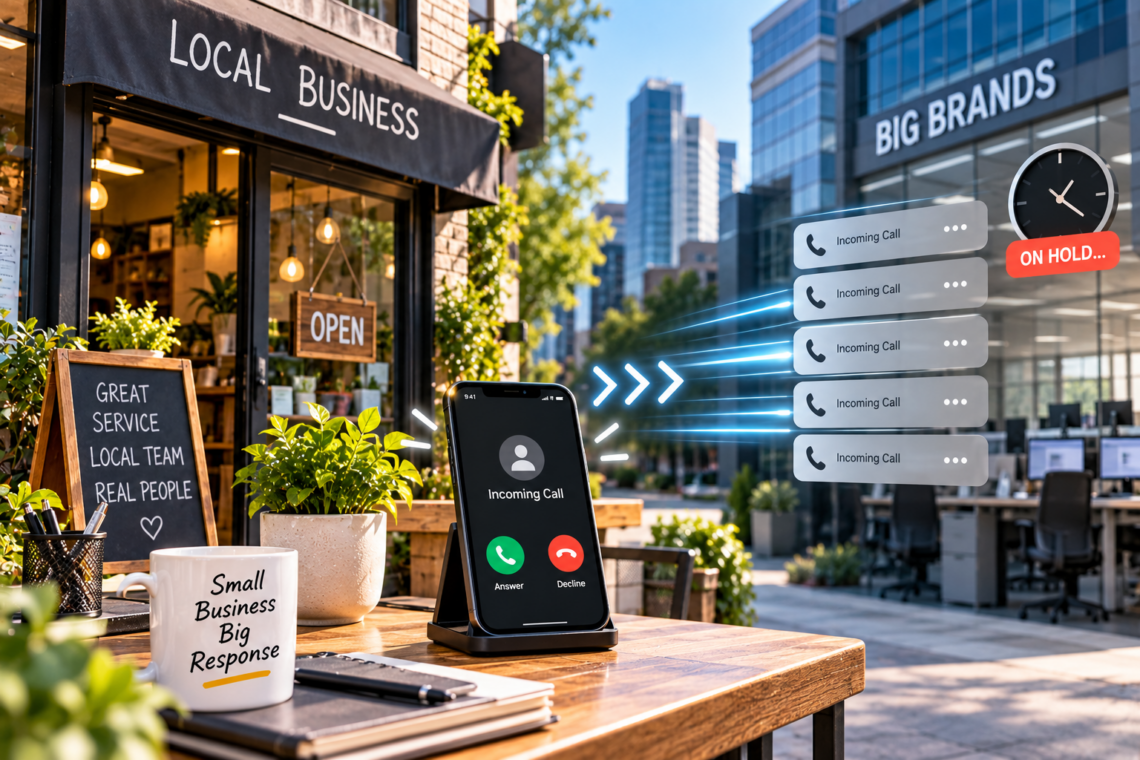
Call your cable company on a Monday morning. Go ahead, I’ll wait (I’d be waiting a while). You press 2 for billing, then 4 for “something else,” and then it’s nineteen minutes of the same saxophone loop until a real person finally says “thanks for your patience” and the line drops. We’ve all been there. And it’s a strangely comforting thing to remember if you run a small business, because the giants you’re up against are nowhere near as fast as their commercials make them look. They’ve got one trick, though. They’ve taught everybody to expect something instant, even if that something is a chatbot or a text that says, “We got your message!” with a little smiley face. Now customers walk around with this odd double standard. They know the family-run HVAC outfit doesn’t have a 300-seat call center. They still want to hear back before lunch.
Speed is where being big stops helping
A national furniture chain can bury you on ad spend. Inventory too, and free delivery promos you’d go broke trying to match. But call them about a recliner that showed up with a busted lever and see who you get: some poor rep three states away, reading a screen, who’ll “escalate” it. Escalate means a ticket number and a callback in 24 to 48 business hours, give or take a week. Meanwhile, the upholsterer across town picks up on the second ring, says, “Yeah, bring it by Thursday, I’ll take a look,” and that’s that. Ninety seconds, done. Fewer layers between the question and the guy who can answer it, that’s your edge. The catch is getting to the phone in the first place.
So why do small shops end up slower?
Caring has nothing to do with it. The same three people who answer the phone are also the ones doing the work. The bike shop owner’s trunking a wheel with grease up to his elbows. The independent insurance agent is stuck in a meeting with a couple who can’t decide on their deductible. On Saturdays the moving company’s dispatcher is, well, driving one of the trucks. 0So response time comes down to who’s free. And at 7:45 on a Tuesday night, when some guy just got a quote from a big national mover and wants to call you to compare? Nobody’s free. He gets voicemail, books the big guys, and you never even find out he called.
You don’t need a call center
Honestly, a lot of this is habits. Make it a house rule that voicemails and web forms get answered within the hour while you’re open. Turn on missed-call text back so the person who couldn’t reach you gets “Sorry, we missed you; calling back in a few” instead of nothing. Fix the hours on your Google listing (you’d be amazed how many say 6 p.m. when the door’s locked at 4). Cheap stuff, all of it. The hard part is the hours when nobody’s around at all. Nights, Sundays, and the week you’re at your cousin’s wedding. That’s the gap a lot of owners are filling with an AI receptionist for small businesses: it answers in a voice that sounds like a person, asks the same questions you’d ask, puts the job on your calendar or takes a real message, and kicks anything weird over to a human. If you’re a five-person shop that can’t swing a full-time front desk hire, it’s about the only way to answer on the first ring at 9 p.m. like the big brands do. One warning. It’s only as good as what you tell it, so if it doesn’t know you skip weekend installs or don’t go past the county line, people will notice, and it will be quick.
Play the hometown card
The big guys can’t fake one thing, and that’s knowing people. You walk into the hardware store, and the guy behind the counter goes, “That deck stain, hold up, okay?” No chain store’s hold music competes with that. So once you’ve got speed sorted, use it. Call back by name. Bring up the last job. If Linda emailed in March about her leaky faucet and calls again in October, she shouldn’t have to start from zero (she’ll love you for it). And if any of your intake is automated, make sure what the caller already said gets passed along, because “can you repeat that?” is the exact big-company feeling people are running from.
Customers’ patience is shrinking.
Five years ago nobody expected the corner print shop to pick up at night. Small businesses got a pass. That pass is expired. Read through what’s been written lately on AI customer support trends and a couple of things keep coming up: people treat being reachable as a trust thing now, and voice is back in the spotlight after a long stretch where every company shoved you toward chat. That’s good news for small shops, weirdly enough. Tools that used to need an enterprise contract are priced for a one-location business with six employees now. It does mean “we’re a small team” buys you less slack every year. Customers aren’t being jerks about it. Their phones do more for them than they used to, so they figure you can too.
Put a number on it
Measure it. Like, actually write it down. How long between someone reaching out and someone (or something) getting back to them? Do daytime and after-hours separately; they won’t look anything alike. Check web forms too; those things rot in an inbox. Get daytime under a few minutes and after-hours under an hour and you’ll be beating a surprising number of national brands. Without hiring anybody.
Small can still mean fast
The big brands will always have more money. More billboards, more apps, more points you’ll never redeem. But somebody with a problem mostly wants two things: to reach a person fast and for that person to be able to fix it. Small businesses are already good at the second one, since the person on the phone is a lot of the time the same person who’ll show up in the van. Nail the first one too, and that’s a combo no national company can buy its way into, no matter how fat the support budget gets.