What if your freight forwarding business is losing money on shipments that appear profitable?
A shipment gets delivered, the customer receives an invoice, and the operations team moves on to the next booking. Everything seems complete. But somewhere between the original quotation, carrier charges, and final invoice, an additional fee was missed.
It might be a detention charge, an incorrect freight rate, or an expense that never reached the billing team.
Individually, these errors may seem small. Across hundreds of shipments, however, they can quietly reduce profitability.
This is why freight forwarders are increasingly exploring freight forwarding software solutions to improve billing accuracy, strengthen financial visibility, and reduce revenue leakage.
Why Billing Errors Lead to Revenue Leakage
Freight forwarding involves multiple charges, including transportation costs, customs handling, documentation fees, storage, and carrier surcharges.
When these charges are recorded across emails, spreadsheets, and disconnected systems, maintaining accurate financial records becomes challenging.
Common causes of revenue leakage include:
- Missed additional charges: Detention, demurrage, or handling fees may not appear on the final customer invoice.
- Incorrect freight rates: Outdated rate sheets can create differences between quoted and actual costs.
- Manual data-entry mistakes: Incorrect amounts, shipment references, or currencies can affect invoicing.
- Delayed invoice processing: Billing teams may wait for carrier invoices or operational updates before finalizing charges.
- Limited shipment-level visibility: Finance teams may struggle to identify which shipments are generating lower-than-expected margins.
The challenge is not simply correcting invoices. It is preventing financial information from getting lost between departments.
How Freight Forwarding Software Solutions Can Help
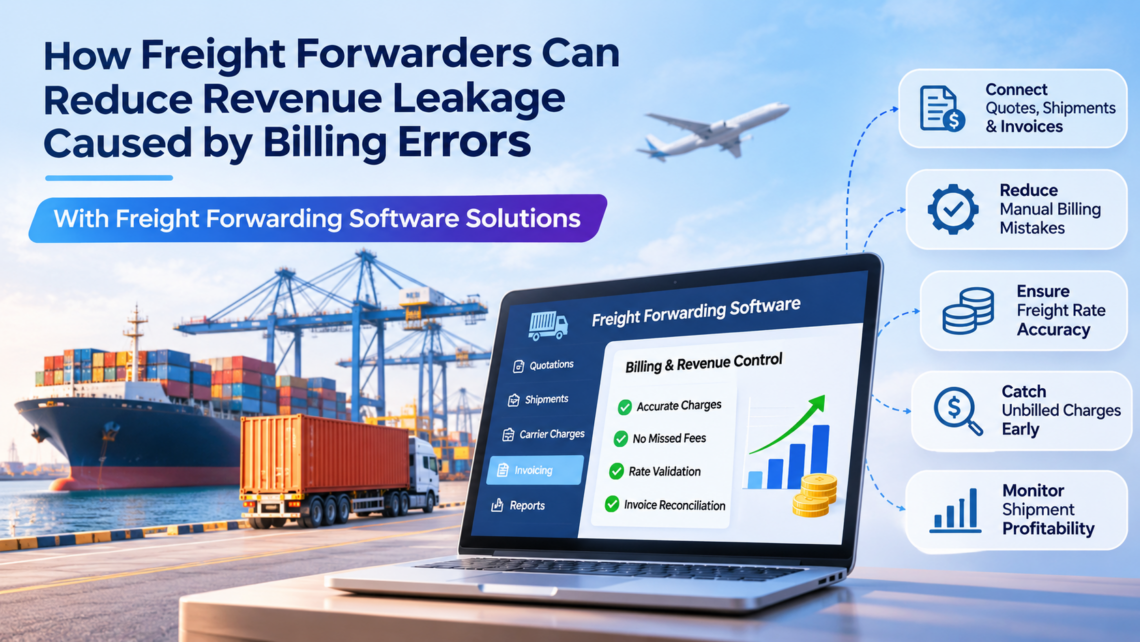
1. Connecting Quotations, Shipments, and Invoices
One of the biggest weaknesses in manual billing is the lack of connectivity between sales, operations, and finance.
An integrated freight management platform can link customer quotations, shipment records, carrier charges, and invoices.
For example, if a shipment incurs an additional handling fee, the system can record the expense against the correct job and flag it for billing review.
This helps teams identify unbilled charges before final invoices are issued.
2. Reducing Manual Billing Mistakes
Repeatedly entering shipment details into separate applications increases the likelihood of mistakes.
Automated billing workflows can reuse approved shipment information and apply configured pricing rules.
Instead of creating every invoice from scratch, finance teams can review system-generated billing details and investigate exceptions.
Human verification remains important, particularly for unusual charges, contract terms, and customer disputes.
3. Improving Freight Rate Accuracy
Carrier rates can vary by route, equipment type, service, contract, and applicable surcharges.
When teams rely on outdated spreadsheets, quotations may not reflect the correct costs.
Digital rate management systems can centralize approved carrier rates and customer pricing agreements.
This allows employees to reference current information when preparing quotations and reviewing invoices, provided the underlying rates are maintained accurately.
4. Identifying Unbilled Charges Earlier
Additional charges sometimes appear after the original booking has been confirmed.
Without a clear process, these expenses may be overlooked.
Connected billing systems can compare recorded shipment expenses against customer invoices and highlight discrepancies.
For instance, an operations employee might record a storage charge that has not yet been included in the customer billing record.
The system can flag the difference so the finance team can review whether the amount is recoverable under the customer agreement.
5. Monitoring Shipment Profitability
Revenue leakage becomes harder to detect when businesses only review overall monthly revenue.
Freight forwarding software solutions can provide shipment-level financial visibility by connecting expected revenue, actual costs, and invoiced amounts.
Managers can then identify jobs with unexpected margin changes, investigate billing exceptions, and improve pricing decisions.
This creates opportunities for stronger financial control across freight operations.
Why Better Billing Matters for Business Growth
Accurate billing does more than protect revenue.
It can reduce invoice disputes, improve customer communication, support faster financial reconciliation, and make operational performance easier to evaluate.
Freight forwarders can track indicators such as billing adjustments, unbilled charges, invoice dispute rates, and profit margin differences.
These measures help businesses understand where manual processes are creating financial risk.
Final Thoughts
Revenue leakage does not always result from major operational failures. Sometimes, it comes from small billing errors repeated across everyday shipments.
Disconnected systems, missed charges, and outdated rate information can gradually affect profitability.
By connecting shipment operations with financial workflows, freight forwarding software solutions can help businesses improve invoice accuracy, identify discrepancies, and maintain better control over shipment margins.
For freight forwarders, protecting profitability starts with ensuring that every legitimate charge is recorded, reviewed, and billed correctly.