The smart toy market is growing fast, though analysts disagree on its size. Grand View Research valued it at USD 14.39 billion in 2025, with a projected 15.8% CAGR to USD 44.04 billion by 2033. IMARC Group put the 2025 figure at USD 20.6 billion. Both estimates agree on direction. Toys with sensors, voice, and connectivity have become a core product category.
Regulation and scrutiny are rising at the same pace. The FTC’s amended COPPA Rule took full effect on April 22, 2026, and it now treats biometric identifiers as personal information. In late 2025, the PIRG Education Fund tested four AI chatbot toys marketed to children aged 3 to 12. Its report found that guardrails vary in effectiveness and sometimes break down entirely.
These facts change the design brief. A toy team now has to balance play value, hardware cost, data risk, and legal exposure in the same sprint. This article explains how AI and IoT reshape interactive toy design, where the main engineering trade-offs sit, and how to measure the business return.
Understand How AI and IoT Work Together Inside a Toy
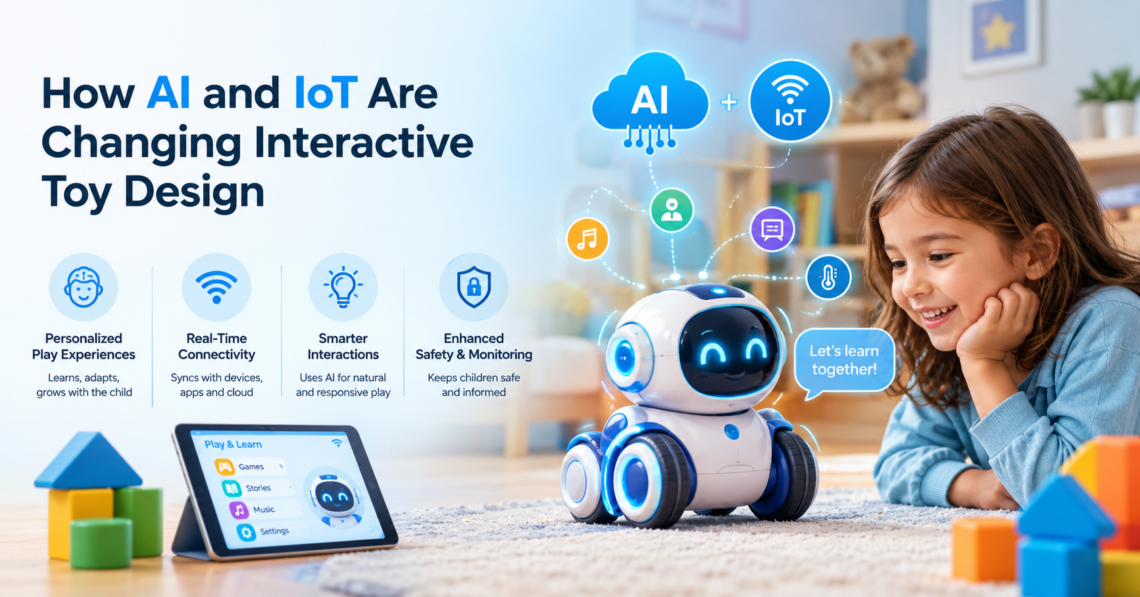
IoT gives a toy senses, memory, and a network connection. AI turns what those senses collect into responses that fit the child and the moment.
A typical connected toy combines microphones, motion or proximity sensors, sometimes a camera, a microcontroller or system on chip, a battery, and Wi-Fi or Bluetooth. Firmware reads the sensors and manages power. A companion app handles setup and parental settings. A cloud backend stores profiles, delivers content, and pushes firmware updates.
AI adds three layers on top. Speech models convert voice to text and text back to speech. A dialogue model chooses the reply. Vision or sensor models recognize faces, gestures, or objects. Each layer adds compute cost, latency, and data risk, so teams must decide where every model runs before they finalize the hardware.
Design Play Around Four AI Capabilities
The best interactive toys start from a play pattern and then pick the technology. These four capabilities cover most current designs.
- Voice conversation:The toy listens and answers in a character voice. Scripted dialogue trees behave predictably. Generative models respond more flexibly but need strict guardrails.
- Vision and gesture recognition: A camera or depth sensor lets a toy recognize a drawing, a block pattern, or a wave. Image data from children needs the tightest handling of any signal in the product.
- Adaptive difficulty: The toy tracks progress and adjusts puzzles, reading level, or game speed.
- Companion app personalization: Parents set time limits, review activity, and choose content packs.
A toy that needs ten voice commands rarely needs a large language model. Simpler designs cost less, pass certification faster, and carry less risk.
Decide What Runs on the Device and What Runs in the Cloud
This choice shapes cost, privacy, latency, and product lifespan. Make it early, because it drives the bill of materials.
On-device processing suits wake words, simple commands, sensor fusion, and safety filters. It responds quickly and keeps data inside the home. Cloud processing suits open-ended dialogue, heavy vision work, and content updates. It adds latency, recurring server cost, and a data trail. Most teams end up with a hybrid.
Offline behavior deserves special attention. Some early AI toys stopped working when their makers went out of business. A toy that loses every function without its server becomes e-waste and damages parent trust. Build a local fallback mode with basic play, and publish how long the cloud service will run.
Teams new to AI IoT Toy Development often underestimate latency. A voice feature that feels instant on a lab network can lag on a crowded home Wi-Fi, and a long pause breaks the illusion of conversation.
Build Safety and Privacy Into the First Prototype
Safety work costs far less in the first prototype than after a recall or a regulatory letter. Treat these requirements as design inputs.
- Collect less data: PIRG found that some AI toys record a child’s voice for up to 10 seconds after a conversation ends, while others stay constantly listening. Add a hardware mute switch and a visible listening indicator.
- Plan consent and retention: The amended COPPA Rule requires separate verifiable parental consent before disclosing child data for purposes that are not integral to the service. It also requires a written security program and a written retention policy.
- Test content guardrails: PIRG reported toys that discussed sexually explicit topics and suggested where a child could find matches or knives. Filter both input and output, restrict topics by age, and run adversarial tests before launch.
- Ship real parental controls: PIRG found at least three tested toys with limited or no parental controls.
- Secure the device: Use secure boot, signed over-the-air updates, unique device credentials, and encrypted storage and transport.
Physical safety still applies too. PIRG’s report also flags button cell batteries and high-powered magnets, which can be deadly if swallowed. Enclosure and battery compartment design belongs in the same review.
Learn From How Mattel and OpenAI Slowed Their Launch
Mattel offers a useful enterprise case because it shows how a large manufacturer handled these pressures in public.
In June 2025, Mattel announced a partnership with OpenAI to bring AI into age-appropriate play experiences. Mattel also planned to use ChatGPT Enterprise inside its own business for product development and brainstorming. Scrutiny grew soon after. Senators Marsha Blackburn and Richard Blumenthal sent AI toy makers a letter demanding transparency about safety testing and developmental risk.
In December 2025, Mattel confirmed it had nothing planned for the holiday season. It said its first product would target older customers and families, because OpenAI’s developer interface supports only users aged 13 and older. Mattel also described AI as a complement to traditional play, and said products would follow safety and privacy rules.
Three lessons stand out. A major brand chose delay over shipping into an unsettled risk environment. The AI vendor’s own age policy set the product’s target audience. And design scope followed governance, not the other way around. Public sources show no sales results for this program, so treat it as a case about process, not performance.
Plan Hardware, Firmware, AI, and Cloud as One Program
Successful AI-Powered IoT Toy Development depends on disciplines planning together from day one. Industrial design, electronics, firmware, machine learning, cloud, and compliance all constrain one another.
A larger microphone array improves speech recognition but raises cost and power draw. A bigger battery adds play time but changes the enclosure and the safety review. A cloud model improves answers but adds a privacy obligation. Reviewing these trade-offs in one forum prevents late redesigns.
Build in stages. Start with a proof of play using cheap hardware. Move to an engineering prototype with the real sensors and radio. Then produce a compliance build for testing, followed by a pilot run. Teams that lack in-house embedded or machine learning skills often add outside specialists at the prototype stage, when architecture decisions are still cheap to change.
Measure Business Impact With Risk and Retention Metrics
Smart toys earn money through hardware margin, content, and subscriptions, and they lose money through returns, support load, and cloud bills. Set baselines before launch so you can judge each release.
Track these measures.
- Share of toys paired to the companion app
- Active use at 30 and 90 days
- Return rate and support tickets per 1,000 units
- Cloud cost per active toy per month, compared with recurring revenue per toy
- Over-the-air update success rate
Risk belongs in the model as well. COPPA civil penalties reach a maximum of $53,088 per violation. Compare that exposure with the cost of privacy engineering, and the case for early investment becomes concrete.
Final Thoughts for Teams Building AI and IoT Toys
AI and IoT give toys the ability to listen, see, adapt, and update. They also turn a toy into a data-collecting device that families keep in a child’s room. The strongest designs start with a clear play pattern, keep as much processing on the device as the experience allows, and treat privacy and safety as core features.
The Mattel example shows where the industry stands. Even a large manufacturer slowed down to settle age limits and safety questions before launch. Teams that do the same work early will ship faster and face fewer surprises. Set measurable baselines, test guardrails hard, and plan for the day the cloud service goes quiet.
Frequently Asked Questions
1. Do AI toys need a constant internet connection?
Not always. Wake words, simple commands, and safety filters can run on the device. Open-ended conversation usually needs the cloud, so a local fallback mode protects the product when the connection fails.
2. What is the biggest compliance risk in connected toys?
Handling children’s data. The amended COPPA Rule covers biometric identifiers, so voiceprints and facial data need clear consent, retention limits, and security controls.
Source: https://www.hashstudioz.com/blog/ai-iot-interactive-toy-design/