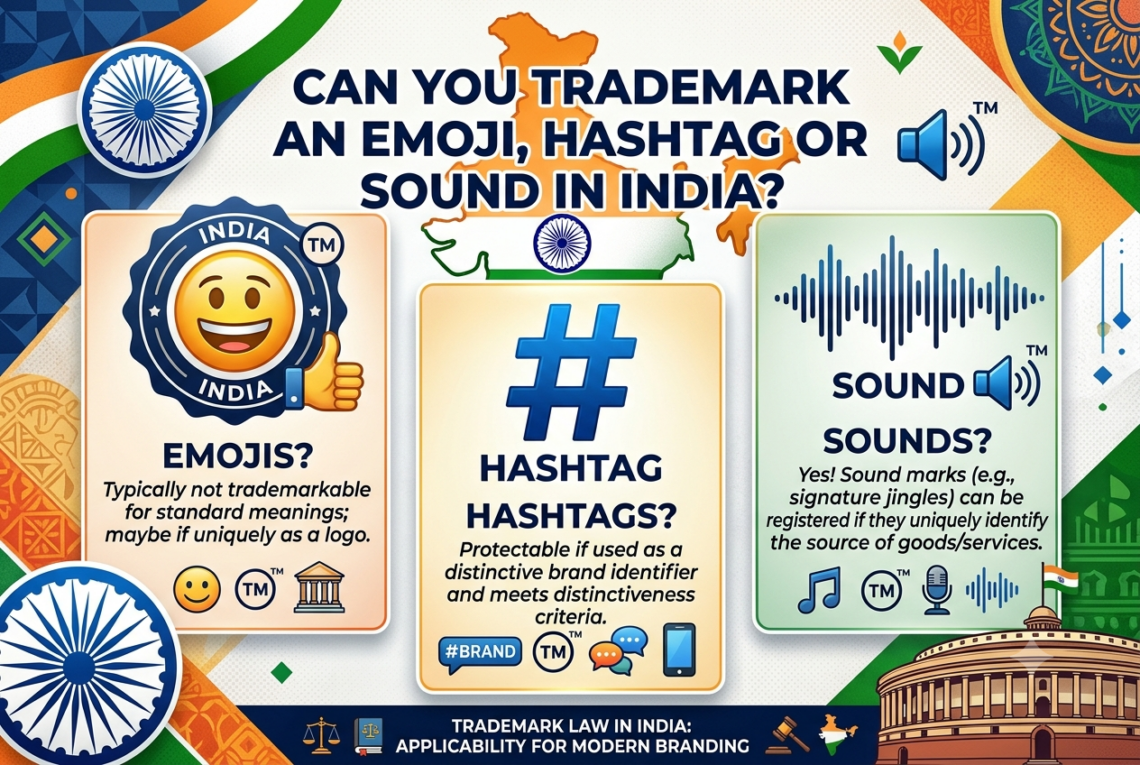
With the evolution of the digital world, businesses need to adapt their communication methods, marketing, and branding methods. Traditionally, trademark registration have been based on words, logos and designs. However, nowadays with a shift to online commerce, businesses use emojis, hashtags and sounds as part of their brand image. In India, there are rules and regulations about what you can and cannot trademark. These are governed by the Trade Marks Act, 1999. Therefore, you may be wondering whether you can trademark non-traditional signs.
To obtain exclusive rights to your unique digital sign, you will need to follow the normal trademark process. Under Indian law, a mark can be any device or brand including a heading, label, ticket, name, signature, word, letter, number, the shape of goods, packaging, or combination of colours. This means that you could potentially trademark some unique branding options as long as they meet the criteria to be registered.
Emojis
Emojis are used globally by millions of people every day. They are used as a way to add tone to your message. Due to the fact they are commonly used, you would struggle to obtain any wide-ranging rights to an emoji.
Lack of Distinctiveness – Emojis do not serve the purpose of a trademark by distinguishing between different businesses.
However, if the emoji is stylised, combined with other branding elements or used consistently with specific goods/services then it could potentially be trademarked.
Hashtags
Hashtags (#) are used to organise online conversations. They are used as keywords that can be searched easily. Whilst they are used to identify a community, businesses often use them as part of their marketing slogan.
If they are used as a source indicator, then they can be registered.
If they are purely descriptive or generic (e.g. #Sale or #BestCoffee) then they will be rejected under section 9 of the Trade Marks Act as they lack distinctiveness.
Sounds
Unlike emojis and hashtags, there is a clear way that you can register non-visible signs such as sounds. Under the Trade Marks Rules, sound can be registered.
You must provide a copy of the sound in MP3 format and a clear visual image (usually in note or specgram format).
In order for the sound to be registered, it must be distinctive enough to be recognised by the consumer as being the source of trade for a particular good/service.
Application Process
Before applying to the Controller General of Patents, Designs and Trademarks you should carry out a Trademark Search to ensure there are no conflicts, previous claims or sounds that are similar in the same Nice classification class. Once this has been done you will need to specify exactly what goods/services you are applying for. You will also need to create a visual/sound for your trademark and submit using the e-filing portal.
Whilst there may be challenges when registering non-traditional digital signs such as emojis, hashtags and sounds in India, it is possible. As long as you can prove distinctiveness. Combine your digital sign with actual business activity and follow the strict application process then you can obtain strong legal monopolies.