Why UAE Enterprises Are Moving Towards AI-Powered Business Process Automation
Short answer: UAE enterprises are adopting AI-powered automation because manual workflows cannot keep pace with growth, customer expectations and national digital transformation goals.
Businesses in the UAE operate in a fast, multilingual and highly competitive market. Manual workflows such as invoice approvals, document checks, customer follow-ups and report preparation consume time, increase the risk of errors and become harder to scale as the organisation grows. Adding more staff to repetitive tasks is rarely the most efficient answer.
AI changes this by adding intelligence to automation. Traditional automation follows fixed rules. AI-powered systems can read documents, interpret requests, predict outcomes, recommend actions and trigger multi-step workflows. This makes business process automation UAE organisations rely on far more capable than the rule-based scripts of the past.
National policy is also accelerating adoption. The UAE National Strategy for Artificial Intelligence 2031 sets out an ambition for the country to become a global leader in AI and to integrate AI across priority sectors and government services. Dubai has reinforced this direction through its own digital transformation and AI initiatives. For private enterprises, this creates a supportive environment, along with rising expectations around speed, service quality and innovation.
Another important shift is strategic. Many organisations that ran isolated AI experiments, such as a chatbot in one department or a pilot in another, are now moving towards integrated automation systems that connect data, workflows and decision-making across the business. Enterprises evaluating this transition often begin by reviewing professional ai development services uae to understand what custom AI solutions can realistically deliver for their operations.
The Latest AI Automation Trends Shaping UAE Enterprises in 2026
Short answer: The leading trends are agentic AI, generative AI integration, predictive analytics, hyperautomation and multilingual conversational automation.
The pace of change in enterprise AI automation is rapid. According to KPMG’s 2026 UAE Tech Report, 97% of surveyed UAE organisations are embedding generative AI and agentic AI into business functions. In practical terms, this means AI is no longer a side project; it is becoming part of how everyday operations run. Enterprises that delay risk falling behind competitors that already operate faster and at lower cost per transaction.
Agentic AI and Autonomous Business Workflows
Agentic AI refers to AI systems, often called AI agents, that can plan and complete multi-step tasks rather than answer a single prompt. An agent can receive a purchase request, check budget limits, route it for approval, update the ERP system and notify the requester. Critical decisions, such as high-value approvals or exceptions, should always remain under human supervision.
Generative AI Integration Across Enterprise Operations
Generative AI is being used for document processing, report drafting, business communication and internal knowledge assistants that help employees find policies, contracts or procedures in seconds. The value lies in embedding these capabilities inside existing workflows rather than using them as standalone tools.
Predictive Analytics and Intelligent Decision-Making
Predictive models analyse historical and live data to forecast demand, sales and resource requirements. They also reveal process inefficiencies and support predictive maintenance, helping teams act before problems occur.
Hyperautomation Through AI, RPA and Machine Learning
Hyperautomation combines RPA, machine learning and API-based system integration to automate both simple and complex workflows end to end. RPA handles repetitive, rule-based steps, while AI manages unstructured data and decisions.
AI-Powered Customer Service and Conversational Automation
Virtual assistants now handle support queries, qualify leads and schedule follow-ups. For the UAE, multilingual capability in Arabic and English is especially valuable, as it allows consistent service across a diverse customer base. Together, these trends make AI-powered business automation a core part of enterprise strategy rather than an optional upgrade.
Which Business Processes Can UAE Enterprises Automate Using AI?
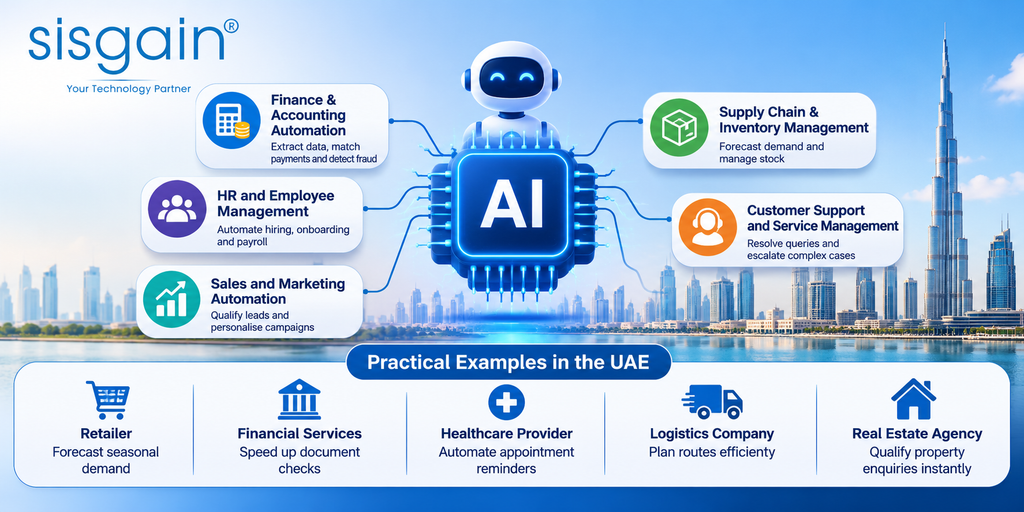
Short answer: Most repetitive, data-heavy and rule-driven processes in finance, HR, sales, supply chain and customer support can be automated using AI.
The real value of AI automation for UAE enterprises appears when it is applied to specific processes. A useful rule is to look for workflows that are high in volume, depend on structured or semi-structured data and cause delays when handled manually. Organisations seeking support across several departments often explore dedicated Business Process Automation Services Dubai providers who can assess workflows and design automation around real operational needs.
Finance and Accounting Automation
AI can extract data from invoices, match payments, reconcile accounts, manage expenses and generate financial reports. Machine learning models also monitor transactions to flag unusual patterns that may indicate fraud.
HR and Employee Management Automation
Automation supports CV screening, candidate communication, onboarding, attendance tracking, payroll workflows and employee query handling, freeing HR teams to focus on people rather than paperwork.
Sales and Marketing Process Automation
AI can score and qualify leads, update the CRM automatically, forecast sales and personalise campaigns based on customer behaviour.
Supply Chain and Inventory Management
Forecasting models predict stock requirements and trigger replenishment. Automated systems also manage supplier communication, order processing and delivery planning.
Customer Support and Service Management
AI classifies tickets, resolves common queries, escalates complex cases to the right team and schedules follow-ups.
Practical examples in the UAE: A retailer can forecast seasonal demand around major shopping festivals. A financial services firm can speed up document checks during onboarding. A healthcare provider can automate appointment reminders and patient documentation. A logistics company can plan routes and delivery windows more efficiently, and a real estate agency can qualify property enquiries instantly. These are common use cases; results will vary by organisation, data quality and implementation approach, which is why business process automation UAE projects should always begin with a clear assessment.
How AI Automation Is Transforming Key Industries Across the UAE
Short answer: Banking, healthcare, real estate, retail and logistics are among the sectors gaining the most from enterprise automation.
Different industries have different priorities, so effective enterprise automation solutions UAE businesses adopt are tailored to sector needs.
Banking and Financial Services
AI supports fraud detection, automated compliance checks and intelligent transaction processing, reducing manual review while improving monitoring accuracy.
Healthcare and Medical Organisations
Hospitals and clinics use automation for appointment management, administrative workflows, patient communication and document processing. This allows clinical staff to spend more time on patient care.
Real Estate and Property Management
Automation helps manage leads, respond to property enquiries, verify documents and generate predictive insights on pricing and demand.
Retail and E-commerce
Retailers use AI for demand forecasting, inventory management, order processing and personalised customer experiences.
Logistics and Manufacturing
AI enables fleet optimisation, warehouse automation, production monitoring and predictive maintenance, which reduces downtime and improves delivery reliability.
How to Implement AI-Powered Business Process Automation in Your UAE Enterprise
Short answer: Identify the right process, define goals, choose suitable technologies, integrate with existing systems, pilot, measure and then scale.
A structured framework reduces risk and improves outcomes. Many enterprises work with specialists offering AI Automation Services In Dubai to ensure technology selection and integration match their business requirements. The role of an experienced AI automation company in Dubai is not only to build the solution but also to assess processes, integrate systems and provide support after deployment.
Step 1 – Identify Repetitive and Time-Consuming Processes
List workflows that consume significant staff time, create delays or produce frequent errors. These are your strongest automation candidates.
Step 2 – Analyse Business Requirements and Automation Goals
Define what success looks like: faster processing, higher accuracy, lower costs or a better customer experience. Clear goals make results measurable.
Step 3 – Select the Right AI Technologies
Match the technology to the problem:
- Machine learning for prediction and pattern detection
- Generative AI for content, summaries and knowledge assistants
- AI agents for multi-step workflow execution
- Robotic process automation (RPA) for repetitive, rule-based tasks
- Natural language processing (NLP) for understanding text and speech
- Intelligent document processing (IDP) for extracting data from invoices, contracts and forms
Step 4 – Integrate AI With Existing Business Systems
Automation delivers value only when it connects with your CRM, ERP, HRMS, accounting platforms and legacy software. Integration should be planned early, because poor integration is one of the most common causes of project delays.
Step 5 – Implement a Pilot Project
Start with one high-impact but manageable workflow. A pilot lets you test accuracy, gather user feedback and validate the business case before wider investment.
Step 6 – Monitor Performance and Scale Automation
Track agreed metrics, refine workflows and extend successful automation to other departments. Continuous monitoring ensures models stay accurate as business conditions change.
Read More :- How SISGAIN Is Helping UAE Enterprises Reduce Operational Costs Through AI Automation
Key Challenges UAE Businesses Must Consider Before Adopting AI Automation
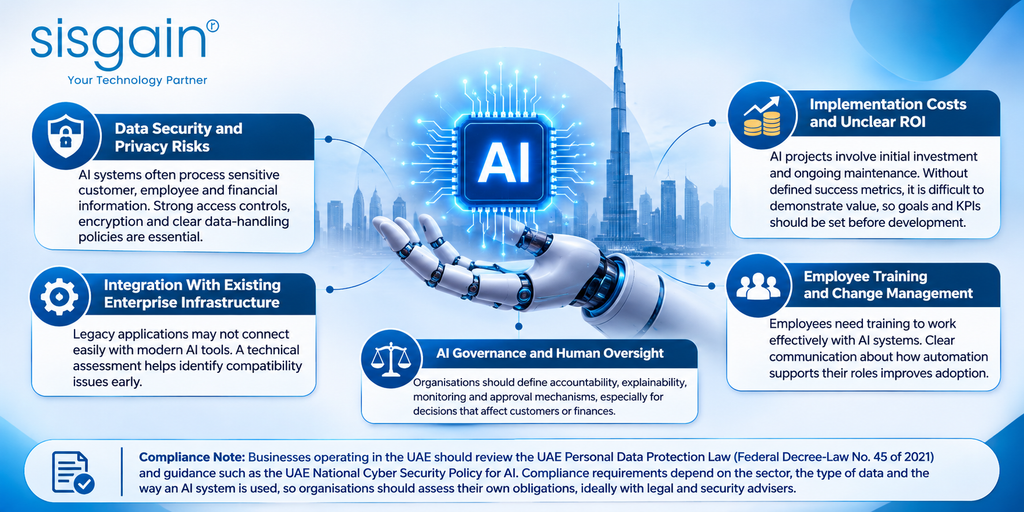
Short answer: The main challenges are data security, integration, cost and ROI clarity, change management and governance.
Data Security and Privacy Risks
AI systems often process sensitive customer, employee and financial information. Strong access controls, encryption and clear data-handling policies are essential.
Integration With Existing Enterprise Infrastructure
Legacy applications may not connect easily with modern AI tools. A technical assessment before development helps identify compatibility issues early.
Implementation Costs and Unclear ROI
AI projects involve initial investment and ongoing maintenance. Without defined success metrics, it is difficult to demonstrate value, so goals and KPIs should be set before development begins.
Employee Training and Change Management
Employees need training to work effectively with AI systems. Clear communication about how automation supports their roles improves adoption.
AI Governance and Human Oversight
Organisations should define accountability, explainability, monitoring and approval mechanisms, especially for decisions that affect customers or finances.
Compliance note: Businesses operating in the UAE should review the UAE Personal Data Protection Law (Federal Decree-Law No. 45 of 2021) and guidance such as the UAE National Cyber Security Policy for AI. Compliance requirements depend on the sector, the type of data and the way an AI system is used, so organisations should assess their own obligations, ideally with legal and security advisers, rather than assuming every system is subject to identical rules.
How to Measure the ROI of AI-Powered Business Process Automation
Short answer: Measure ROI by comparing baseline performance with post-implementation results across time, cost, accuracy, decision speed and productivity.
Reduction in Manual Processing Time
Record how long a workflow takes before and after automation.
Operational Cost Savings
Evaluate reduced administrative effort, lower rework and better resource utilisation.
Improved Accuracy and Fewer Processing Errors
Track error rates, rework volumes and data inconsistencies.
Faster Business Decision-Making
Measure how quickly reports and insights become available to decision-makers.
Employee Productivity and Customer Experience
Assess employee capacity, response times and customer satisfaction scores.
Use a simple KPI table like the one below. Fill it with your own measured data rather than estimates.
How to Choose the Right AI Automation Partner in Dubai
Short answer: Choose a partner with proven enterprise integration expertise, relevant industry experience, strong security practices, scalable solutions and a business-first approach.
Evaluate AI Development and Enterprise Integration Expertise
Look for experience in custom AI development, machine learning and enterprise software integration. Ask how the team handles legacy systems and APIs.
Check Industry Experience and Previous Projects
Review case studies, technical capabilities and documented outcomes relevant to your sector.
Assess Data Security and Compliance Practices
Evaluate data handling, access controls, security testing and governance processes.
Understand Scalability and Long-Term Technical Support
The solution should grow with your business and be supported after launch.
Prioritise Business-Focused AI Solutions
The best partner starts with your business objectives rather than recommending tools first. For organisations comparing AI solutions in Dubai, companies such as sisgain are often considered for custom AI development, enterprise integrations and automation designed around specific business requirements. A reliable AI automation company in Dubai should be able to explain its approach, show relevant experience and define measurable outcomes before the project begins.
Why SISGAIN Is Important for AI Automation Projects
Short answer: AI automation succeeds when strategy, technology, integration and support work together, and this is where an experienced partner such as SISGAIN Technologies adds value.
Many automation projects fail not because the technology is weak, but because the process was poorly understood, systems were not integrated properly or no one owned the results after launch. An end-to-end partner helps avoid these problems. The areas in which SISGAIN supports enterprises include:
- Business process analysis: Understanding your workflows, bottlenecks and automation opportunities before recommending technology.
- Custom AI development: Building solutions around your processes instead of forcing your business into a generic tool.
- Enterprise integration: Connecting AI with CRM, ERP, HRMS, accounting platforms and legacy systems.
- Security and governance awareness: Designing solutions with data protection, access control and human oversight in mind.
- Pilot-to-scale approach: Validating value on a focused workflow before expanding across departments.
- Post-deployment support: Monitoring performance, improving workflows and supporting growth over time.
This combination of analysis, development, integration and support helps enterprises move from an AI idea to a working, measurable system.
Why UAE Enterprises Should Prepare for the Next Phase of AI Automation
The next phase of AI automation will centre on intelligent, autonomous and connected workflows. Instead of automating isolated tasks, enterprises will link departments, data and decisions into a single operating environment where AI agents coordinate routine work and analytics guide strategy.
Preparing for this shift means getting the foundations right: clean and accessible data, well-integrated systems, a scalable automation roadmap and clear governance. It also means combining AI capability with human expertise, since people remain essential for judgement, accountability and customer relationships.
Successful AI automation is not simply about adopting new technology. It requires identifying the right processes, selecting suitable AI solutions, integrating existing systems and continuously measuring business outcomes. If your organisation is planning its automation journey, start with a focused assessment of your highest-impact workflows and speak with an experienced team about a realistic roadmap.
Frequently Asked Questions
1. What is AI-powered business process automation?
AI-powered business process automation uses technologies such as machine learning, natural language processing, generative AI and RPA to perform and improve business workflows. Unlike rule-based automation, it can interpret documents, learn from data, predict outcomes and handle exceptions, reducing manual effort and improving speed and accuracy.
2. How is AI automation helping UAE enterprises?
AI automation helps UAE enterprises process work faster, reduce errors, improve customer response times and make data-driven decisions. It supports departments such as finance, HR, sales, logistics and customer service, and aligns with national digital transformation goals, including the UAE National Strategy for Artificial Intelligence 2031.
3. Which business processes can be automated using AI?
High-volume, repetitive and data-driven processes are the best candidates. Common examples include invoice processing, payment reconciliation, recruitment screening, onboarding, lead qualification, inventory forecasting, ticket classification and customer query handling. Processes that need complex human judgement should keep human oversight even when AI assists.
4. What are the benefits of enterprise AI automation?
Key benefits include reduced manual processing time, lower operational costs, fewer errors, faster decision-making, better employee productivity and improved customer experience. The actual results depend on the process selected, data quality and implementation approach, so benefits should be measured against a clear baseline.
5. How much does AI automation cost in Dubai?
Cost depends on project scope, number of workflows, required integrations, data complexity, security needs and ongoing support. A small pilot costs far less than an enterprise-wide programme. The most reliable way to get an accurate figure is a requirements assessment and a written proposal from a provider.
6. Is AI automation suitable for small and medium-sized businesses in the UAE?
Yes. SMEs can start with focused use cases such as customer support chatbots, invoice processing or lead management, then expand gradually. A phased approach keeps investment manageable and allows the business to confirm value before automating additional processes.
7. How can businesses choose the right AI automation company in Dubai?
Evaluate integration expertise, relevant industry experience, security and compliance practices, scalability and post-deployment support. Ask for case studies, a clear implementation plan and defined success metrics. Choose a provider that begins with your business goals rather than simply recommending AI tools.
8. What is the difference between traditional automation and AI-powered automation?
Traditional automation follows fixed rules and works best with structured, predictable tasks. AI-powered automation can learn from data, understand unstructured information such as documents and messages, adapt to changes and support decisions. Many organisations combine both for the best results.