Most docks are boring. I’ll just say it. A slab of wood on some poles that gets you from the lawn to the boat and back.
Your waterfront isn’t a parking lot, though. It’s the six a.m. coffee. Kids cannonballing off the end. Friends who stay too late and nobody wants to leave first.
Aluminum boat docks deserve a second look. Ten years ago they were the practical, ugly option. Designs improved. So did pricing. And I’ve watched enough people tear out rotting wood to know which one holds up.
Ask How You’ll Actually Use It
Copying your neighbor’s dock is the first mistake. He doesn’t live your life.
Do you fish, or do you sit? Two people and a dog most weekends, or twenty people every Saturday? Pontoon, or three kayaks and a paddleboard?
Answer those and the layout sort of figures itself out.
Some things people do:
- A bump-out at the end for chairs and a cooler. Better than a long skinny pier.
- An L or a T shape, which gives you corners that are actually usable.
- A wider platform. Costs more. You’ll use it.
- Put the swim ladder away from the fishing rods.
Think of it like a room in the house. Good flow, clear zones, nothing wasted.
Roofs, Colors, and Aluminum Boat Docks That Don’t Look Cheap
A roof does more than keep rain off your head.
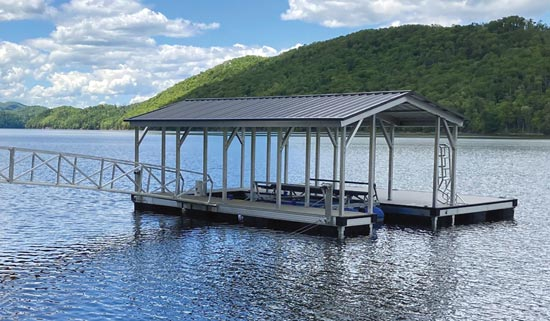
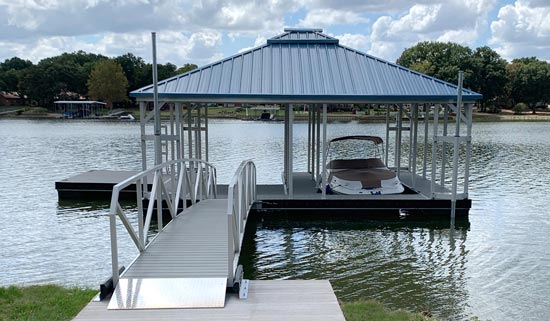
Gable is classic. Simple, gets the job done, and looks fine from the water. Hip has more flair. Sharper lines read a little fancier from the shoreline.
Sundeck is the one that sells itself. Sun on top, storage underneath. You roughly double your footprint without widening it.
The color used to be brown or brown. Now there are nine natural shades. Driftwood, Savannah, Cedar Creek, Blackstone, and Timberline. They look like the shoreline instead of a rental unit.
That pick matters more than people expect.
The Upgrades People Forget to Ask About
Accessories are where a decent dock turns into the spot everyone ends up at. None of it is exotic. Folks just forget to request it.
- LED strips along the walkway and under the roof. Safety thing, yes. Also looks great at ten at night.
- Built-in benches. Nobody wants to haul folding chairs down a dock.
- Watertight decking, which I’ll get to.
- Storage boxes for tubes, skis, tackle.
- A cleaning table with rod holders nearby.
- A ladder placed on purpose this time.
You’ll notice these every weekend, not just when you buy.
The Part That Actually Worries People
Nobody says it out loud. You’re paying real money for a structure that sits in water, gets rained on, snowed on, and baked all summer. You want it still standing in fifteen years.
Wood rots. You know that already. Composite fades, goes brittle, and then you’re swapping boards anyway.
Aluminum doesn’t rot, and it doesn’t rust. Light, strong, and doesn’t care about the sun. Decent aluminum boat docks are engineered rather than just assembled, and that’s the difference on big water.
If your lake sees heavy traffic or weather that misbehaves, that engineering is the gap between a dock and a repair bill.
Decking Is the Decision You’ll Regret Getting Wrong
Everyone fusses over the roof and forgets the floor. Decking is what you walk on barefoot. What gets soaked. What takes the beating?
A slotted deck drips right through onto whatever sits underneath. Fine, until you want furniture down there.
Watertight decking fixes that. LockDry channels water off the edge so the space below stays dry. The covered dock becomes a patio. Simple as that.
It’s the cheaper path too if your dock is just old and tired. You don’t tear the whole thing out. Re-deck it, and it looks new again.
What a Good Builder Actually Brings
Worth naming one, since they push a lot of this. Flotation Systems has been building aluminum docks for a while.
What separates them isn’t the catalog. It’s that you don’t get a template and a shrug. Anchoring, style, color, and accessories. Built around your shoreline, not dropped on it.
WAVEPro is their real selling point. Designed for high-traffic lakes and weather that won’t cooperate.
The short version:
- Fixed or floating anchoring, depending on your water.
- Piers, platforms, gable roofs, and hip roofs.
- Sundeck and sundeck combo docks when space is tight.
- Commercial marinas if you’re not a homeowner.
- LockDry decking, new build or refurbishment.
Things I’d ask before signing anything:
- Does the anchoring suit my depth and bottom type?
- What’s the warranty, and what voids it?
- Who pulls the permits?
- Can I add accessories later?
- What does the decking do in an actual downpour?
Stop Scrolling and Just Decide
People freeze on this. Six weeks of gallery scrolling and they end up with the safest, plainest dock on the lake.
Bad plan. Pick two or three things you honestly care about. A great roof. A color you love. One killer feature like dry space underneath.
Everything else stays simple. Simple is fine. Boring is what you avoid.
You look at that dock every single day. It should look like somebody chose it.
Ready to Build Your Own Escape
Your waterfront is a big asset. The dock is the main feature, not an afterthought.
Layout that fits your life. Roof that matches the house. Colors that make you happy. Features that make time on the water easier.
The boring dock era is over. Modern aluminum boat docks give you the look, the durability, and low maintenance together, and they’ll still look right in twenty years.
Ready to start? Go see what’s possible at Flotation Systems Aluminum Boat Docks. Get it right the first time.
Frequently Asked Questions
1. Are aluminum boat docks strong enough for rough water?
Yes, and this is the question I get asked the most. A good aluminum boat dock is built to achieve that, not just look good and pray for calm days. Systems like WAVEPro are designed for high-traffic lakes and adverse weather. The material is light but very sturdy, and a correct build will not twist or flex like a weary wood dock. If your lake experiences strong waves or storms, engineering is more important than the metal.
2. What is the maintenance on aluminum docks?
And that’s the thing. Much less than wood. No scraping, no staining, no replacing rotting boards every couple of seasons. Mostly you just spray it off every now and again to get rid of bird droppings and lake debris. I know people that do virtually nothing, and their dock still looks sharp after ten years. You get your weekends back, which is sort of why you bought lakefront property.
3. Is it possible to personalize the dock to meet my usage?
This is the fun part, and sure. You can do more than just a simple rectangle. Choose a gable roof, hip roof, piers, platforms, or sundeck combo based on what suits. Then add lighting and benches and storage and a cleaning table and whatever else you want. Good builders create to fit your beachfront and your lifestyle, not just dump the same model on every site. Ultimately it feels like yours.
4. What is waterproof decking, and why is it important?
Watertight decking is a solid maritime floor that does not allow water to leak through. Rain and spray stream straight down through the open decks on to whatever is below. Systems like LockDry feature a profile that directs water off the edge instead. That keeps the space under your covered dock dry enough for furniture, goods, and passengers. And if you’re mending an old dock rather than replacing it, this is a smart addition as well.
5. Is a dock made of aluminum worth the money?
It’s pricier than just plain wood up front. In the long run, I’d argue it’s cheaper. You don’t have to stain, seal, and replace boards for years, and aluminum lasts 30 years or more with little bother. Add the design freedom, and what it adds to your property value is not even close. It’s like buying your own piece of waterfront—not a maintenance nightmare you’ll loathe by year three.