Patient care depends on more than the expertise of doctors and nurses. Hospitals also need accurate patient information, coordinated departments, efficient appointment scheduling, reliable clinical documentation, and well-managed resources. When these processes rely on disconnected systems or manual paperwork, delays and information gaps can affect both staff efficiency and the patient experience.
A hospital management system (HMS) helps bring essential clinical and administrative workflows into a more connected digital environment. By supporting patient registration, appointment management, electronic records, billing, inventory, and reporting, hospital software can help healthcare organizations streamline operations and make relevant information available to authorized staff.
Understanding how hospital management systems improve patient care requires looking beyond administrative automation. Their value also depends on how effectively they support clinical workflows, protect patient information, reduce avoidable process errors, and help healthcare professionals make informed decisions.
What Is a Hospital Management System?
A hospital management system is a software platform designed to manage and coordinate hospital operations. Depending on its features and integrations, it may support patient registration, appointments, admissions, discharge processes, clinical documentation, billing, pharmacy, laboratory workflows, inventory, and reporting.
An HMS can connect different departments so authorized staff can access the information relevant to their responsibilities without repeatedly entering the same details into separate applications.
For example, when a patient registers for an appointment, the system may help coordinate registration details, scheduling, billing information, and the associated clinical encounter. The exact workflow depends on the hospital’s configuration and the systems connected to it.
A well-implemented HMS supports healthcare teams by organizing information and processes. It does not replace professional clinical judgment or guarantee better outcomes on its own.
Faster Access to Patient Information
Timely access to accurate information is important for effective patient care. Doctors and nurses may need to review medical histories, allergies, diagnoses, medications, previous test results, and treatment notes before making clinical decisions.
When these records are stored across disconnected systems or paper files, locating the correct information can take additional time.
How an HMS helps
- Centralized information access: Authorized users can retrieve relevant records through a connected digital workflow.
- Reduced manual searching: Staff can spend less time locating paper documents or switching between separate applications.
- Improved continuity: Relevant information can be made available during consultations, referrals, and follow-up visits.
- Faster administrative processing: Digital registration and scheduling can help reduce delays before a patient reaches the appropriate department.
For example, when a returning patient visits a hospital, staff may be able to retrieve previous encounter details and relevant records through the configured system. Clinicians can then review available information before proceeding with the consultation.
The benefit depends on the completeness and accuracy of the records, the quality of system integration, and whether staff have appropriate access permissions.
Reducing Medical Errors With Hospital Management Systems
Patient safety is a major consideration in hospital operations. Errors can occur when information is incomplete, records are mismatched, instructions are unclear, or clinical workflows depend heavily on manual processes.
Reducing medical errors with HMS involves designing workflows that help prevent avoidable administrative and information-related mistakes.
Digital patient identification
Consistent patient identification helps reduce the risk of attaching information to the wrong record. An HMS can support patient identifiers and record-matching processes, although duplicate records and incorrect matches still require appropriate controls.
Medication information management
Where medication-related functionality is available, hospital software may help authorized users review medication lists, allergies, and prescribing information. Additional safeguards, such as clinical decision support and interaction alerts, depend on the specific system and its configuration.
Medication workflows should be tested carefully to prevent duplicate orders, incorrect information, and unintended changes.
Standardized clinical workflows
Structured forms, required fields, and predefined workflows can help reduce omissions in documentation. However, mandatory fields should be designed thoughtfully so they improve completeness without encouraging users to enter inaccurate placeholder information.
Audit trails and accountability
Audit logs can record relevant system activity, including access and changes to records. These logs can support reviews, investigations, and quality-improvement activities.
Important: An HMS can help reduce certain process-related risks, but it cannot eliminate medical errors. Patient safety also requires trained staff, appropriate clinical protocols, reliable technology, and ongoing monitoring.
Improving the HMS Patient Experience
The HMS patient experience is shaped by the ease of accessing services, the time spent on administrative procedures, communication with healthcare teams, and the consistency of care.
A hospital management system can improve these aspects by making common processes more organized and predictable.
Easier appointment scheduling
Digital scheduling tools can help staff manage appointment availability, cancellations, and rescheduling. Patient-facing systems may also allow people to request appointments or receive reminders.
These capabilities can help reduce scheduling confusion and support better coordination between patients and providers.
Reduced registration delays
Electronic registration can reduce repeated data entry and help staff verify patient information more efficiently. Pre-registration features may further streamline the process when supported by the hospital’s workflow.
Better communication and follow-up
Depending on the platform, an HMS may support appointment notifications, discharge instructions, follow-up reminders, and patient communication workflows.
Clear communication can help patients understand their next steps and reduce confusion after a visit.
More coordinated departmental services
When registration, diagnostics, billing, and clinical workflows are connected, patients may experience fewer unnecessary administrative handoffs.
For instance, a patient undergoing diagnostic testing may benefit when the relevant order, test status, and result are available to the appropriate teams through connected systems.
A better patient experience ultimately depends on system usability, staff training, accessibility, and the quality of communication—not software alone.
Better Patient Records Management
Accurate records are essential for informed clinical decisions and continuity of care. Paper-based processes and disconnected applications can make it difficult to maintain consistent information across departments.
Patient records management software helps healthcare organizations organize, retrieve, update, and protect patient information digitally.
Depending on the solution, it may support:
- Patient demographics and identification details
- Medical histories and diagnoses
- Clinical notes and encounter records
- Medication and allergy information
- Laboratory and diagnostic reports
- Discharge summaries and follow-up documentation
- Role-based access and audit trails
Supporting continuity of care
When authorized healthcare professionals can review relevant historical information, they may be better positioned to understand a patient’s previous treatment and current needs.
For example, a clinician reviewing a patient’s record may identify a documented allergy or review a previous investigation before deciding on the next step.
Maintaining data quality
Digital records are only useful when the information is accurate, complete, and appropriately updated. Hospitals should establish procedures for patient matching, correction of errors, record reconciliation, and management of duplicate entries.
Where information is exchanged between separate applications, integration testing is especially important to ensure that the data retains its meaning.
Protecting patient confidentiality
Patient records contain sensitive information. Hospitals should implement appropriate access permissions, authentication, audit logging, encryption, backup procedures, and incident-response processes in line with applicable requirements.
Improving Patient Outcomes With Hospital Software
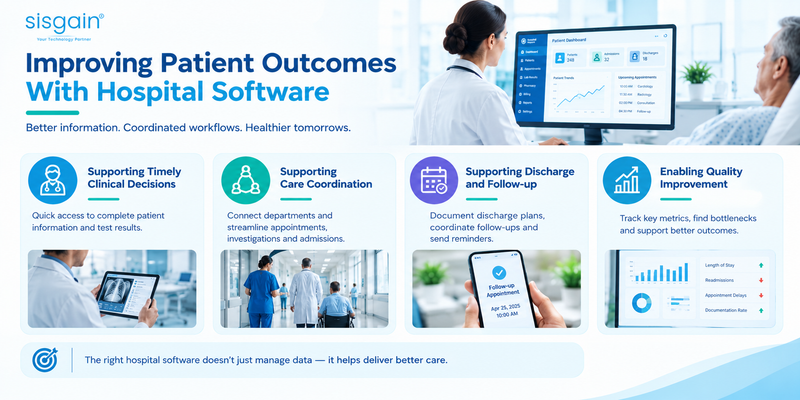
Improving patient outcomes with hospital software involves using reliable information and coordinated workflows to support appropriate care delivery.
An HMS can contribute by helping clinicians and administrators access relevant information, coordinate services, and monitor selected operational or clinical indicators.
Supporting timely clinical decisions
When relevant patient information and test results are available through connected systems, healthcare professionals can review them as part of their clinical assessment.
This may reduce avoidable information delays, provided the data is accurate and reaches the right user at the right time.
Supporting care coordination
A connected workflow can help departments coordinate appointments, investigations, admissions, and discharge activities. Better coordination may reduce unnecessary process delays and improve the overall patient journey.
Supporting discharge and follow-up
Hospital software may help teams document discharge information, coordinate follow-up appointments, and issue reminders where appropriate. Clear discharge documentation and communication can support patients as they continue care outside the hospital.
Enabling quality improvement
Reporting and analytics features can help hospitals review indicators such as appointment delays, length of stay, readmissions, documentation completeness, and workflow bottlenecks.
These metrics require careful interpretation. For example, readmission rates are influenced by patient characteristics, clinical complexity, and wider healthcare factors, so changes should not automatically be attributed to software.
Hospitals should define baseline measurements and evaluate whether the system contributes to measurable improvements over time.
Better Coordination Between Hospital Departments
Hospitals depend on cooperation between clinical and administrative departments. When teams use disconnected applications, information may need to be transferred manually, creating additional work and potential delays.
An HMS can support coordination between departments such as:
- Outpatient services and appointment scheduling
- Emergency and inpatient departments
- Laboratory and diagnostic services
- Pharmacy and medication management
- Billing and insurance teams
- Medical records and administration
- Inventory and procurement
For example, a hospital may configure its system so that an admission triggers relevant administrative tasks, while authorized clinical teams receive access to the appropriate encounter information.
The aim is not to make every department access every record. Instead, the system should provide the right information to the right users for their responsibilities.
Supporting Billing and Insurance Workflows
Administrative delays can affect the patient journey, especially when billing information and insurance documentation require repeated manual handling.
An HMS may support billing, payment tracking, insurance details, and claim-related workflows, depending on its functionality.
More organized insurance processing
Structured digital records can help staff collect and review information needed for insurance submissions. Integration with payer systems or relevant claims platforms may further support the exchange of required information.
Hospitals considering insurance submissions software for hospitals should evaluate the required payer interfaces, validation rules, documentation workflows, and applicable local requirements.
Fewer administrative discrepancies
Automated validation and consistent data entry can help identify missing fields or mismatched information before a submission is processed. These checks can reduce some avoidable administrative errors, although claims may still be rejected for clinical, contractual, eligibility, or other reasons.
Better visibility into billing activity
Dashboards and reports can help authorized teams review pending submissions, payment status, and outstanding administrative tasks. The usefulness of these reports depends on data quality and correct configuration.
Hospital Inventory Management and Patient Care
The availability of medicines, medical supplies, and essential equipment can influence hospital operations. Poor inventory visibility may contribute to stock shortages, expired supplies, or delays in obtaining necessary items.
A hospital management platform with inventory capabilities can help teams monitor stock levels, record usage, track expiry dates, and coordinate purchasing.
Hospitals evaluating a hospital inventory management system Dubai solution should consider the following capabilities:
- Real-time or regularly updated stock visibility
- Batch and expiry-date tracking
- Reorder thresholds and low-stock alerts
- Department-level inventory monitoring
- Purchase orders and supplier records
- Stock movement and audit reporting
For example, an alert about a medicine approaching its expiry date can prompt staff to review stock and take appropriate action under hospital policy.
Inventory software cannot guarantee that every medicine or supply will always be available. Its effectiveness depends on accurate stock records, timely updates, procurement processes, and clear responsibilities.
Choosing Hospital Management Software in the UAE
Selecting the right platform requires more than comparing feature lists. Hospitals should assess how the software fits their clinical workflows, existing infrastructure, regulatory obligations, and long-term objectives.
Organizations evaluating hospital management software UAE should consider these factors.
Clinical and administrative requirements
Identify the workflows that need improvement, such as patient registration, appointment management, records, billing, pharmacy, or discharge coordination.
Integration capabilities
Assess whether the system can connect with existing EHR or EMR platforms, laboratory systems, imaging applications, and other relevant software.
For facilities in Dubai, review the applicable DHA and NABIDH requirements before planning any external health-information exchange.
Security and privacy
Evaluate access control, authentication, audit trails, encryption, backup arrangements, and incident management. Confirm how the provider supports the healthcare organization’s applicable data-protection and regulatory requirements.
Usability and training
A system should be practical for the staff who use it every day. Involve clinical and administrative users in demonstrations, testing, and workflow design.
Scalability and support
Consider whether the software can support future departments, additional locations, new integrations, and changing operational requirements. Review the provider’s maintenance, support, upgrade, and implementation arrangements.
Measurable performance goals
Define what success should look like before implementation. Potential measures include registration time, duplicate-record rates, missing documentation, claim-processing delays, and patient feedback.
A structured evaluation helps hospitals choose a solution based on operational needs rather than features that may not deliver meaningful value.
Best Practices for Implementing an HMS Successfully
A hospital management system is most effective when the implementation process includes both technology and people.
Assess current workflows. Identify bottlenecks, repeated tasks, information gaps, and patient-facing problems before selecting features.
Involve clinical stakeholders. Doctors, nurses, administrative teams, and IT staff should help define requirements and review workflows.
Prioritize data quality. Clean and validate existing records before migration, and establish procedures for managing duplicates and incorrect information.
Test realistic scenarios. Verify registration, clinical documentation, billing, integrations, permissions, downtime procedures, and error recovery.
Train staff before deployment. Provide role-specific training and clear instructions for common tasks and exceptional situations.
Monitor results after launch. Compare performance with baseline measurements, gather staff and patient feedback, and improve workflows based on evidence.
Review security and compliance continuously. Reassess controls and implementation practices as systems, workflows, and applicable requirements evolve.
Conclusion
Hospital management systems can improve patient care by making relevant information easier to access, coordinating departmental workflows, supporting accurate records, and reducing avoidable administrative errors. Features such as appointment management, digital documentation, billing workflows, and inventory monitoring can also help hospitals deliver a more organized patient experience.
However, technology alone does not guarantee fewer medical errors or better clinical outcomes. Hospitals need reliable data, secure system design, trained staff, effective clinical processes, and continuous performance evaluation to achieve meaningful results.
By selecting and implementing hospital management software around clear patient-care objectives, healthcare organizations can build a stronger foundation for efficient operations, coordinated services, and continuous improvement.
Frequently Asked Questions
1. How do hospital management systems improve patient care?
Hospital management systems can improve patient care by supporting faster access to relevant information, better appointment coordination, organized clinical records, and more efficient departmental workflows. The benefits depend on system quality, staff adoption, and how well the software fits clinical processes.
2. Can hospital management software help reduce medical errors?
Yes. Depending on its features and configuration, hospital software can support accurate patient identification, structured documentation, medication information review, and audit trails. It cannot eliminate all medical errors, so clinical safeguards, trained staff, and regular monitoring remain essential.
3. How does an HMS improve the patient experience?
An HMS may improve the patient experience through more organized registration, appointment scheduling, reduced duplicate paperwork, coordinated departmental services, and clearer follow-up workflows. Patient-facing features and effective staff training can further support convenience and communication.
4. What is the role of patient records management software in hospitals?
Patient records management software helps authorized healthcare professionals store, retrieve, update, and review patient information digitally. It can support continuity of care, reduce information gaps, and improve documentation, provided the records remain accurate, secure, and appropriately accessible.
5. How can hospitals measure the impact of hospital management software on patient outcomes?
Hospitals can monitor indicators such as registration time, documentation completeness, duplicate-record rates, appointment delays, discharge-process efficiency, patient satisfaction, and selected clinical quality measures. Results should be compared with a baseline and interpreted alongside other factors that affect patient outcomes.