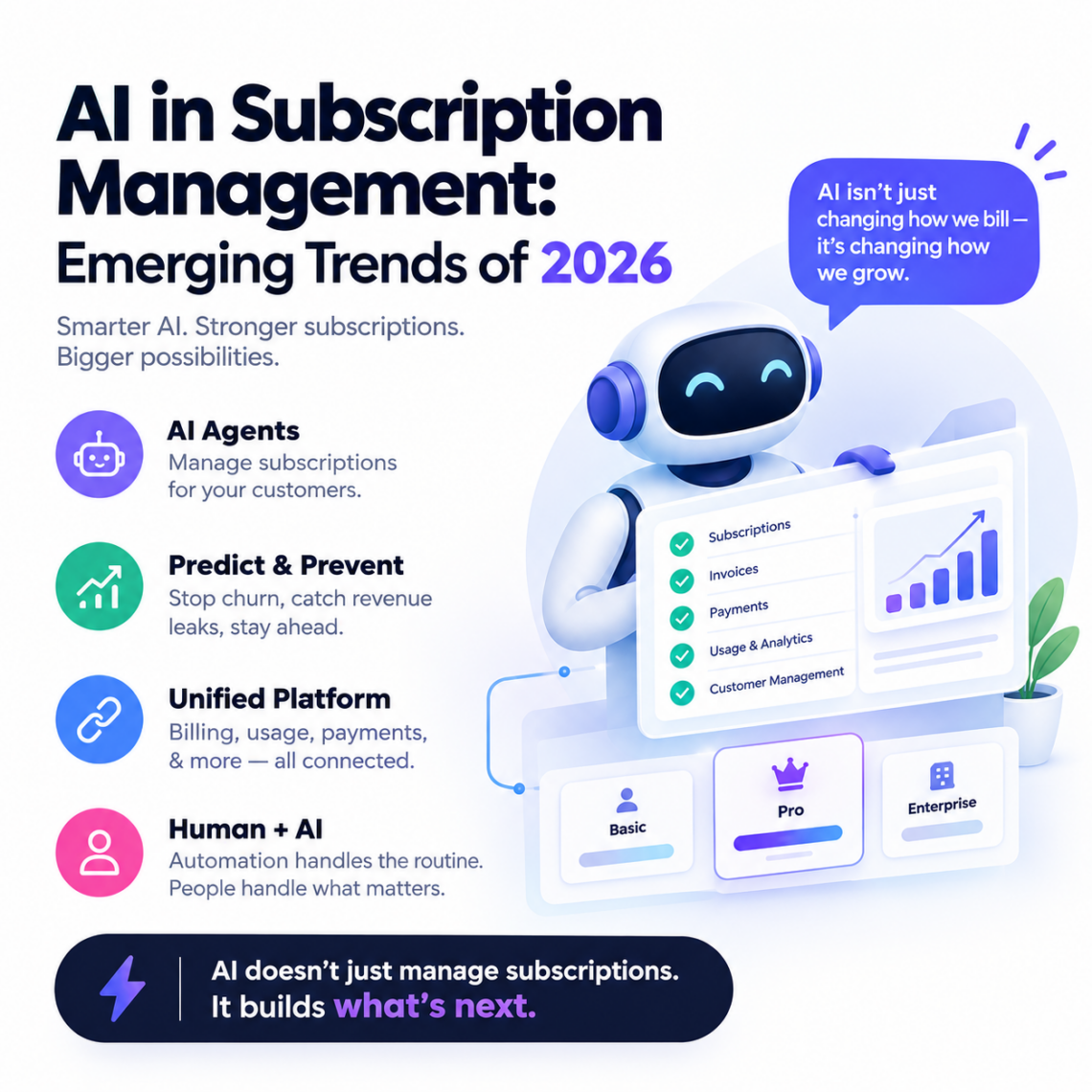
Subscription businesses have become a major part of the modern economy. Consumers now pay recurring fees for everything from streaming platforms and software to meal kits, fitness services, financial products, and consumer goods. This shift has created significant opportunities for businesses, but it has also made subscription operations more complex.
As companies grow, they have to manage more subscribers, pricing models, payment methods, renewals, upgrades, cancellations, and usage patterns. Artificial intelligence is increasingly being introduced to manage this complexity. In 2026, AI is moving beyond simple chatbots and recommendations into billing, payment recovery, revenue management, contract analysis, churn prediction, pricing, compliance, and customer lifecycle management.
The biggest change is that AI is becoming part of connected business workflows. Instead of simply providing suggestions, AI systems can monitor activity, identify problems, recommend actions, and, within defined limits, execute tasks automatically.
The Subscription Industry Is Moving Toward Enterprise-Scale AI
In 2026, businesses are increasingly moving from small AI experiments toward wider enterprise adoption. For subscription companies, this means replacing some traditional, rule-based processes with systems that can continuously analyze information and respond to changing circumstances.
Instead of relying only on fixed payment-retry schedules, standard dunning messages, or manual month-end reconciliation, companies can use AI to identify patterns and determine which action is most appropriate. This allows subscription teams to respond to customer and financial events more quickly.
However, the emerging model is not about completely replacing human employees. Human supervision remains important, particularly for financial, regulatory, and customer-impact decisions. AI can manage repetitive tasks while people establish rules, review exceptions, and approve high-risk actions.
AI Agents Are Changing the Subscription Customer Journey
One of the most important developments in subscription commerce is the rise of AI agents that can act on behalf of consumers. Traditionally, customers visited a company’s website, compared plans, selected a subscription, completed payment, and managed their accounts directly.
AI agents can increasingly perform some of these activities for customers. They can research products, compare subscription plans, make purchases, and potentially manage ongoing services. This creates a new requirement for subscription platforms because they need to support not only human interactions but also authorized AI-driven transactions.
For example, an AI agent could determine that a customer would benefit from changing their subscription tier. The subscription platform would need to provide structured information about plans, pricing, eligibility, discounts, and add-ons. Once authorized, the platform could process the change, calculate prorations, update billing, and manage future renewals.
This is creating a new concept of agent-ready subscription commerce. Subscription platforms will increasingly need secure ways for AI agents to discover, purchase, modify, pause, upgrade, downgrade, and cancel subscriptions while businesses maintain control over permissions and billing rules.
AI Is Making Revenue Leakage Detection More Proactive
Revenue leakage is a common challenge for subscription businesses. A discount may remain active longer than intended, a usage event may not reach the billing system, or a contract amendment may fail to appear correctly on an invoice. These issues can remain unnoticed until finance teams perform reconciliation.
AI can change this process by continuously comparing contracts, usage information, billing records, and invoices. Instead of waiting until the end of the month, intelligent systems can identify unusual patterns and potential discrepancies closer to the moment they occur.
Contract analysis is particularly valuable in this area. AI can review contracts, amendments, and related documents to identify pricing terms, discounts, usage commitments, billing schedules, and renewal conditions. These details can then be connected to billing workflows, helping businesses reduce manual work and identify potential revenue leakage earlier.
Pricing Is Becoming More Usage-Based
Traditional SaaS pricing has often been based on seats or users. However, AI is challenging this model because a single AI system can potentially perform tasks that would previously have required several human users.
As a result, businesses are exploring pricing models based on credits, usage, completed actions, and outcomes. These models can better connect the amount customers pay with the value they receive, but they also make billing more complicated.
A traditional subscription might generate one simple recurring charge. An AI product, however, may generate hundreds or thousands of usage events. Customers may need to understand how many credits they consumed, which features they used, and how different pricing tiers affected their invoice.
AI can help by analyzing usage data, identifying unusual consumption, explaining invoice calculations, and warning customers before they reach usage limits. This can make complex billing easier for customers to understand and easier for businesses to manage.
AI Can Simulate Billing Changes Before They Happen
Another emerging use of AI is financial simulation. Traditionally, a business might change a contract, apply a discount, modify an allocation, or introduce a new pricing arrangement and only discover the financial consequences afterward.
AI-powered systems can reverse this process by showing the potential impact before a change is implemented. They can analyze how a proposed modification could affect invoices, revenue schedules, discounts, allocations, and other financial calculations.
This can be particularly useful for businesses managing complex subscription contracts. Finance teams can review the proposed impact before approving the change, reducing the risk of incorrect invoices, unnecessary credit notes, or accounting adjustments.
Sales teams can also benefit because they can understand whether proposed pricing or discount arrangements can actually be supported by the billing infrastructure before making commitments to customers.
AI Retention Must Work Alongside Cancellation Compliance
AI is becoming increasingly useful for identifying customers who may be at risk of churn. Changes in product usage, payment problems, reduced engagement, or other behavioral signals can help businesses identify customers who may be considering cancellation.
Once a potential churn risk is identified, AI can help recommend an appropriate response. Depending on the situation, this could involve additional support, a plan adjustment, a pause option, or a personalized retention offer.
However, retention cannot come at the expense of cancellation rights. Subscription businesses operate under different consumer-protection and automatic-renewal requirements depending on the jurisdiction.
For this reason, retention and cancellation should be treated as separate processes. AI can identify customers who may benefit from an offer, but cancellation workflows should remain clear, accessible, and compliant with the applicable rules.
Revenue Recognition and Audit Trails Matter More Than Ever
The growth of usage-based and outcome-based pricing is also creating new accounting challenges. Businesses need to determine when revenue should be recognized based on the terms of each customer contract and the nature of the service being provided.
As AI systems become involved in billing and revenue processes, maintaining a clear audit trail becomes increasingly important. Businesses need to understand what an AI system did, what information it used, and whether a human reviewed or approved the action.
AI should therefore not operate as a black box for critical financial processes. Automated actions should generate appropriate records that finance, compliance, and audit teams can review when necessary.
Customer Support Is Becoming More Proactive
AI is also changing how subscription companies approach customer support. Traditional chatbots mainly respond when customers ask questions. The emerging approach is more proactive, with AI systems monitoring the customer lifecycle and identifying problems before customers need to contact support.
For example, if a renewal payment fails, an AI system could identify the issue, initiate an appropriate payment-recovery workflow, and notify the customer. If product usage suddenly declines, the system could identify the change and recommend a pause, plan adjustment, or support intervention.
This approach can improve the customer experience because businesses can address problems before they turn into complaints or cancellations. Instead of simply responding to customer problems, subscription companies can increasingly work to prevent them.
How Subscription Businesses Can Start Using AI
Businesses do not need to automate every subscription process immediately. A practical starting point is to focus on areas where the financial or operational impact can be measured clearly.
Failed-payment recovery, billing exceptions, invoice anomalies, revenue leakage, and churn are all potential starting points because businesses can establish a baseline and measure improvement over time. Starting with a focused use case also makes it easier for teams to understand how AI performs in their specific environment.
Data quality should be another priority. AI systems need accurate customer, contract, billing, payment, and usage information. If the underlying data is incomplete or inconsistent, AI may simply automate existing problems.
Businesses should also establish clear autonomy levels. Some actions can be fully automated, while others should require approval. High-impact activities involving refunds, contract changes, pricing exceptions, or compliance decisions may require human oversight.
The Future of AI in Subscription Management
AI in subscription management is moving from individual features toward connected systems that operate across billing, finance, revenue, and customer lifecycle processes.
At the same time, subscription businesses may increasingly have to serve two types of AI systems: their own internal agents and AI agents acting on behalf of customers. This could fundamentally change how subscriptions are discovered, purchased, managed, renewed, and canceled.
The opportunity is significant, but businesses need to approach AI with the right balance of automation and oversight. Clean data, clear rules, transparent processes, and reliable audit trails will become increasingly important as AI takes on more operational responsibility.
The future of subscription management will not necessarily belong to the companies using the most AI. It will belong to businesses that use AI where it creates measurable value while maintaining customer trust, financial accuracy, regulatory compliance, and meaningful human oversight.
Conclusion
AI is becoming a core part of the subscription technology landscape in 2026. From intelligent billing and payment recovery to agent-driven commerce, dynamic pricing, revenue monitoring, churn prediction, and proactive customer support, AI is changing how subscription businesses operate.
The most successful implementations will combine intelligent automation with reliable data and clearly defined controls. When implemented responsibly, AI can help subscription companies reduce operational complexity, protect revenue, improve customer experiences, and build more scalable recurring-revenue businesses.