Children are growing up surrounded by technology. They use computers, tablets, websites, games, and mobile applications every day, but using technology and understanding how it works are two different things. Learning to code can give children an opportunity to become creators rather than simply consumers of digital technology.
For parents, however, choosing the right learning program can be difficult. There are many programming languages, teaching formats, age groups, and course options available. A program that works well for a teenager may not be appropriate for a young beginner.
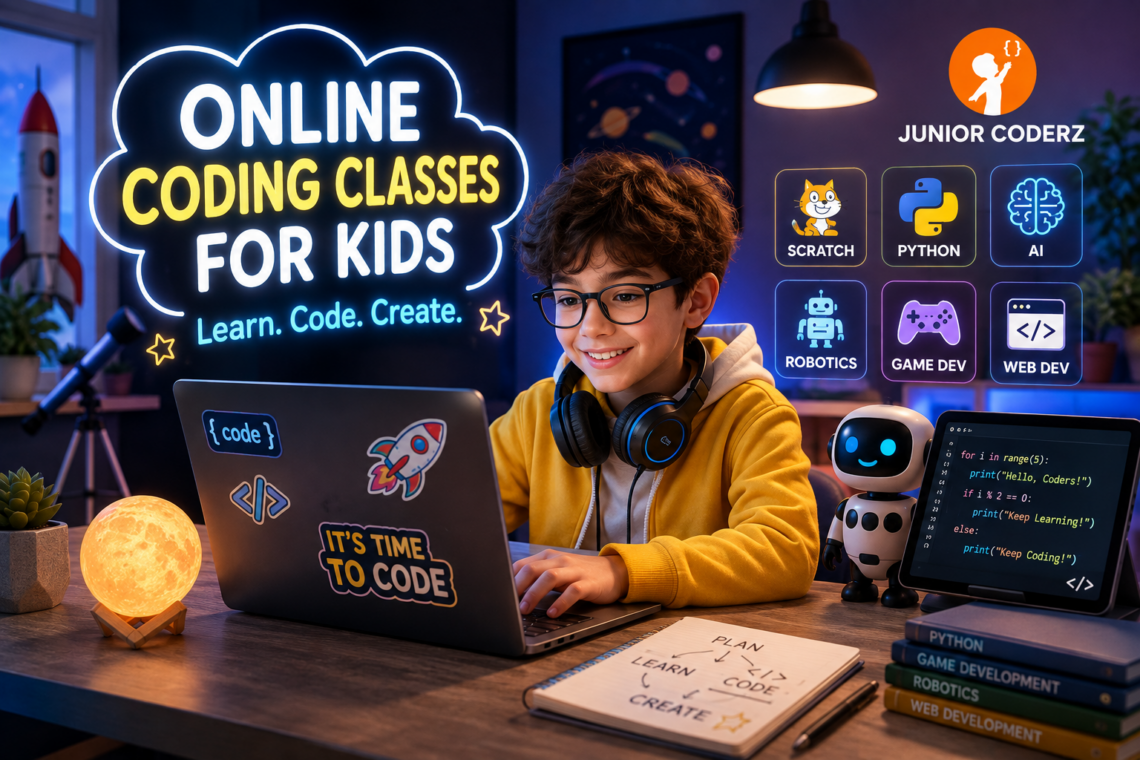
Online coding classes for kids can provide a structured way for children to explore programming from home while learning at a level suited to their age and experience. Junior Coderz offers age-specific programs for children and teens ages 6–18, with learning paths that range from beginner coding to advanced programming, artificial intelligence, web development, game development, and other technology subjects.
Why Children Can Benefit From Learning Coding
Coding is more than learning a programming language. It involves understanding problems, creating logical steps, testing ideas, and improving solutions.
When children work on coding projects, they can practice skills such as:
- Logical thinking
- Problem-solving
- Creativity
- Sequencing
- Debugging
- Planning
- Experimentation
- Technical communication
A project-based approach can also make learning more engaging. Instead of only studying programming concepts, students can apply them to games, websites, applications, animations, or other digital creations.
The process of building something can encourage children to ask questions and experiment with different solutions.
What Makes Online Coding Classes Different?
Online learning gives children the opportunity to study programming without needing to travel to a physical classroom. This can make technology education more accessible for families with different schedules and locations.
However, effective online learning still requires more than simply providing video lessons.
Children can benefit from structured instruction, interaction with an instructor, practical activities, and a clear progression from one concept to the next.
Junior Coderz describes its classes as interactive and engineer-led, with experienced technology professionals providing personalized guidance. Its teaching approach also includes structured lessons, hands-on projects, and progress tracking.
Choosing a Program Based on Age
One of the most important considerations when selecting coding education is the child’s age.
A young learner may need visual programming and simple projects, while an older student may be ready for Python, JavaScript, artificial intelligence, or more advanced programming concepts.
Junior Coderz organizes its curriculum into age-specific programs, ranging from Tiny Techies for ages 6–7 to Algorithm Avengers for learners ages 14 and above.
This type of progression can help children learn concepts at an appropriate level rather than being introduced to advanced material too early.
Introducing Coding to Ages 6–7
Young children can begin learning programming through visual and creative activities.
Junior Coderz’s Tiny Techies program is designed for ages 6–7 and is listed as a beginner-level course. It covers basic coding, computer skills, logical thinking, typing, and beginner game development through block-based coding. The program includes 48 classes over six months.
Block-based coding can make programming concepts easier to visualize because children work with graphical instructions rather than starting with complicated text-based syntax.
At this stage, coding education can focus on developing curiosity, confidence with technology, and an understanding of basic programming logic.
Expanding Skills at Ages 8–10
As children become more comfortable with computers and coding concepts, they can explore a wider range of technology.
Junior Coderz’s Junior Inventors program is designed for ages 8–10 and includes Python, virtual robotics, artificial intelligence, 3D modeling, game development, electronics, and web and app development.
Exposure to different technology areas can help children discover what interests them.
One child might enjoy designing games, while another could become fascinated by robotics, artificial intelligence, digital design, or websites.
This exploration can be useful before students begin focusing more deeply on a particular programming language or technology.
Building Stronger Programming Skills at Ages 11–14
Older children can begin working with more advanced programming concepts and text-based languages.
Junior Coderz offers several programs for ages 11–14, including Code Champions, Python Hybrid, and Python Pioneers. These programs vary in focus and difficulty, allowing students to explore programming at different levels.
Code Champions combines Python with subjects such as virtual robotics, AI, 3D modeling, game development, electronics, and web and app development.
Python Hybrid takes a more advanced approach by combining advanced Python with AI, robotics, game development, electronics, 3D modeling, and web and app development.
Python Pioneers provides a more focused Python pathway covering fundamentals, advanced Python, graphics, debugging, and object-oriented programming.
Why Python Can Be a Useful Next Step
Python is an important programming language for students who want to move beyond introductory block-based coding.
Its applications extend across software development, automation, artificial intelligence, and many other areas of technology.
A structured Python program can introduce learners to concepts such as variables, functions, loops, conditions, debugging, and object-oriented programming.
Junior Coderz’s Python-focused programs give students different ways to develop these skills. Python Pioneers, for example, progresses from Python fundamentals toward advanced concepts such as object-oriented programming, while Python Hybrid connects Python with AI, automation, and interactive applications.
Learning Through Game Development
Games can be an engaging way to apply programming concepts.
Creating a game requires students to think about rules, characters, movement, interaction, scoring, and user input. Each feature can provide an opportunity to practice programming logic.
Junior Coderz incorporates game development into multiple programs, including Junior Inventors, Code Champions, Python Hybrid, and advanced learning paths.
For children who already enjoy games, learning how games are created can turn an existing interest into a practical technology project.
Exploring Web Development
Web development introduces students to another side of programming.
Children can learn how websites are structured, styled, and made interactive. As students progress, they can encounter technologies such as HTML, CSS, and JavaScript.
Junior Coderz includes web development in several programs, with HTML, CSS, and JavaScript specifically appearing in the advanced Algorithm Avengers curriculum.
Creating a website can also provide students with a visible result of their work. They can see how code affects the layout, appearance, and behavior of a digital page.
Creating Apps
Application development can help children connect programming with everyday technology.
An app project requires students to consider both functionality and user experience. They can think about what the application should do, how users will interact with it, and how programming can make those interactions possible.
App development is included in several Junior Coderz programs, including Junior Inventors, Code Champions, Python Hybrid, and AI Hybrid.
This type of project-based learning can help students understand how individual programming concepts contribute to a larger product.
Exploring Robotics and Electronics
Coding can also extend beyond websites and software.
Robotics and electronics can demonstrate how programming connects with physical systems. Students can explore how instructions and logic can influence technological devices and systems.
Virtual robotics and electronics are included in several Junior Coderz learning paths. These subjects are combined with programming and other STEM areas to create a broader technology-learning experience.
For children interested in engineering, machines, or building things, these subjects can provide another way to apply programming knowledge.
Introducing Artificial Intelligence
Artificial intelligence is becoming an important area of technology education.
Junior Coderz includes AI in several age-based programs and also offers an AI Hybrid course for learners ages 8–16. The program covers generative AI, prompt engineering, machine learning fundamentals, Python programming, Cursor IDE, n8n automation, and app and web development.
The course also focuses on practical projects involving intelligent applications, chatbots, automated workflows, AI models, and modern coding tools.
Introducing AI through projects can help students understand how programming and artificial intelligence can work together.
Developing Digital Design Skills
Technology education can also involve visual and three-dimensional design.
3D modeling gives students an opportunity to explore digital objects and environments while developing spatial and creative thinking.
Junior Coderz incorporates 3D modeling into several of its programs. More advanced students can also encounter tools such as Blender and SolidWorks in the Algorithm Avengers curriculum.
Combining design with coding can be especially useful for students who enjoy both creative and technical activities.
The Importance of Hands-On Projects
One of the strongest ways to reinforce programming concepts is to use them in projects.
A student might learn a programming concept and then apply it to a game, application, animation, website, or other creation.
Projects can also teach students that programming is an iterative process. A first attempt may not work perfectly, so learners need to test, identify problems, make adjustments, and try again.
Junior Coderz describes its approach as interactive and project-focused, with students building apps, games, and 3D models.
Learning From Experienced Instructors
Instructor support can be particularly valuable when children are learning technical subjects.
Programming mistakes can sometimes be difficult for beginners to understand. A knowledgeable instructor can help students identify where they went wrong and explain how to approach the problem differently.
Junior Coderz states that its instructors are experienced engineers from the technology industry and that classes include personalized guidance.
This approach can give students opportunities to ask questions and receive guidance instead of trying to solve every challenge independently.
Tracking a Child’s Progress
Parents may also want to understand how their child is progressing.
A structured learning program can make development easier to observe by providing lessons, activities, projects, and milestones.
Junior Coderz highlights progress tracking through quizzes, report cards, and month-end competitions. Its structured lessons are designed to keep students engaged while helping parents remain informed about learning progress.
Progress tracking can also help identify areas where a student may need additional practice or where they are ready for a greater challenge.
Making Coding Enjoyable
Children often learn best when they are interested in what they are doing.
Coding does not have to feel like memorizing technical instructions. Games, animations, applications, websites, robotics, and AI projects can make programming more creative and interactive.
Junior Coderz describes its learning experience as fun, engaging, and future-ready, with projects intended to encourage creativity and problem-solving.
When students are encouraged to experiment and build their own ideas, they can begin to see programming as a creative tool rather than simply another academic subject.
How Parents Can Compare Online Coding Programs
Before selecting a program, parents can consider a few practical questions.
Is the program suitable for the child’s age?
Look for lessons that match the student’s current experience. A beginner needs different material from an experienced teenager.
Does the program offer practical projects?
Children can benefit from applying concepts rather than only watching demonstrations.
Is there a clear learning progression?
A good program should provide opportunities to move from foundational concepts toward more advanced subjects.
Are instructors available to help?
Interaction and personalized guidance can make difficult programming concepts easier to understand.
Does the curriculum match the child’s interests?
Some children may prefer games, while others enjoy Python, robotics, web development, design, or AI.
Is progress visible?
Quizzes, projects, feedback, or other milestones can help parents understand how the learner is developing.
Building a Long-Term Learning Path
Coding education can become more valuable when it develops gradually.
A child may begin with block-based coding at a young age, move into broader technology subjects, and eventually specialize in Python, web development, AI, game development, or another area.
Junior Coderz’s age-based curriculum is designed around this type of progression, with courses ranging from beginner programs for ages 6–7 to expert-level learning for students ages 14 and above.
This allows students to develop foundational skills before taking on increasingly challenging concepts.
Encouraging Creativity Alongside Technical Skills
Technical knowledge is only one part of technology education.
Children also need opportunities to think creatively and develop their own ideas.
A programming assignment can become more meaningful when students are allowed to decide what they want to build. They might create a game based on an original idea, design a website around a personal interest, or experiment with an AI-powered project.
This combination of creativity and programming can encourage children to see technology as something they can shape and use to express ideas.
Online Learning From Home
One of the practical advantages of online coding classes is that students can learn from their own home environment.
This can make technology education easier to incorporate into a family’s schedule. Children can attend classes without traveling to a physical location, while parents can remain nearby when needed.
Online learning can also connect students with instructors and educational programs beyond their immediate local area.
For families looking for a structured technology program, this flexibility can make coding education more accessible.
Preparing for Future Technology Learning
Children who develop an early understanding of programming can have a foundation for exploring more advanced technology later.
The purpose is not necessarily to decide a child’s future career at a young age. Instead, early coding education can introduce concepts and skills that may become useful across many areas of technology.
Programming, problem-solving, digital design, AI, and logical reasoning can all contribute to a broader understanding of how modern technology works.
Junior Coderz aims to give children early exposure to technology while providing learning paths that continue into more advanced subjects.
Conclusion
Choosing online coding classes for kids is about finding a learning experience that matches a child’s age, interests, experience, and pace.
A strong program can introduce programming gradually, combine lessons with hands-on projects, provide instructor guidance, and offer opportunities for students to explore different areas of technology.
Junior Coderz provides age-specific online coding programs for children and teens ages 6–18, covering subjects such as Scratch, Python, game development, web and app development, robotics, electronics, 3D modeling, artificial intelligence, and machine learning.
From beginner-friendly block-based coding to advanced Python, JavaScript, AI, and digital design, students can follow different learning paths as their skills develop. The combination of structured lessons, project-based activities, professional instructors, and progress tracking gives families a framework for supporting a child’s technology education.
For parents considering coding education, the best starting point is usually the program that feels appropriate for the child’s current level while leaving room for future growth. With the right guidance and opportunities to create, coding can become an enjoyable way for children to learn, experiment, and develop confidence with technology.