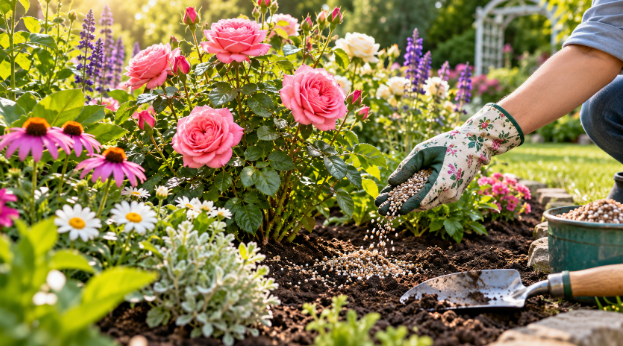
Flowering plants need more than sunlight and water to perform well throughout the growing season. Soil must supply essential nutrients that support foliage, roots, stems, and flowers. When available nutrients become limited, plants may show slower growth, pale foliage, fewer blooms, or reduced overall vigor. Fertilization can help replenish nutrients and maintain a productive growing environment when used appropriately.
Selecting the right fertilizer for flowering plants starts with understanding what the plants need and how different nutrient ratios support different stages of growth. Roses and other flowering plants can benefit from balanced nutrition, while the application method, soil condition, plant variety, and growing environment should also be considered.
Understanding the Main Plant Nutrients
Most fertilizer for flowering plants provide three primary macronutrients: nitrogen, phosphorus, and potassium. These nutrients perform different functions within plants.
Nitrogen is closely associated with vegetative growth and helps support healthy leaves and stems. Phosphorus plays an important role in root development and reproductive processes, including flowering. Potassium contributes to overall plant strength and several physiological functions.
The numbers printed on a fertilizer package represent the percentages of nitrogen, phosphate, and potash, respectively. A 7-5-3 fertilizer, for example, contains 7% nitrogen, 5% phosphate, and 3% potash.
Understanding this ratio can help gardeners compare products and choose nutrition appropriate for their plants.
Why Flowering Plants Need Consistent Nutrition
Fertilizer for flowering plants requires energy and resources from the plant. A plant that is actively producing foliage, developing buds, and opening flowers may have different nutritional demands from a plant that is dormant or newly established.
However, adding more fertilizer does not automatically result in more flowers. Excessive fertilization can create nutrient imbalances and may contribute to unwanted vegetative growth or other plant problems. Soil condition, watering, sunlight, and drainage remain important parts of successful flower gardening.
A sensible feeding program considers all these factors rather than relying on fertilizer alone.
Choosing a Formula for Roses and Flowers
Roses have specific nutritional requirements, but they are not the only plants that benefit from fertilizer formulated for flowering growth. Gardeners may use targeted products for roses, annual flowers, flowering perennials, and other ornamental plants.
The product is supplied as a 4-pound fertilizer and is designed to be mixed with soil followed by thorough watering. The manufacturer’s instructions should always be followed for application rates and specific growing conditions.
Organic-Enriched Fertilizer and Soil Health
Organic-enriched fertilizers can provide nutrients while contributing organic material to the growing environment. Neem-based ingredients are commonly used in WonderTree Organics’ fertilizer range, reflecting the company’s focus on natural soil and plant nutrition.
Soil health is important because roots depend on a suitable physical and biological environment to obtain water and nutrients. Organic matter can support soil structure and microbial activity, although the exact effect depends on soil composition, application practices, moisture, and other conditions.
Gardeners should therefore view fertilizer as one part of an overall soil-management strategy rather than a replacement for good growing practices.
How to Apply Flower Fertilizer
Application instructions vary between fertilizer products, so the product label should always be the primary guide. For WonderTree Organics’ Rose & Flower fertilizer, the recommended approach is to mix the fertilizer thoroughly with soil and water well after application.
Gardeners should avoid guessing application rates based on another fertilizer. Different formulas have different nutrient concentrations, and plants can respond differently depending on their growing conditions.
It is also important to apply fertilizer to suitable soil and avoid placing concentrated fertilizer directly against sensitive plant tissues unless the product instructions specifically allow it.
Other Factors That Influence Flowering
Fertilization is only one component of successful flowering. Plants also require appropriate sunlight, water, temperature, drainage, and growing space.
Roses, for example, generally perform best when their growing conditions match the requirements of their variety. Poor drainage can affect roots, while insufficient sunlight can limit flowering even when adequate nutrients are available.
Pruning can also influence the growth and flowering habits of certain plants. Gardeners should therefore consider the complete growing environment when flowers are not developing as expected.
Fertilizing Plants in Containers
Container-grown flowers can have different nutritional considerations from plants growing directly in garden soil. Because containers contain a limited volume of growing medium, nutrients may become depleted more quickly depending on watering frequency and plant growth.
At the same time, fertilizer can accumulate when products are overapplied. Following the recommended rate and maintaining appropriate watering and drainage can help reduce these problems.
Before feeding container plants, gardeners should check whether the potting mix already contains fertilizer and determine whether additional feeding is necessary.
Building a Practical Flower-Garden Routine
A successful fertilization routine should begin with observation. Look at the plant’s growth, foliage color, flowering pattern, soil condition, and watering habits before deciding that fertilizer is needed.
Soil testing can also provide useful information about nutrient levels and pH. When deficiencies are suspected, testing is generally more informative than applying additional fertilizer without knowing what the soil lacks.
Once the needs are understood, gardeners can select a suitable formula, follow its application instructions, and monitor the plants over time. This approach helps keep fertilization purposeful rather than excessive.
Conclusion
Healthy flowering depends on more than simply adding nutrients. Plants need suitable sunlight, water, drainage, soil conditions, and consistent care alongside an appropriate feeding program. A rose and flower fertilizer can provide a nutrient ratio intended for plants grown primarily for their blooms. A 7-5-3 formulation such as WonderTree Organics’ Rose & Flower fertilizer provides nitrogen, phosphate, and potash for gardeners caring for roses and other flowering plants. Following label directions, observing plant response, and considering overall soil health can help create a more balanced approach to flower gardening.