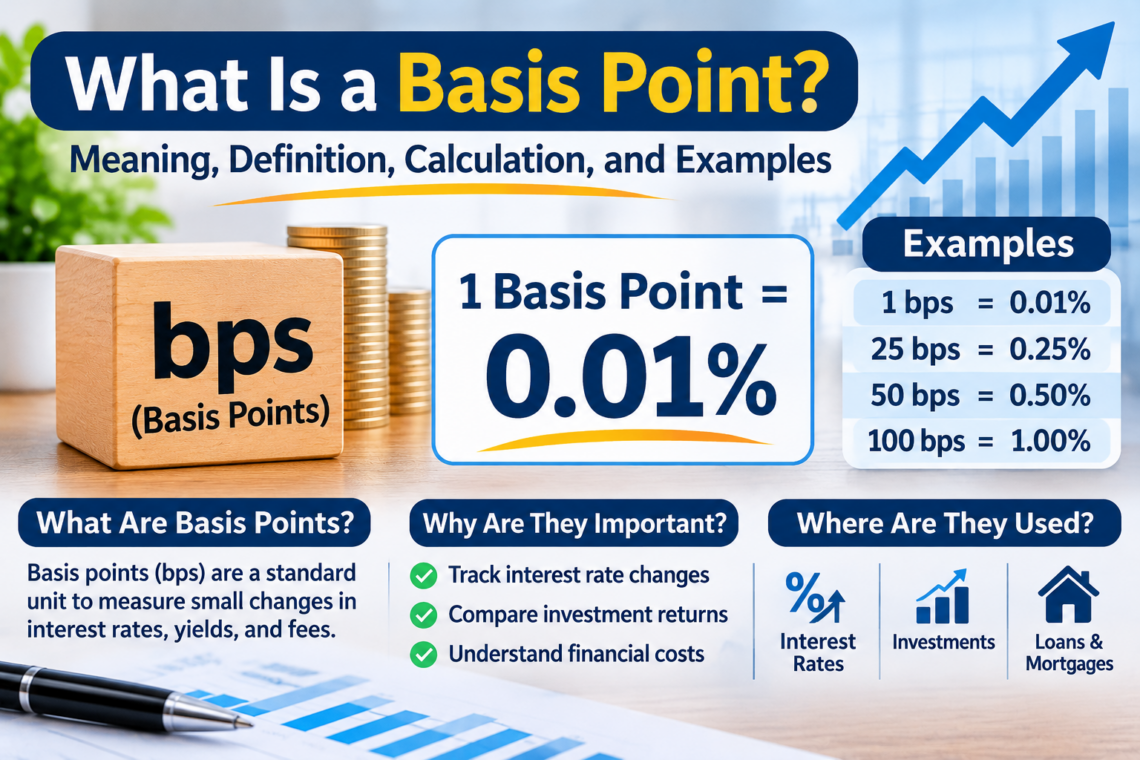
Financial terminology is crucial for trading, investors, and business owners. A basis point is one of the terms in finance that is commonly used. What is a basis point? It’s a typical unit for measuring interest rate changes, investment returns, bond yields and financial fees. A basis point is equal to 0.01% or 1/100th of a percent.
In the financial world, basis points are frequently referred to as bp, bps, or bips. While a basis point is a small amount, it can mean a very big deal when it comes to investments, loans, and business finances. From analyzing investment returns to tracking financial data via expert bookkeeping cloud services, comprehending basis points can aid in making more informed financial choices.
What Are Basis Points and What Does BPS Mean in Finance?
The basis point definition is a measurement unit that is used to express small changes in percentages. One basis point is equal to 0.01% and 100 basis points will be equal to 1%.
So, what is bps, and why is it important? BPS is a term that is used to denote basis points and is helpful to financial professionals in communicating interest rate changes without confusion. For instance, a rise in interest rate from 5% to 5.25% is said to be a 25 basis point rise.
The concept of basis points is especially helpful when comparing financial products, investment and borrowing rates. Rather than state that an interest rate rose by 0.25 percentage point, financial professionals can simply declare it rose by 25 bps.
The other important question that might be asked is what is a basis point in finance? It is a method to assess exact percentage changes in the financial markets. Frequently, changes in bond yields, mortgage rates, mutual fund expense ratios and more are expressed in basis points.
Generally basis points and bips are the same measure. They render the communication of money easier as even the slightest changes can be clearly communicated and accurately.
How to Calculate Basis Points Using a BPS Calculator?
Once you know how to convert percentages to bps, it’s quite easy to calculate. If you want to find the percentage change in basis points, multiply the percentage points gap by 100.
For instance, if the rate of interest goes up from 4% to 4.75%, This is 0.75 percentage point different. 75 basis points is equal to 0.75 x 100.
This calculation can be done quicker with a basis point calculator or bps calculator. These tools can come in handy for investors, financial analysts and business owners who are constantly checking interest rates and investment returns.
Here are some quick examples:
- 1 basis point = 0.01%
- 10 basis points = 0.10%
- 25 basis points = 0.25%
- 50 basis points = 0.50%
- 100 basis points = 1%
When analyzing financial reports, a basis calculator can also be useful to convert bps to percentage. For instance, 150 basis points equal to a change of 1.50 percentage points.
Remember, basis point is referring to a difference in percentage, NOT a percentage change from the original value. This separation assists in avoiding errors in financial calculations.
In the end, understanding what a basis point is and know the meaning of bps can enhance your financial knowledge. Whether you’re assessing investment options, monitoring interest rates or analyzing business costs, basis points offer a simple and precise method to gauge changes in the financial world.
For more details visit us – Accountance