
Processing customer payments efficiently forms the backbone of operational success for brick-and-mortar businesses. When checkout lines move smoothly, customer satisfaction rises, and transaction processing costs remain predictable. However, managing legacy terminal hardware, complex fee structures, and fragmented sales channels frequently creates operational drag for store owners and operators.
Adopting integrated merchant services streamlines daily accounting, reduces human entry error, and protects sensitive customer card data. Understanding how specialized hardware and software components interact allows business owners to choose payment processing setups that align directly with their daily transaction volume and inventory workflows.
Streamlining Restaurant Operations with Modern Terminals
Food service environments operate under strict time constraints. High-volume dining establishments require processing hardware that connects floor management, kitchen display systems, and payment collection seamlessly.
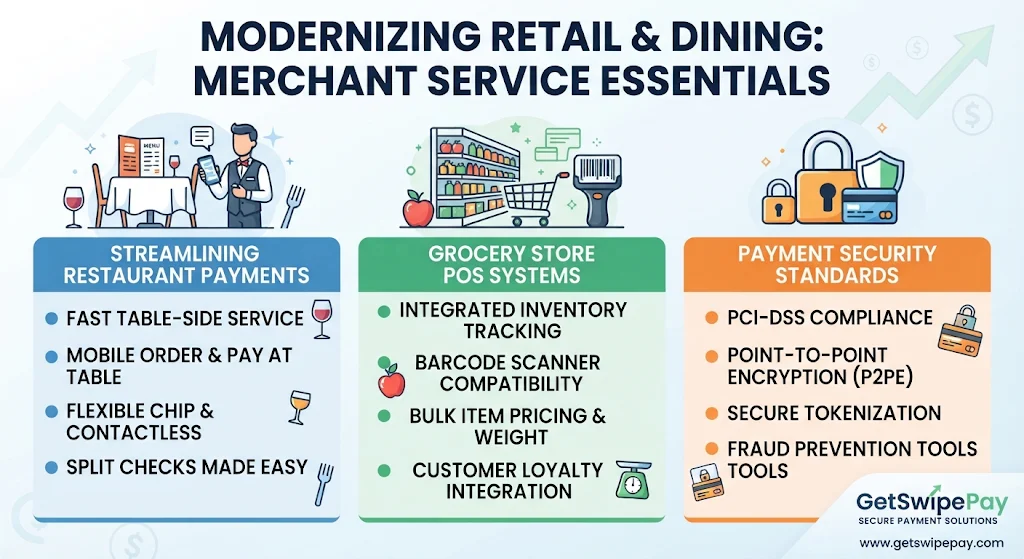
- Speed at Checkout: Rapid authorization times keep front-of-house lines moving during peak meal rush periods.
- Flexible Payment Methods: Accepting contactless payments, mobile wallets, chip cards, and traditional magnetic stripe swipes ensures no sale is lost due to payment limitations.
- Order and Pay at Table: Mobile handheld readers allow servers to close out checks right at the table, increasing table turnover rates and reducing trip times between dining rooms and main terminals.
Implementing a robust setup tailored specifically for restaurant payment processing ensures that order modifications, split checks, and gratuity payouts sync directly into daily balance sheets without manual reconciliation errors.
Optimizing High-Volume Retail Checkout Systems
Supermarkets, convenience stores, and specialized food markets handle large stock-keeping unit (SKU) counts and continuous foot traffic. Payment processing systems in these environments must integrate tightly with barcode scanners, digital weight scales, and inventory databases.
Core Features of Retail Checkout Systems
Retail operations require specialized terminal setups designed to handle complex inventories and multi-lane setups efficiently.
- Inventory Tracking Integration: Real-time balance updates adjust stock levels instantly as items pass through the check-stand.
- Bulk Pricing and Barcode Scanning: Integrated scale pricing and custom unit calculations keep transaction times short for produce and bulk goods.
- Customer Loyalty Integration: Automatic balance lookups apply promotional pricing and point accruals directly to customer transactions at checkout.
Deploying a reliable grocery store pos system provides retail managers with accurate sales audit trails while maintaining steady traffic flow through multi-lane register queues.
Key Technical Standards for Payment Security
Protecting customer cardholder data reduces financial exposure to fraudulent transactions, chargebacks, and regulatory non-compliance penalties.
Modern transaction systems rely on multi-layered security protocols to safeguard electronic payments across wired and wireless networks:
- PCI-DSS Compliance: Adhering to the Payment Card Industry Data Security Standard protects merchant infrastructure against network vulnerabilities.
- Point-to-Point Encryption (P2PE): Encrypts payment card data immediately upon swiping, tapping, or dipping, preventing raw data from entering internal networks.
- Tokenization: Replaces sensitive card numbers with random alphanumeric identifiers during transaction processing, protecting recurring billing and stored customer profiles.
Upgrading legacy terminals to security-compliant processing units protects customer trust and lowers merchant risk exposure across all sales channels.
Strategic Selection of Merchant Service Providers
Selecting an ideal merchant processing partner requires evaluating interchange models, hardware compatibility, and recurring service fees.
Transparency in Interchange Pricing
Merchant service costs vary based on card types, authorization methods, and pricing structure models.
- Interchange-Plus Pricing: Separates actual credit card network fees from processor markups, giving merchants clear visibility into true processing overhead.
- Flat-Rate Pricing: Simplifies accounting by applying a single percentage rate to all card types, which works well for lower-volume operations.
- Tiered Fee Structures: Groups transactions into qualified, mid-qualified, and non-qualified tiers, which can sometimes obscure actual processing margins.
Partnering with established providers such as Get Swipe Pay helps business owners establish cost-effective payment structures, eliminate unexpected monthly fee adjustments, and secure reliable hardware support.
Maintaining Operational Reliability and Performance
Hardware failures or network downtime directly translate to lost revenue and customer frustration. Building resilience into payment processing infrastructure safeguards daily cash flow.
To prevent transaction outages during peak store hours, operators focus on three infrastructure essentials:
- Dual-Connectivity Hardware: Equipment featuring cellular fallback alongside main broadband lines keeps payment processing active during internet outages.
- Offline Transaction Processing: Terminal capabilities that store encrypted authorization requests locally ensure sales continue during temporary network losses.
- Responsive Technical Support: Access to dedicated technical assistance minimizes register downtime and resolves batching errors quickly.
Establishing structured operational safeguards ensures uninterrupted payment processing, allowing store management to focus on product quality and customer service.
Efficient Business Growth Through Payment Technology
Modern merchant processing systems do more than transfer money between accounts; they provide valuable operational data that drives business decisions. Centralizing sales data across registers, online ordering platforms, and inventory platforms reduces administration costs and improves visibility into daily margins. Investing in business-tailored transaction processing hardware positions store operators for steady, sustainable growth.
Frequently Asked Questions
Question 1: What is the main benefit of contactless payment processing?
Contactless payments reduce checkout speeds to seconds, improving line throughput while using advanced tokenization for secure transactions.
Question 2: How does point-to-point encryption protect business transactions?
Encryption locks payment card details at the physical terminal level, ensuring readable data never enters the merchant’s internal computer system.
Question 3: What is the difference between flat-rate and interchange-plus processing?
Flat-rate charges a uniform fee per transaction, whereas interchange-plus separates raw card network fees from processor service markups for greater transparency.
Question 4: Can modern payment systems handle split checks efficiently?
Yes, modern restaurant systems allow staff to divide bills by guest or item instantly, processing separate payment methods on a single table tab.
Question 5: Why is offline transaction processing useful for store registers?
Offline processing temporarily stores encrypted transaction approvals during network failures, keeping checkout lines active until internet connectivity returns.