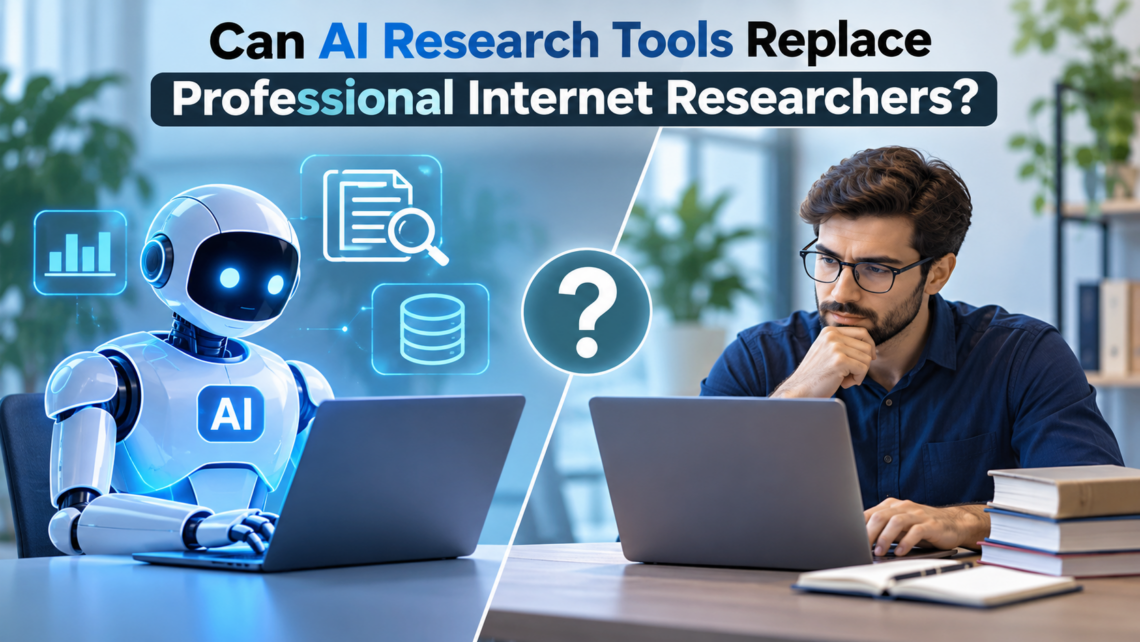
Artificial intelligence has changed how people search for information online. AI research tools can summarize lengthy documents, analyze large datasets, identify patterns, and generate answers within seconds. These capabilities have made online research faster and more accessible for businesses, students, journalists, and independent researchers. However, the growing use of artificial intelligence raises an important question. Can AI research tools completely replace professional internet researchers?
Although AI offers impressive speed and automation, professional research involves much more than collecting information. It requires critical thinking, source verification, contextual understanding, and ethical judgment. Understanding the strengths and limitations of both approaches helps explain why human expertise remains important.
How AI Research Tools Are Changing Online Research
Traditional internet research often requires searching multiple websites, reviewing documents, comparing sources, and organizing findings. AI tools simplify many of these activities by processing information quickly and presenting structured summaries.
Modern research assistants can help identify relevant publications, extract important details, and organize information into understandable reports. Some tools also support document analysis, multilingual research, and automated data classification.
These capabilities are particularly useful when researchers need to examine large amounts of publicly available information. Instead of manually reviewing hundreds of pages, they can use AI to identify potentially relevant material and focus their attention on important findings.
However, faster information processing does not necessarily guarantee accurate research results.
Why AI Cannot Always Guarantee Accurate Information
One of the biggest limitations of AI research tools is their potential to generate incorrect or misleading information. AI systems sometimes produce convincing answers that contain inaccurate facts, outdated references, or unsupported claims.
This becomes particularly problematic when research involves legal matters, business decisions, academic studies, or personal information. A small factual error can influence an important conclusion.
Professional internet researchers verify information through multiple credible sources. They examine publication dates, assess the reliability of websites, and investigate inconsistencies before presenting findings.
AI can assist with these tasks, but human oversight remains necessary to distinguish verified evidence from assumptions.
The Importance of Human Judgment in Research
Professional research requires understanding why information matters, not simply identifying where it appears. Human researchers evaluate context, recognize conflicting evidence, and determine whether available information adequately answers a specific question.
For example, researching a company’s history may involve examining official records, archived websites, industry publications, and financial documents. Different sources may provide incomplete or contradictory details.
An experienced researcher can investigate these differences and explain their significance. AI tools may identify inconsistencies, but they can also overlook important context or incorrectly connect unrelated information.
Human judgment is especially valuable when research questions are complex, sensitive, or difficult to define.
Can AI Handle People Search and Background Research?
People search is an area where AI research tools can assist with organizing publicly available information. However, identifying individuals accurately requires careful verification because multiple people may share similar names, locations, or professional backgrounds.
Someone using a fast people search address query may encounter outdated directory listings, incomplete public records, or information associated with the wrong individual. AI systems can sometimes combine these details incorrectly, creating misleading conclusions.
Professional researchers examine source reliability, distinguish individuals with similar identities, and consider privacy obligations before using personal information.
Research involving personal records must also respect applicable laws, ethical standards, and legitimate purposes. Automated results should never be treated as definitive evidence without appropriate verification.
Why Source Verification Remains Essential
Reliable research depends on the quality of its sources. AI generated summaries may appear comprehensive while excluding important details or relying on questionable information.
Professional researchers understand the difference between primary and secondary sources. Official government records, original research publications, and authenticated documents often provide stronger evidence than anonymous websites or unverified online discussions.
Researchers also evaluate whether information is current and relevant to the question being investigated.
For example, an outdated business registration record may not reflect a company’s present ownership or operating status.
AI tools can accelerate source discovery, but evaluating the credibility and limitations of evidence remains a critical responsibility.
Where AI Research Tools Perform Better
Despite their limitations, AI tools offer significant advantages in repetitive and time consuming research activities. They can summarize documents, organize large collections of text, identify recurring themes, and assist with preliminary information gathering.
AI can also help researchers develop search strategies, generate relevant research questions, and compare information across multiple documents.
These capabilities allow professionals to spend less time on routine tasks and more time on analysis and verification.
However, the usefulness of AI depends on the quality of its inputs, access to reliable sources, and the accuracy of its outputs. Sensitive information also requires appropriate security and privacy safeguards.
Why Professional Internet Researchers Still Matter
Professional internet researchers bring skills that automated systems cannot consistently reproduce. These include investigative reasoning, ethical decision making, research methodology, and the ability to recognize misleading information.
They also understand how to document evidence and explain the limitations of their findings.
In complex investigations, the absence of information can be as important as the information discovered. Experienced researchers know when available evidence is insufficient to support a conclusion.
This distinction matters because AI tools may produce confident responses even when reliable information is unavailable.
Professional expertise helps ensure that research conclusions are supported by appropriate evidence rather than plausible assumptions.
The Future of AI and Professional Internet Research
The future of internet research is likely to involve greater collaboration between artificial intelligence and human researchers rather than complete replacement.
AI can support information discovery, document processing, and preliminary analysis, while professionals remain responsible for verification, interpretation, and final conclusions.
As research technologies evolve, professionals will also need to develop stronger skills in AI evaluation, digital literacy, data privacy, and advanced search methods.
Organizations that combine automation with human expertise may benefit from faster workflows without sacrificing research quality.
The most effective approach is not necessarily choosing between AI and professional researchers, but understanding where each provides the greatest value.
Conclusion
AI research tools have transformed online information gathering by making many research tasks faster and more efficient. They are valuable for document analysis, preliminary searches, data organization, and identifying relevant sources.
However, they cannot consistently replace the critical thinking, ethical judgment, contextual understanding, and verification skills of professional internet researchers.
Accurate research requires more than producing quick answers. It involves evaluating evidence, recognizing uncertainty, and ensuring conclusions are supported by reliable information.
Rather than replacing professional researchers entirely, AI is becoming an important tool that can enhance their capabilities. Combining human expertise with responsible AI use offers a practical path toward faster, more accurate, and trustworthy internet research.