Pay-per-click advertising has a reputation for being fast. You set up a campaign, add a budget, and within hours your business appears in front of people who are searching or scrolling. For many owners in Karachi, that speed is exactly what makes PPC attractive, whether they run a clinic, a clothing brand, a coaching center, or a repair service.
The same speed also makes mistakes expensive. Unlike organic marketing, where errors cost time, PPC errors cost money every day they continue. A weak keyword list, a confusing landing page, or a missing tracking code can quietly drain a budget while the dashboard still shows a healthy number of clicks. Many owners only realize something is wrong when the monthly bill arrives and the phone has barely rung.
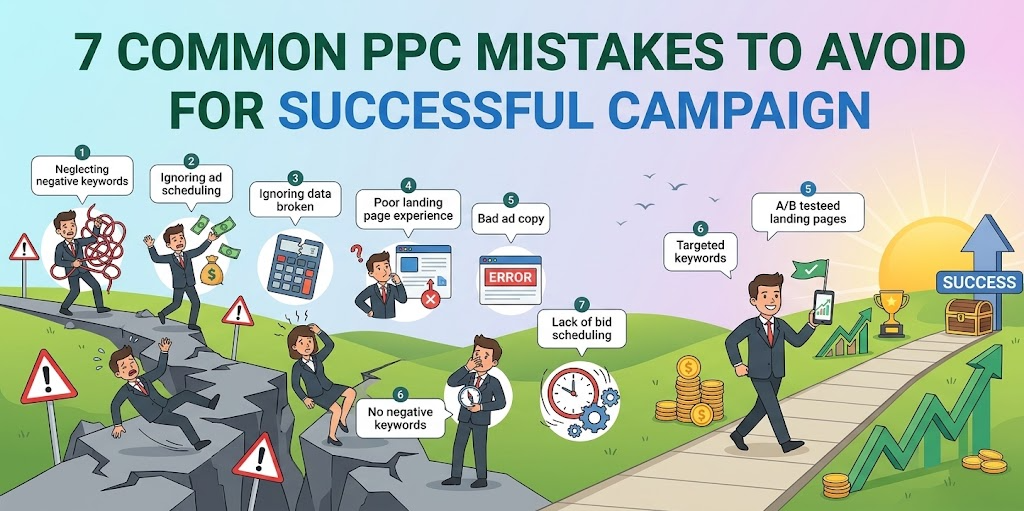
Working with a digital marketing agency in Karachi can help you spot these problems early, but it also helps to know what to watch for yourself. This guide covers seven of the most common PPC mistakes we see among local business owners, why each one hurts, and what to do instead, so your advertising budget turns into customers rather than clicks.
Mistake 1: Launching without a clear goal or numbers
The first mistake happens before the first ad goes live. Many businesses start PPC with a vague hope, such as getting more customers or appearing on the first page of Google. Without a specific target, there is no way to judge whether a campaign is succeeding, and decisions get made on mood rather than evidence.
A useful goal is concrete. It might be thirty qualified calls a month, twenty booked appointments, or a set number of online orders at a cost you can afford. To set that cost, you need to know what a customer is worth. Work out your average sale, your profit margin, and how many inquiries usually turn into paying customers. From those numbers, you can calculate the most you can pay for a lead and still make money. Campaigns built around this figure are far easier to improve, because every adjustment can be measured against it.
Mistake 2: Choosing broad or irrelevant keywords
Keywords decide who sees your advertisement, and careless choices waste money quickly. A single general word attracts many searchers who are curious, comparing options, or looking for something completely different. A Karachi dental clinic that bids on a broad health term may pay for clicks from people who wanted information, not an appointment.
Better results come from keywords that show clear intent, such as a service combined with a location, or a phrase suggesting the person is ready to act. Just as important is adding negative keywords, which tell the platform what not to show your ad for. Without them, searches for jobs, free options, DIY advice, and unrelated products can eat budget day after day. Reviewing the actual search terms that triggered your ads each week is one of the simplest ways to stop this waste.
Mistake 3: Sending clicks to a weak landing page
This is perhaps the most costly mistake, and it is often invisible to the business owner. The advertisement does its job and brings a person to your website, but the page that greets them is slow, cluttered, confusing, or unrelated to what they searched for. The visitor leaves within seconds, and the money is gone.
A strong landing page matches the ad’s promise, explains the offer clearly, loads quickly on a phone, shows trust signals such as reviews, and makes the next step obvious with a visible call button, WhatsApp link, or short form. Sending all your traffic to a general homepage forces visitors to hunt for what they came for, and most will not bother. If you are unsure how to find and fix these drop-off points, our conversion rate optimization guide explains how to improve pages so more visitors take action.
Mistake 4: Ignoring mobile users and local targeting
Most online activity in Karachi happens on phones, yet many landing pages and forms are designed for desktop screens. Tiny text, hidden buttons, slow loading, and long forms make it hard for mobile visitors to respond, and every failed visit still costs you a click.
Targeting settings matter just as much. A business that serves only certain parts of the city gains nothing from clicks across the whole country, and a service that cannot answer messages at night wastes money running ads around the clock. Review your location, device, and schedule settings, and focus spending on the areas, devices, and hours where real customers appear. Testing your own pages on an ordinary phone with mobile data, the way a customer would, reveals problems quickly.
Mistake 5: Skipping or breaking conversion tracking
If you cannot see which clicks turn into calls, messages, or sales, you are advertising blind. Many small business accounts have no conversion tracking at all, or they track the wrong thing, such as page views, instead of phone calls, form submissions, WhatsApp clicks, and purchases. As a result, they judge campaigns by clicks and impressions, which say very little about profit.
Set up tracking for the actions that represent real interest, and test each one to make sure it records correctly. Then compare the platform’s reports with your own records of inquiries and sales, because the most honest measure is how many real customers you gained. Where tracking calls or chats is difficult, simply asking every new customer how they found you can fill much of the gap. Without this information, you cannot tell which keywords, ads, or locations deserve more money and which should be cut.
Mistake 6: Slow follow-up and ignoring lead quality
Sometimes the campaign works, and the business is the problem. Leads arrive by phone and WhatsApp, but no one answers quickly, messages sit unread overnight, or inquiries never receive a follow-up. A person who searched with real intent will often contact several businesses, and the first helpful reply frequently wins the sale. Every slow reply turns a paid lead into wasted money.
Treat each lead as valuable. Prepare quick replies for common questions, assign someone to watch the inbox during business hours, and follow up politely with people who showed interest but did not book. It is also worth paying attention to lead quality, not just quantity. If most inquiries are price shoppers or people outside your service area, adjust your keywords, ad wording, and targeting to attract better-fitting customers. A smaller number of good leads is usually more profitable than a large number of poor ones.
Mistake 7: Setting it and forgetting it, or changing everything too often
PPC campaigns need regular attention, but they also need patience. Some owners launch a campaign and never look at it again, so wasted spend accumulates, ads grow stale, and competitors gradually outbid them. Others make the opposite error, changing keywords, budgets, and settings every day in response to a single bad afternoon. Frequent changes confuse the platform’s learning process and make it impossible to know what actually caused a result.
A better routine is steady and measured. Check search terms and add negative keywords weekly, compare ad versions, review cost per lead and cost per customer monthly, and adjust one thing at a time, giving each change a couple of weeks to show an effect. Avoid dramatic budget jumps, and scale gradually toward the campaigns that perform best. Our post on SEO vs paid ads also explains how organic efforts can reduce your dependence on paying for every click over time.
How to fix these mistakes without starting over
If you recognize several of these problems in your own account, there is no need to panic or shut everything down. Start with the foundations. Write down a clear goal and your maximum cost per lead, then set up or repair conversion tracking so you can see real results. Next, review your search terms and add negative keywords, tighten your keyword list around clearer intent, and narrow your location and schedule settings.
Then improve the landing page, since better conversion lowers your cost per lead without reducing traffic. Finally, speed up your follow-up process and set a simple review routine. Making these changes in order, one at a time, gives you a stable base and clear evidence about what is working.
Questions worth asking before you spend more
Before increasing any budget, ask yourself a few honest questions. Do you know what a customer is worth to your business, and what you can pay to win one? Can you see which ads and keywords produce inquiries? Does your landing page load quickly and clearly deliver what the ad promised? Does someone respond to leads within minutes during business hours? If the answer to any of these is no, fixing that problem will usually do more for your results than spending more money.
Final thoughts
PPC is a powerful tool for Karachi businesses, but it rewards preparation and punishes guesswork. The seven mistakes above, unclear goals, careless keywords, weak landing pages, poor mobile and location targeting, missing tracking, slow follow-up, and inconsistent management, account for a large share of wasted advertising money.
The encouraging part is that each one can be fixed without a large budget. Set clear numbers, track what matters, send visitors to pages built to convert, respond quickly, and review your account on a steady schedule. With these habits in place, PPC can move from an expensive experiment to a dependable source of customers.