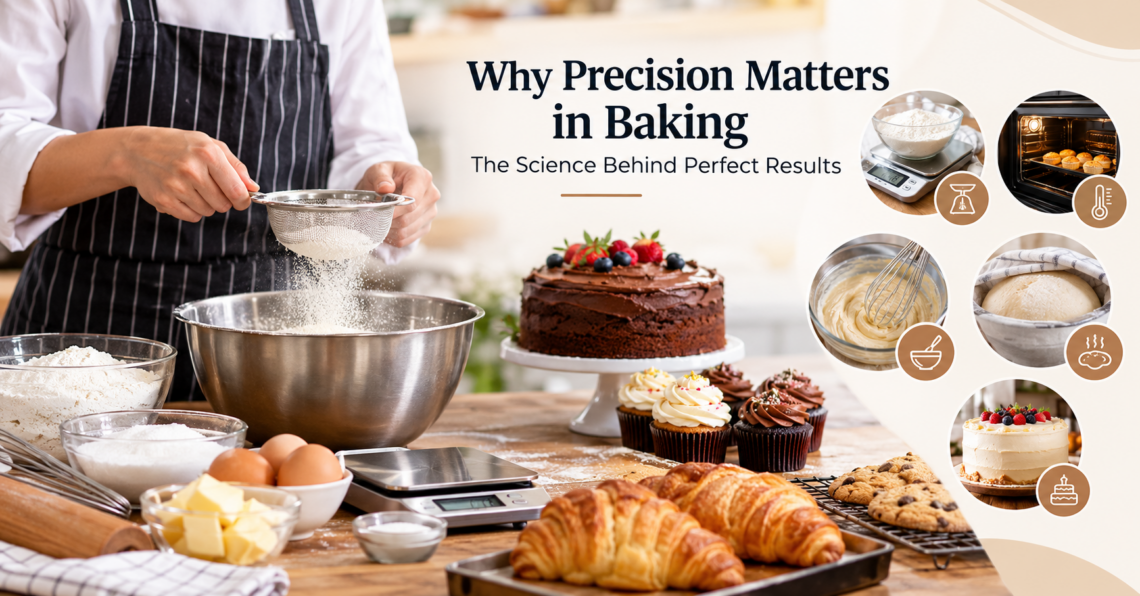
Introduction: Baking Is Both an Art and a Science
Baking is often considered a creative activity, but achieving consistently delicious results requires more than imagination and good ingredients. Every successful cake, loaf of bread, cookie, and pastry depends on accurate measurements, controlled temperatures, and the right techniques. Even a small mistake in the quantity of flour, sugar, butter, or baking powder can change the texture, flavour, and appearance of the final product.
Understanding the science behind baking helps beginners and experienced bakers produce reliable results. Precision allows bakers to understand how ingredients interact, identify common mistakes, and maintain quality across different batches. When creativity is supported by scientific knowledge, baking becomes more predictable, efficient, and rewarding.
Understanding the Role of Accurate Measurements
Why Ingredient Ratios Matter
Every baking recipe is developed around specific ingredient proportions. Flour provides structure, sugar contributes sweetness and moisture, fats create tenderness, and eggs help bind ingredients while supporting the structure of baked products. Leavening agents such as baking powder and baking soda help create the rise and texture expected from many recipes.
Changing these proportions can significantly affect the finished product. Too much flour may result in a dry, dense cake, while excess sugar can make the texture overly soft or cause excessive browning. Adding too much baking powder may create a rapid rise followed by collapse.
Using a digital weighing scale is one of the simplest ways to improve accuracy. Measuring ingredients by weight rather than relying entirely on cups helps reduce variations caused by differences in scooping and packing. This is particularly important when preparing large batches or repeating a recipe for customers.
Temperature Control and Its Impact on Baking
The Importance of Oven Temperature
Temperature influences nearly every stage of the baking process. It affects how quickly butter melts, how proteins coagulate, how starches gelatinise, and how leavening agents release gases. These changes determine the structure, colour, moisture, and overall quality of the final product.
An oven that is too hot may brown the outside of a cake before the centre has finished baking. A temperature that is too low can delay setting, resulting in a dense texture or an uneven rise. Even when the oven display shows the correct setting, the actual temperature may vary.
Using an oven thermometer helps bakers understand these differences and make adjustments when necessary. Preheating the oven, selecting the correct rack position, and following the recommended baking time are equally important steps.
Why Ingredient Temperature Matters
The temperature of individual ingredients also affects the outcome. Softened butter and room-temperature eggs often combine more effectively in cake batters, creating a smoother mixture and supporting better aeration. Cold ingredients may cause mixtures to separate or affect how evenly ingredients blend.
However, not every recipe requires room-temperature ingredients. Certain pastry preparations depend on cold butter to create distinct layers and a flaky texture. Understanding when ingredients should be warm, cool, or chilled helps bakers achieve the intended result.
Mixing Techniques and Chemical Reactions
Developing the Right Texture
Mixing is another area where precision makes a significant difference. Creaming butter and sugar incorporates air into a mixture, helping certain cakes develop a lighter texture. Folding gently combines ingredients while preserving incorporated air, making it useful for delicate batters and some sponge preparations.
Overmixing flour-based batters can develop excess gluten, producing a tougher texture in products that should be soft and tender. On the other hand, insufficient mixing may leave dry pockets of flour or create an uneven distribution of ingredients.
Each method serves a specific purpose. Learning the difference between whisking, folding, creaming, and kneading allows bakers to choose the correct technique for each recipe.
The Science of Leavening Agents
Leavening agents are essential for creating volume in many baked goods. Baking powder releases carbon dioxide through chemical reactions, while yeast produces gas through fermentation. Steam also contributes to expansion in products such as choux pastry.
The quantity, freshness, and handling of these ingredients influence the final structure. Incorrect proportions or unsuitable mixing and resting conditions can result in poor volume, irregular holes, or collapsed products. Precision helps maintain the balance required for a consistent rise.
Consistency: The Foundation of Professional Baking
Reproducing the Same Quality Every Time
Consistency becomes especially important when baking for customers, cafés, restaurants, or bakery businesses. Customers expect the same taste, size, texture, and appearance whenever they purchase a familiar product.
Professional bakers achieve this by following standardised recipes, weighing ingredients carefully, recording oven settings, and monitoring baking times. They also pay attention to portion sizes, cooling methods, storage conditions, and finishing techniques.
Maintaining a recipe log helps identify what works and what needs improvement. If a batch turns out differently, recorded measurements and process details make troubleshooting easier. This approach reduces ingredient waste and supports better production planning.
Learning Precision Through Practical Baking
Turning Baking Knowledge into Practical Skills
Understanding baking science becomes easier when learners can observe how different techniques affect real products. Practical training provides opportunities to measure ingredients, prepare batters, control temperatures, evaluate textures, and correct mistakes under guidance.
Those exploring Baking Classes chennai can benefit from learning how accurate measurements and systematic methods influence the final outcome. Instead of simply following instructions, learners can develop the ability to understand why a recipe works and how to improve it.
For aspiring professionals, structured training also introduces important production habits, including maintaining hygiene, organising ingredients, managing time, and following standard procedures. These skills are valuable for employment in bakeries, hotels, cafés, and pastry kitchens.
Applying Precision to Advanced Baking
Precision becomes even more important when working with delicate pastries, layered cakes, chocolate preparations, and large-scale production. Small differences in temperature or ingredient ratios can affect texture, stability, and presentation.
Learners interested in Baking Classes in Anna nagar can look for practical opportunities to develop these foundational techniques and build confidence across different baking preparations. A strong understanding of measurements, mixing methods, and temperature control creates a reliable foundation for exploring more advanced recipes.
Common Mistakes That Affect Baking Results
Many baking problems can be traced to avoidable inconsistencies. Measuring flour incorrectly, substituting ingredients without understanding their functions, opening the oven door too early, or removing products before they are fully baked can affect the final result.
Relying only on visual appearance may also lead to mistakes. Bakers should consider recommended baking times alongside signs of doneness, such as texture, colour, internal temperature where appropriate, and the specific requirements of the recipe.
Accurate preparation, careful observation, and systematic troubleshooting help transform these mistakes into learning opportunities. Rather than changing several factors at once, adjusting one variable at a time makes it easier to identify the cause of a problem.
Conclusion: Precision Creates Better Bakers
Precision is one of the most important foundations of successful baking. Accurate measurements, suitable ingredient temperatures, correct mixing techniques, and consistent oven conditions all contribute to better results. These practices help bakers reduce waste, improve product quality, and reproduce recipes with confidence.
Although creativity gives baking its personality, scientific understanding makes that creativity dependable. By learning the reasons behind each step and practising carefully, bakers can develop stronger technical skills and achieve consistently excellent results. Whether baking at home or preparing for a professional career, mastering precision is an essential step towards becoming a skilled and confident baker.