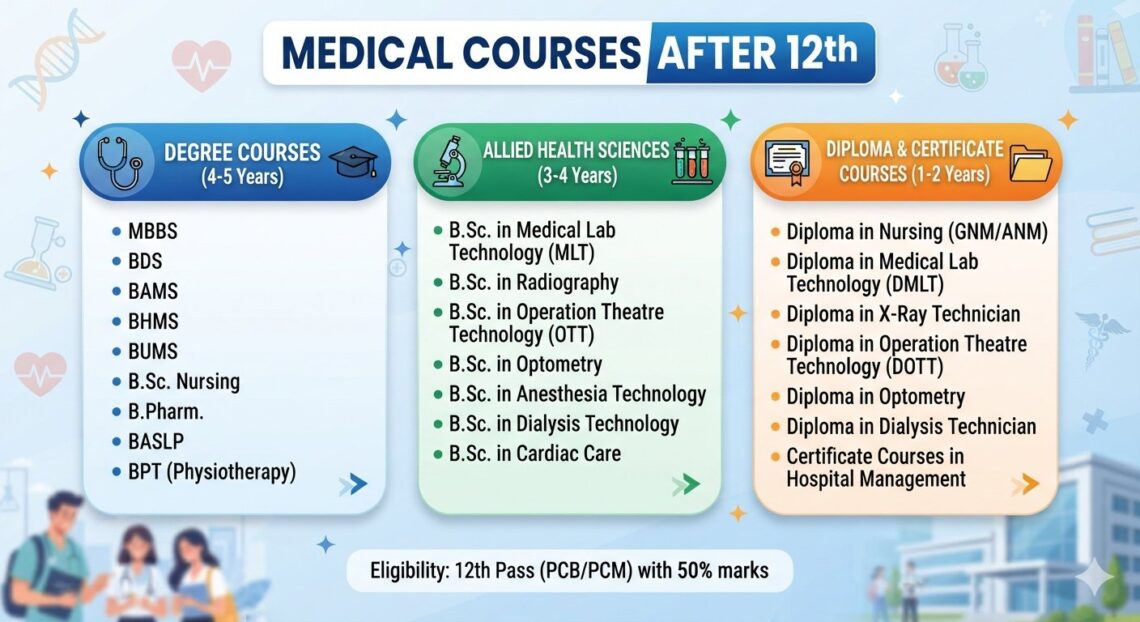
Explore paramedical courses after 12th with duration, eligibility, entrance exams and careers. Compare diploma and degree options to pursue a medical course.
Paramedical courses after 12th are short, job-focused programs in diagnostics, therapy, emergency care and surgical support. Options include DMLT, BMLT, radiology, OT technology, dialysis, optometry and physiotherapy. Diplomas take 1–2 years, degrees 3–4.5 years. Most need 10+2 Science, usually with Biology, and lead to hospital, lab and clinic jobs.
Not everyone who wants to work in healthcare ends up in an MBBS seat, and that is fine. Hospitals run on lab technicians, radiographers, dialysis technicians, optometrists and therapists as much as on doctors. If you want to pursue medical courses after 12th without the long road of NEET-UG, a medical degree and a specialisation, paramedical and allied health programs are the most practical route.
This guide explains the main options, how long each takes, how admission works, and what careers they lead to, so you can choose with clear eyes.
What Are Paramedical Courses?
Paramedical courses (now officially grouped under allied health sciences) train you to support doctors in diagnosing, treating and rehabilitating patients. You do not prescribe treatment as a doctor does. You run the tests, operate the equipment, assist in procedures, or deliver therapy that makes treatment work.
In India, allied healthcare professions are regulated under the National Commission for Allied and Healthcare Professions (NCAHP) Act, 2021. Some fields, such as nursing, pharmacy and rehabilitation, also have their own councils. That matters because a recognised qualification is what employers and licensing bodies look for.
Who Can Apply? Typical Eligibility
Requirements differ by course, state and institute, but these are common:
- Passed 10+2 from a recognised board
- Science stream, usually Physics, Chemistry and Biology (PCB)
- A minimum aggregate in the qualifying exam, often 40–50% (check each institute)
- Minimum age of 17 at admission for many programs
Some certificate and assistant-level courses accept students with other streams or even a 10th pass, and some courses such as D.Pharm accept PCM as well as PCB. Always read the prospectus of the specific college.
List of Paramedical Courses After 12th
The table below covers the most common programs. Durations are typical; confirm with the institute and the relevant council.
| Course | Level | Typical Duration | Core Focus |
|---|---|---|---|
| DMLT (Diploma in Medical Laboratory Technology) | Diploma | About 2 years | Blood, urine and tissue testing |
| BMLT / B.Sc. MLT | Degree | 3 years + internship | Advanced pathology and lab management |
| Diploma in Radiology / X-ray Technology | Diploma | About 2 years | X-ray, basic imaging |
| B.Sc. Radiology & Imaging Technology | Degree | 3 years + internship | CT, MRI, ultrasound |
| Diploma / B.Sc. in Operation Theatre Technology | Diploma / Degree | 2 years / 3 years | Assisting surgeons, sterilisation |
| Diploma / B.Sc. in Dialysis Technology | Diploma / Degree | 1–2 years / 3 years | Kidney dialysis care |
| Diploma / B.Optom in Optometry | Diploma / Degree | 2 years / 3–4 years | Eye testing, vision correction |
| Bachelor of Physiotherapy (BPT) | Degree | 4.5 years incl. internship | Rehabilitation, movement therapy |
| Bachelor of Occupational Therapy (BOT) | Degree | 4.5 years incl. internship | Daily-living skills rehabilitation |
| ANM / GNM / B.Sc. Nursing | Diploma / Degree | 2 / 3.5 / 4 years | Patient care and nursing |
| D.Pharm / B.Pharm | Diploma / Degree | 2 years / 4 years | Medicines and dispensing |
| Emergency Medical Technician (EMT) | Diploma / Degree | 1–2 years / 3 years | Ambulance and trauma care |
| Perfusion, Cardiac Care, Anaesthesia Technology | Degree | 3–4 years | Heart-lung machines, ICU and anaesthesia support |
Diploma vs. Degree: Which Should You Choose?
Both lead to jobs, but they open different doors.
Choose a diploma if you want to start earning sooner, have budget limits, or want a trial run in healthcare. Many diploma holders later move into a degree through lateral entry, where the institute allows it.
Choose a degree if you want better prospects for supervisory roles, teaching, research, or higher studies such as an M.Sc. Degrees also tend to carry more weight with larger hospital chains and for work abroad, although foreign recognition depends on each country’s rules.
A simple rule: diploma for speed, degree for range.
Diploma Medical Exams After 12th: How Admission Works
Students often search for “diploma medical exams after 12th” expecting one national test. There isn’t one for paramedical courses. Admission usually works in one of four ways:
- Merit-based: Many colleges admit students on 10+2 marks, especially for diploma programs.
- State-level counselling or entrance exams: Some state boards and health universities run their own admission processes for paramedical and nursing seats.
- Institute-level entrance exams: Premier institutes such as AIIMS and JIPMER have conducted entrance-based admission for some allied health and nursing programs. Check their current notifications, as rules change.
- NEET-UG: Required for MBBS, BDS and AYUSH degrees such as BAMS and BHMS. It is not compulsory for most paramedical diplomas, but check your state’s rules for nursing and some allied health degrees.
Tip: use the official website of your state health university or the admitting college, not agent claims, to confirm dates and eligibility.
Popular Paramedical Courses in Detail
DMLT and BMLT: Medical Laboratory Technology
Lab technologists perform and analyse tests that doctors rely on for diagnosis. Work includes handling blood samples, running analysers and preparing reports. It suits students who like precision and have patience for routine, detail-heavy work.
Radiology and Imaging Technology
Radiographers operate X-ray, CT and MRI machines and position patients correctly for scans. Demand tracks the growth of diagnostic chains and hospital imaging departments. Radiation-safety training is a core part of the course.
Operation Theatre and Anaesthesia Technology
OT technicians prepare the theatre, sterilise instruments and assist surgical teams. Anaesthesia technicians support anaesthetists by preparing equipment and monitoring patients. The work is high-pressure and best for people who stay calm in emergencies.
Dialysis Technology
Kidney disease patients need regular dialysis, so trained technicians are needed in hospitals and standalone dialysis centres. The course is short and the role is very hands-on.
Optometry
Optometrists test vision, prescribe corrective lenses and detect common eye problems. Careers include hospitals, optical retail chains and private practice, depending on local regulations.
Physiotherapy and Occupational Therapy
These are longer degree courses with a mandatory internship. Graduates work in hospitals, sports clinics, rehabilitation centres and, after gaining experience, in private practice.
Career Opportunities After Paramedical Courses
| Role | Typical Workplaces |
|---|---|
| Medical Laboratory Technologist | Hospitals, diagnostic labs, blood banks |
| Radiographer / Imaging Technologist | Hospitals, scan centres |
| OT / Anaesthesia Technician | Surgical hospitals, day-care centres |
| Dialysis Technician | Hospitals, dialysis units |
| Optometrist | Eye hospitals, optical chains, clinics |
| Physiotherapist / Occupational Therapist | Hospitals, rehab and sports centres, home care |
| Emergency Medical Technician | Ambulance services, emergency departments |
| Pharmacist | Hospital pharmacies, retail pharmacies, pharma companies |
Other routes include government health jobs (through state or national recruitment exams), teaching, medical equipment sales and support, and higher studies such as an M.Sc. or MPT. Salaries vary widely by city, employer, experience and specialisation, so check recent job listings in your target city rather than trusting a single average figure.
How to Choose the Right Course
- Match the work to your temperament. Do you prefer lab precision, patient contact or emergency pace?
- Check recognition. Confirm the college and course are approved by the relevant council or affiliated university.
- Look at clinical exposure. Good programs include hospital training or internship.
- Compare total cost. Include fees, hostel, internship and exam charges.
- Research local demand. Talk to people working in hospitals in your region.
- Plan the next step. Know whether the course allows bridge programs or higher studies.
Common Mistakes to Avoid
- Joining an unrecognised institute because the fees are low
- Assuming every paramedical course needs NEET, or that none does
- Ignoring internship quality
- Following friends rather than your own strengths
- pursue medical courses after 12th
FAQ’s
1. Which paramedical course is best after 12th?
There is no single best course. DMLT, radiology, OT technology and physiotherapy are widely chosen. Pick based on your interest, budget and local job demand.
2. Can I do a paramedical course after 12th without Biology?
Some diplomas and certificate courses accept non-Biology students, and D.Pharm accepts PCM. Most degrees and nursing programs expect PCB. Check each institute’s criteria.
3. Is NEET required for paramedical courses?
Not for most diploma programs. NEET-UG is required for MBBS, BDS and AYUSH degrees. Some states use it for nursing or allied health seats, so verify locally.
4. How long is a diploma in paramedical science?
Usually 1–2 years. Degree programs take 3–4.5 years, including internship.
5. What is the difference between DMLT and BMLT?
DMLT is a diploma of about 2 years. BMLT is a 3-year degree with deeper theory and better scope for supervisory roles.
6. Can I become a doctor after a paramedical course?
Not directly. Becoming an MBBS doctor requires qualifying NEET-UG and completing MBBS. Paramedical qualifications lead to allied health careers.
7. Are paramedical courses worth it?
Yes, if the course is recognised and you choose a field with local demand. Hospitals and diagnostic centres continue to hire trained technicians and therapists.
8. Can paramedical graduates work abroad?
Possibly, but each country has its own licensing, exams and recognition rules. Research the destination’s regulator before you plan.
9. Which paramedical courses can I do after 12th Arts or Commerce?
Options are limited. A few certificate and assistant-level courses accept them, but most programs require a Science background.
10. Can I study further after a diploma?
Yes. Many diploma holders move to a bachelor’s degree via lateral entry where available, and later to an M.Sc. or specialised postgraduate course.
Conclusion
If you want to without waiting years for a doctor’s seat, paramedical programs give you a legitimate, in-demand path into healthcare. Start by confirming that the course and college are recognised, compare diploma and degree options against your goals and budget, and choose a field that fits how you like to work. A good choice now can lead to a stable career, and a diploma today can still become a degree tomorrow.