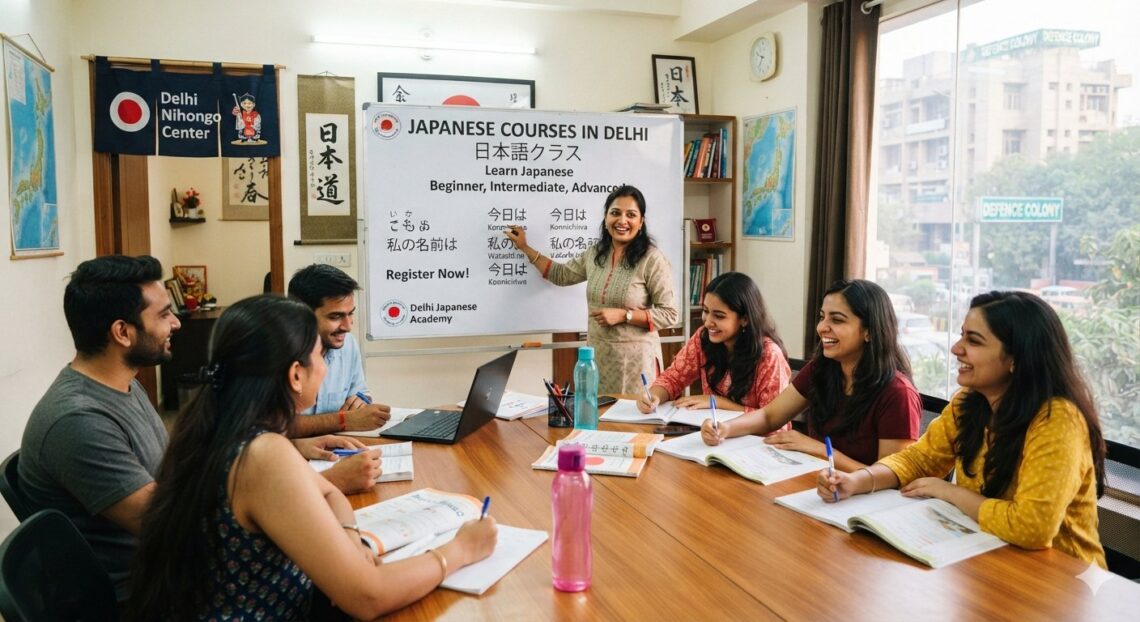
Explore the latest Japanese courses in Delhi. Learn JLPT levels, how to choose an institute, and how to say hello in Japanese. Start today.
The latest Japanese courses in Delhi run from beginner (JLPT N5) to advanced (N1), with classroom, online and weekend batches. Most beginners start with hiragana, katakana and basic grammar, then take 6–12 months to reach N5 or N4. Compare the syllabus, trainer qualifications, batch size, and JLPT support before enrolling.
Why Learn Japanese in Delhi Right Now?
Interest in Japanese has grown steadily among Indian students and working professionals. Japanese companies operate across the Delhi NCR region, and the language opens doors in roles such as bilingual coordinator, translator, interpreter, IT project communicator, and hospitality or manufacturing liaison. Others learn it for anime, travel, study in Japan, or simple curiosity.
The good news: Delhi offers a wide range of options, from government-linked institutions and universities to private language schools and online academies. The challenge is choosing well. This guide explains what to look for, what you will learn, and how to start with confidence.
What Search Intent Does This Guide Cover?
If you searched for “Japanese courses in Delhi,” you most likely want to know four things: which levels exist, how long each takes, what to check before paying, and how to begin as a complete beginner. The sections below answer each in order.
Understanding Japanese Course Levels (JLPT Explained)
Most Japanese courses in India follow the Japanese Language Proficiency Test (JLPT) framework. It has five levels, from N5 (easiest) to N1 (hardest).
| JLPT Level | What It Means | Typical Learner |
|---|---|---|
| N5 | Basic phrases, simple sentences, hiragana, katakana, around 100 kanji | Complete beginner |
| N4 | Everyday conversation on familiar topics | Post-beginner |
| N3 | Understand daily-life Japanese in many situations | Intermediate |
| N2 | Business and academic contexts | Upper intermediate |
| N1 | Complex, abstract and professional Japanese | Advanced |
The JLPT is usually held twice a year, in July and December, but dates and test cities can change. Always confirm the current schedule on the official JLPT website.
Types of Japanese Courses Available in Delhi
1. Classroom Courses
In-person batches suit learners who like structure, live speaking practice and direct feedback. Delhi’s metro network makes it easy to attend evening or weekend classes.
2. Online and Hybrid Courses
Live online classes save travel time across Delhi NCR. Check that they include speaking practice, not only recorded videos.
3. University and Institutional Programmes
Some universities in Delhi offer Japanese as part of degree, diploma or certificate programmes. The Japan Foundation in New Delhi has also run Japanese-language classes and resources for learners. Availability, eligibility and fees change, so verify directly with each institution.
4. Weekend and Crash Courses
Useful for working professionals, but fast-paced. These work best if you can practise daily.
5. Exam-Focused JLPT Preparation
Ideal once you know the basics. These batches focus on mock tests, vocabulary drills and listening practice.
What Will You Learn as a Beginner?
A good beginner course (N5 level) typically covers:
- Hiragana and katakana, the two phonetic scripts
- Basic kanji, starting with numbers, days and common nouns
- Core grammar, such as particles (は, が, を), the verb ます form, and simple past tense
- Daily-life vocabulary: family, food, shopping, directions, time
- Listening and speaking: self-introductions, greetings, polite requests
- Cultural etiquette: bowing, honorific speech and workplace manners
Many Indian institutes use textbooks such as Minna no Nihongo, while others use Genki or the Japan Foundation’s Marugoto series. Ask which one your teacher uses and why.
Hello in Japanese: The Trending First Words to Learn
One of the most searched beginner questions is how to say “hello” in Japanese. There isn’t a single word. The right greeting depends on the time of day and the situation.
| English | Japanese | Romaji | When to Use |
|---|---|---|---|
| Hello / Good afternoon | こんにちは | Konnichiwa | Daytime, general greeting |
| Good morning | おはようございます | Ohayō gozaimasu | Morning, polite form |
| Good evening | こんばんは | Konbanwa | Evening |
| Goodbye | さようなら | Sayōnara | Formal farewell, less common in daily chat |
| Thank you | ありがとうございます | Arigatō gozaimasu | Polite thanks |
| Nice to meet you | はじめまして | Hajimemashite | First meeting |
| Hello (phone) | もしもし | Moshi moshi | Answering or starting a phone call |
Practical tip: Konnichiwa is safe in most daytime situations, but Japanese people often use more specific greetings in workplaces, such as Otsukaresama desu (thank you for your hard work). A trained teacher will explain these nuances.
How to Choose the Right Japanese Institute in Delhi
Do not choose only by price or by claims like “100% placement.” Use this checklist instead:
- Trainer qualifications: Look for JLPT N2/N1 certification or formal teaching experience. Native-speaker sessions are a bonus, not a necessity.
- Syllabus clarity: The institute should share a level-wise plan with expected outcomes.
- Batch size: Smaller batches allow more speaking practice.
- Demo class: Attend one before paying.
- Mock tests and JLPT guidance: Essential if you plan to sit the exam.
- Study material: Check whether books are included or bought separately.
- Flexible timings: Evening, weekend and online options matter for working learners.
- Transparent fees: Ask for a written breakdown, including exam registration, which is paid separately to the JLPT organisers.
- Student reviews: Read independent reviews, not only testimonials on the institute’s own site.
How Long Does It Take to Learn Japanese?
Timelines depend on your effort and class hours. As a general guide, many learners need roughly:
- N5: about 4–6 months of regular classes
- N4: another 4–6 months
- N3 and beyond: a year or more per level
These are rough estimates, not guarantees. Japanese is considered one of the more time-intensive languages for English speakers, mainly because of kanji and grammar structure.
Career and Study Benefits of Learning Japanese
Japanese skills can support careers and academic goals in several areas:
- Translation, interpretation and localisation
- hello in Japanese language tranding
- Bilingual roles in IT, manufacturing, automotive and trading firms
- Tourism, hospitality and aviation
- Higher studies or exchange programmes in Japan
- Research roles where Japanese-language sources matter
Japanese skills improve your options, but they do not guarantee a job. Employers also look for domain skills, communication ability and experience.
A Simple 5-Step Plan to Start Learning Japanese
- Define your goal: hobby, JLPT, career or study abroad.
- Learn hiragana first, ideally within the first two to three weeks.
- Attend two demo classes at different institutes and compare teaching style.
- Practise daily for even 20–30 minutes, using flashcards, audio and writing.
- Set a JLPT target and book your exam well ahead of the registration window.
Common Mistakes Beginners Make
- Relying only on romaji instead of learning the scripts
- Skipping listening practice
- Memorising kanji without context
- Joining an advanced batch too early
- Studying in bursts instead of regularly
A lesson from many learners’ experience: consistent short practice beats occasional long sessions.
FAQ’s
1. Which is the best Japanese course in Delhi for beginners?
There is no single best option. Choose a course that starts from N5, has a clear syllabus, qualified trainers and a demo class, then compare two or three institutes.
2. How much do Japanese courses in Delhi cost?
Fees vary widely by institute, format and level. Ask for a written fee breakdown and check whether books and exam fees are included.
3. Can I learn Japanese online instead of attending classes?
Yes. Live online classes work well if they include speaking practice and regular feedback. Pure recorded courses tend to be weaker for conversation.
4. Is Japanese hard for Indian learners?
It has new scripts and kanji, but the sentence structure (subject-object-verb) feels familiar to Hindi speakers. Pronunciation is often considered relatively approachable.
5. How do you say hello in Japanese?
The most common greeting is Konnichiwa (こんにちは). Use Ohayō gozaimasu in the morning and Konbanwa in the evening.
6. What is JLPT and do I need it?
The JLPT is an internationally recognised test of Japanese proficiency. It is not mandatory for everyone, but many employers and universities ask for N3, N2 or N1.
7. How many months does it take to clear JLPT N5?
Many learners prepare in roughly four to six months with regular classes and practice, though this varies by person.
8. Can I get a job after learning Japanese?
It can improve your chances in bilingual and Japan-linked roles, but jobs depend on your overall skills and experience, not language alone.
9. What is the minimum age to start Japanese courses?
Many institutes accept school students, but policies differ. Check with the institute.
10. Do I need to learn Hindi or English first?
No. Instruction is usually in English or Hindi, so basic comfort with either is enough.
Conclusion
Starting Japanese in Delhi is more achievable than it looks. Begin with a clear goal, choose a structured course that follows the JLPT path, and attend a demo class before committing. Learn the scripts early, practise daily, and treat greetings like konnichiwa as your first small win. With steady effort, N5 is a realistic first milestone, and everything after builds on it.