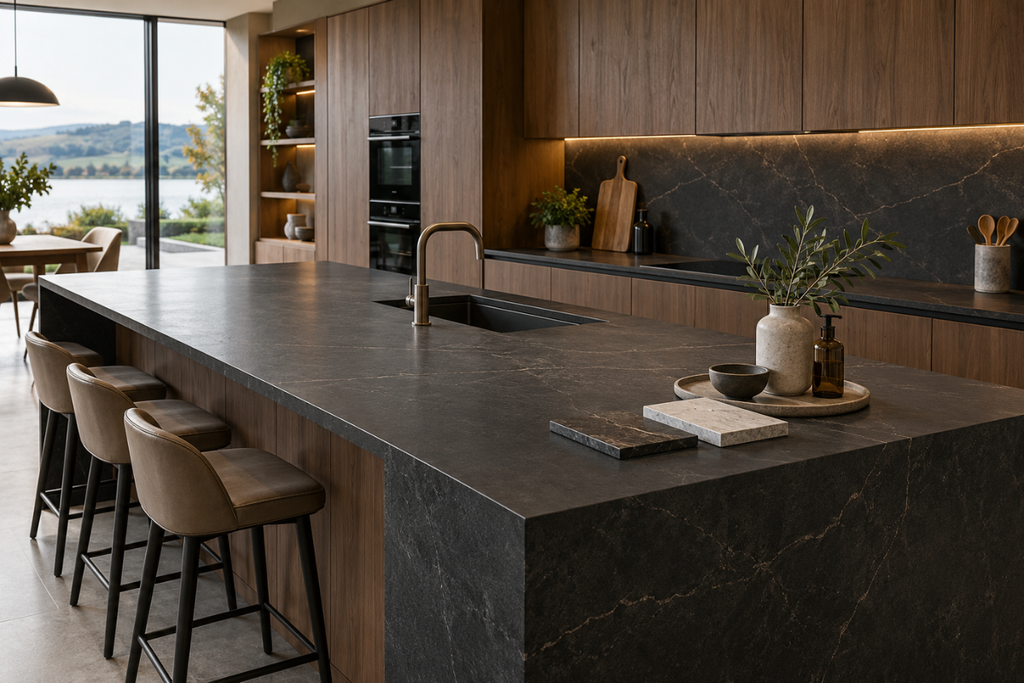
Choosing a worktop involves balancing appearance, durability, maintenance, and suitability for the space. Kitchen and bathroom surfaces are exposed to moisture, spills, heat, cleaning products, and everyday wear, so the material needs to match the demands of the room. Dekton worktops have become one option for homeowners looking for an engineered surface with a combination of durability and design flexibility.
Dekton is an ultra-compact surface produced from a blend of raw materials subjected to high pressure and temperature. Quartz Supply describes its Dekton range as suitable for kitchens and bathrooms, with properties including resistance to scratches, stains, heat, UV exposure, and everyday wear.
What Are Dekton Worktops?
Dekton is an engineered, ultra-compact surface rather than a natural stone such as granite or marble. Its manufacturing process uses a mixture of raw materials that are compressed and treated at high temperatures to create a dense surface.
This composition contributes to several characteristics that can be useful for worktops. Quartz Supply describes Dekton as impact resistant, scratch resistant, UV resistant, hygienic, frost resistant, and heat resistant.
The material is available in numerous colours, textures, and finishes. Current Quartz Supply listings include options ranging from darker stone-inspired finishes to lighter concrete and marble-style designs.
Why Consider Dekton for a Kitchen?
Kitchen worktops experience considerable daily use. Food preparation, hot cookware, spills, sharp utensils, and cleaning can all place demands on the surface.
One reason Dekton worktops are considered for kitchens is their resistance to several common forms of wear. Quartz Supply states that the material is designed to resist scratches, stains, heat, and impacts.
However, no worktop should be considered completely indestructible. Correct installation, suitable cleaning products, and appropriate everyday care remain important.
The worktop should also be selected according to the particular kitchen layout, including sink positions, hob cut-outs, overhangs, and other fixtures.
Heat Resistance
Heat resistance is an important consideration for kitchen surfaces because hot cookware may frequently come into contact with the worktop.
Quartz Supply describes Dekton as heat resistant and states that its surfaces can withstand contact with hot pots and pans.
Even when a material has strong heat-resistant properties, homeowners should follow the manufacturer’s care recommendations. Good habits can help protect the surface and surrounding cabinetry over time.
Heat resistance can also be relevant when comparing worktop materials for kitchens where cooking is frequent or where large areas of exposed countertop are required.
Scratch and Impact Resistance
Worktops can be scratched or damaged by sharp utensils, heavy cookware, appliances, and other objects.
Dekton’s dense, ultra-compact structure gives it high resistance to scratches and impacts. Quartz Supply specifically identifies scratch and impact resistance among the material’s properties.
This can be useful in busy kitchens, but resistance should not be interpreted as immunity from damage. Heavy impacts at vulnerable areas, particularly around cut-outs and edges, can still require care.
Professional fabrication and installation are therefore important parts of achieving a durable finished surface.
Resistance to Stains and Moisture
Spilled coffee, oil, sauces, water, and other liquids are common on kitchen worktops. A surface that does not readily absorb liquids can make everyday cleaning easier.
Quartz Supply describes Dekton as non-porous and states that its surface resists the absorption of liquids. The company also describes the material as hygienic and easy to clean.
This characteristic can also be useful in bathrooms, where surfaces are regularly exposed to water and personal-care products.
As with any worktop, spills should still be cleaned appropriately rather than being left on the surface unnecessarily.
Low-Maintenance Care
Maintenance is another factor to consider when choosing a worktop.
Quartz Supply’s current care guidance states that Dekton does not require sealing and recommends routine cleaning with a damp cloth and mild detergent. It also advises against abrasive cleaners, abrasive pads, and harsh chemicals such as bleach or ammonia.
Following the manufacturer’s care instructions is preferable to assuming that a highly durable surface can tolerate every cleaning product.
A simple maintenance routine can help preserve the appearance of the surface over time.
Indoor and Outdoor Applications
One distinctive characteristic of Dekton is its suitability for both indoor and outdoor applications.
Quartz Supply identifies UV resistance as one of the material’s properties and states that this makes it suitable for outdoor kitchens, patios, and areas exposed to direct sunlight.
UV resistance can be particularly useful where a surface receives regular sunlight because prolonged exposure can affect some materials.
Outdoor applications still require careful planning around the supporting structure, installation environment, weather exposure, and local conditions.
Dekton for Bathrooms
Worktops are not limited to kitchens. Bathrooms can also benefit from durable, low-maintenance surfaces.
Dekton worktops can be used for vanity tops and other bathroom applications. Their resistance to moisture and their non-porous characteristics can make them suitable for environments where water exposure is routine.
Bathroom design also requires accurate planning for sinks, taps, storage units, splashbacks, and plumbing. These details should be established before fabrication begins.
Colour and Design Options
A worktop contributes significantly to the overall appearance of a room. Dekton is available in a broad selection of colours and patterns, allowing homeowners to coordinate the surface with cabinets, flooring, splashbacks, and walls.
Quartz Supply’s current colour listings include options such as Somnia, Grafite, Avorio, Sabbia, Ceppo, Marmorio, Polar, Laurent, Marina, and numerous other finishes.
When selecting a design, it is useful to consider the size of the room and the amount of visual pattern already present. A strongly patterned worktop may become a focal point, while a more understated surface can allow cabinetry or other features to take centre stage.
Physical samples can also be useful because lighting can change how colours and textures appear.
Comparing Dekton With Quartz
Dekton and quartz are both engineered worktop materials, but their composition and manufacturing processes differ.
Quartz Supply describes quartz as a non-porous worktop material available in a wide variety of colours and patterns, while its Dekton range is described as an ultra-compact surface with strong heat, scratch, stain, and UV resistance.
The choice between the two can depend on the intended application.
Homeowners should consider:
- How much heat the surface will experience
- Whether it will be exposed to direct sunlight
- Desired colour and pattern
- Maintenance preferences
- Required thickness
- Edge profile
- Sink and hob design
- Budget
- Installation requirements
Rather than assuming one material is suitable for every project, the characteristics should be matched to the actual environment.
Templating and Fabrication
Even a durable worktop can perform poorly if it is incorrectly measured or installed.
A typical worktop project may require accurate measurements for sinks, hobs, taps, sockets, appliances, corners, and other features. Quartz Supply describes a process involving an actual-size template before fabrication and installation.
Templating helps ensure that the finished worktop corresponds with the physical dimensions of the kitchen or bathroom.
Fabrication also needs to account for edges, cut-outs, joins, overhangs, and the supporting cabinetry. These details should be discussed before the material is ordered.
Questions to Ask Before Choosing a Worktop
Before purchasing a worktop, homeowners can ask:
- What is the material made from?
- What thicknesses are available?
- Which colours and finishes can be ordered?
- How resistant is the surface to heat and scratches?
- Does it require sealing?
- Which cleaning products are suitable?
- Can sinks and hobs be integrated?
- What edge profiles are available?
- How will the worktop be measured and templated?
- What installation requirements apply?
These questions can help clarify both the appearance and practical performance expected from the finished surface.
Conclusion
Dekton worktops combine an engineered ultra-compact construction with characteristics such as scratch, stain, impact, UV, and heat resistance. They can be considered for kitchens, bathrooms, and selected outdoor applications, while their broad range of colours and finishes provides flexibility for different interior styles. When comparing options such as Calacatta quartz, homeowners should look beyond colour alone and consider heat exposure, maintenance, surface characteristics, installation requirements, and how the worktop will be used every day. A well-planned worktop selection should ultimately balance visual preferences with the practical requirements of the space, supported by accurate templating, appropriate fabrication, and correct care.