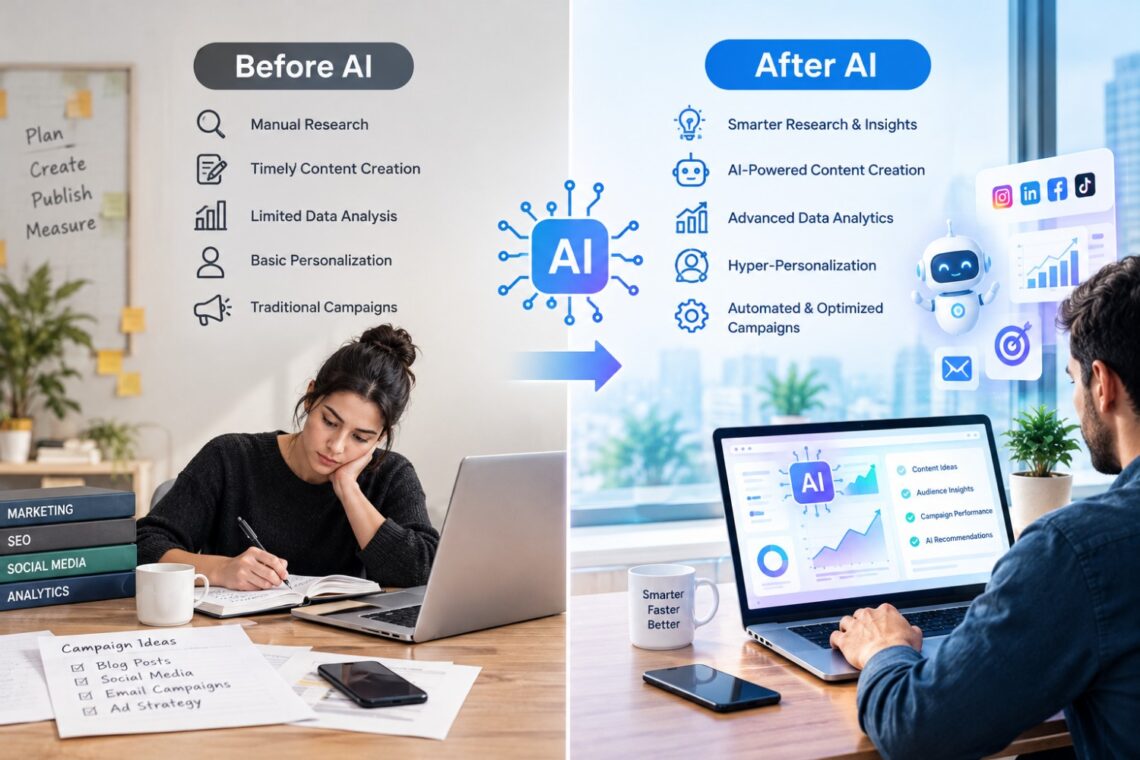
Digital marketing has changed dramatically over the past decade. Before artificial intelligence became widely available to marketers, most digital marketing activities depended heavily on manual research, human analysis, traditional software, and significant amounts of time.
Today, artificial intelligence has become part of many digital marketing workflows. Digital marketing agency can use AI to analyze data, generate ideas, assist with content, identify trends, automate repetitive tasks, and support decision-making. This does not mean that digital marketing existed without technology before AI. Marketers have always used analytics platforms, SEO tools, advertising systems, marketing automation, customer databases, and other technologies.
The major difference is that AI can now analyze information, recognize patterns, generate content, and assist with tasks that previously required considerably more manual effort. Understanding digital marketing before and after AI helps explain how the industry has evolved and what the role of the modern digital marketer looks like today.
Digital Marketing Before AI
Before AI became a mainstream marketing tool, digital marketers relied heavily on human research, established software, spreadsheets, analytics platforms, and manual processes. Marketers still had access to powerful technologies, but these technologies generally required people to interpret the information and perform many tasks themselves.
For example, an SEO specialist could use keyword research software to find search volumes and keyword suggestions, but the marketer would need to analyze the results, group keywords, identify search intent, and develop a content strategy. The technology provided data. The marketer provided the interpretation.
Keyword Research Before AI
Keyword research was traditionally a highly manual process. An SEO specialist would typically:
- Research seed keywords
- Review search volumes
- Analyze keyword difficulty
- Examine related keywords
- Study competitors
- Group keywords into topics
- Identify search intent
- Build keyword lists
- Create content plans
This process could take many hours, especially for large websites. Keyword research tools made the process faster, but marketers still needed to manually analyze and organize the information.
Content Creation Before AI
Before generative AI became widely available, content creation depended almost entirely on human writers. A typical content workflow involved:
- Researching the topic.
- Reviewing competing articles.
- Creating an outline.
- Writing the article.
- Editing the content.
- Checking grammar.
- Adding keywords.
- Optimizing headings.
- Reviewing the final version.
- Publishing the article.
Producing high-quality content required considerable time and human effort. The advantage was that experienced writers could naturally incorporate their knowledge, opinions, experiences, and brand voice into their work.
SEO Before AI
SEO professionals traditionally relied on a combination of tools and manual analysis. They would manually investigate:
- Website structure
- Meta titles
- Meta descriptions
- Headings
- Internal links
- Backlinks
- Keyword rankings
- Competitor websites
- Technical SEO problems
- Page speed
- Search performance
SEO software could identify many technical issues, but professionals still needed to interpret the findings and decide what actions should be taken.
Social Media Marketing Before AI
Social media marketing also involved considerable manual work. Marketers had to:
- Research content ideas
- Create captions
- Design posts
- Schedule content
- Monitor comments
- Respond to audiences
- Analyze engagement
- Study competitors
- Develop social media calendars
Content scheduling tools helped automate publishing, but developing the actual strategy and content remained largely a human responsibility.
Advertising Before AI
Digital advertising platforms already provided automated features before modern generative AI became popular. However, marketers often spent significant time analyzing campaign performance and adjusting:
- Audiences
- Budgets
- Ad copy
- Keywords
- Bids
- Placements
- Campaign structures
Marketing decisions were often based on dashboards, historical performance, testing, and human analysis.
Data Analysis Before AI
Digital marketers have always worked with data. They used tools such as analytics platforms, spreadsheets, dashboards, and reporting software to understand website traffic, conversions, advertising performance, and customer behavior.
However, marketers often had to manually examine large amounts of information to identify important trends. This could make data analysis time-consuming, particularly for large campaigns.
Digital Marketing After AI
The arrival of modern AI has changed many of these workflows. AI has not created digital marketing, but it has changed how many marketing tasks are performed.
Instead of simply providing information, modern AI systems can help marketers process information, generate ideas, identify patterns, produce drafts, and automate parts of the workflow. The marketer increasingly moves from doing every task manually to directing, reviewing, and improving AI-assisted processes.
Keyword Research After AI
AI can help marketers process large keyword datasets and identify relationships between search terms. It can assist with:
- Keyword clustering
- Search intent classification
- Topic discovery
- Content gap analysis
- Related keyword identification
- Content planning
- Competitor analysis
For example, instead of manually organizing hundreds of keywords into topic groups, a marketer can use AI to create an initial classification and then review and refine it. The marketer still needs to determine whether the classifications actually make sense for the business and its target audience.
Content Creation After AI
Content creation has probably experienced one of the most noticeable changes. AI can now help marketers:
- Generate article outlines
- Brainstorm topics
- Create initial drafts
- Rewrite sections
- Summarize research
- Generate headlines
- Create FAQs
- Develop social media content
- Suggest meta descriptions
This can dramatically reduce the time required to produce a first draft. However, AI-generated content still requires human oversight. Marketers need to verify information, improve originality, add expertise, ensure the content matches search intent, and remove generic or inaccurate information.
SEO After AI
AI is also changing SEO itself. Modern SEO professionals can use AI to assist with:
- Technical SEO analysis
- Keyword research
- Search intent analysis
- Content optimization
- Competitor research
- Internal linking ideas
- Content briefs
- Schema recommendations
- SEO reporting
- Large-scale data analysis
This allows SEO professionals to spend less time on repetitive analysis and more time developing strategies. At the same time, search engines themselves are incorporating more AI into the search experience.
This means SEO professionals increasingly need to think beyond traditional rankings and consider how content is discovered, understood, and presented through AI-powered search experiences.
Social Media Marketing After AI
AI has made social media content production significantly faster. Marketers can use AI to generate:
- Post ideas
- Captions
- Content calendars
- Short-form content
- Audience insights
- Content variations
- Campaign concepts
AI can also help marketers analyze engagement patterns and identify which types of content may perform well. However, successful social media marketing still depends on understanding the audience and creating content that feels relevant and authentic.
Advertising After AI
AI has become increasingly important in digital advertising. Advertising platforms can use machine learning and AI to help with:
- Audience targeting
- Campaign optimization
- Budget allocation
- Conversion prediction
- Creative testing
- Ad recommendations
- Performance analysis
This means marketers can rely more on automated systems for certain optimization tasks. The role of the marketer increasingly involves setting the right objectives, providing appropriate inputs, monitoring results, and making strategic decisions.
Data Analysis After AI
AI has significantly changed how marketers can work with data. Instead of manually reviewing every dataset, marketers can ask AI systems to help summarize information, identify patterns, compare results, and highlight unusual changes. For example, a marketer could provide campaign data and ask:
“Which campaigns experienced the largest decline in conversion rate, and what patterns can you identify?”
AI can help process the information much faster than a manual review. The marketer can then investigate the findings and determine what action should be taken.
Before AI vs After AI
The difference becomes clearer when the two approaches are compared directly.
| Digital Marketing Activity | Before AI | After AI |
| Keyword research | Mostly manual analysis | AI-assisted research and clustering |
| Content creation | Primarily human-written | AI-assisted drafting and human editing |
| SEO analysis | Manual interpretation of tools | AI-assisted analysis and recommendations |
| Social media | Manual content planning | AI-assisted ideas and scheduling |
| Advertising | Manual optimization and testing | Greater AI-powered automation |
| Data analysis | Spreadsheets and dashboards | AI-assisted analysis and insights |
| Reporting | Manually prepared reports | AI-assisted summaries and reporting |
| Customer support | Primarily human | AI chatbots plus human support |
| Competitor research | Manual research | AI-assisted research and analysis |
| Marketing strategy | Human-led | Human-led with AI assistance |
What Has Actually Changed?
The biggest change is not that marketers have disappeared. The biggest change is how marketers spend their time. Before AI, marketers often spent a significant amount of time gathering information, organizing data, creating first drafts, preparing reports, and performing repetitive tasks. After AI, many of these activities can be accelerated or partially automated. This gives marketers more opportunity to focus on higher-value activities such as:
- Strategy
- Creativity
- Decision-making
- Customer understanding
- Brand development
- Campaign planning
- Business growth
AI is therefore changing the workflow rather than simply eliminating the profession.
Digital Marketers Are Becoming AI-Assisted
The modern digital marketer is increasingly becoming an AI-assisted marketer. Instead of working completely manually, marketers can combine their experience with AI capabilities.
For example:
- AI can analyze data. The marketer interprets the results.
- AI can generate content ideas. The marketer chooses the ideas that fit the strategy.
- AI can create a first draft. The marketer improves it with expertise and original insights.
- AI can identify potential opportunities. The marketer decides which opportunities are worth pursuing.
- This creates a collaborative relationship between humans and technology.
The Importance of Human Expertise
The rise of AI has actually made human expertise more important in some areas. As AI makes it easier for almost anyone to produce basic marketing content, generic content becomes increasingly common. Simply producing content is no longer enough. Marketers need to create content and campaigns that are useful, distinctive, relevant, and aligned with business objectives. Human expertise can provide:
- Industry knowledge
- First-hand experience
- Original ideas
- Strategic judgment
- Brand understanding
- Emotional intelligence
- Customer relationships
- Creative direction
These qualities help distinguish professional marketing from automated content production.
AI Has Increased the Speed of Marketing
One of the clearest benefits of AI is speed. Tasks that previously required hours can sometimes be completed in minutes with AI assistance. This does not mean marketers should simply produce more content. Instead, the extra time can be used to improve quality and strategy.
For example, a marketer might use AI to quickly generate several content ideas and then spend the saved time researching the best idea, adding original insights, and improving the final article.
The goal should not be maximum automation. The goal should be better marketing.
The Role of the Digital Marketer Is Evolving
Before AI, digital marketers were often expected to be highly involved in execution. Today, marketers increasingly need to become effective managers of both technology and strategy. A modern marketer may need to understand:
- Traditional marketing principles
- SEO
- Analytics
- Content strategy
- Social media
- Paid advertising
- AI tools
- Data interpretation
- Automation
- Customer behavior
This combination of marketing expertise and technological understanding can make marketers more capable and productive.
What Businesses Should Expect
Businesses should not think about AI simply as a way to replace marketing employees. Instead, AI can be used to increase the capabilities of existing marketing teams. A small marketing team can potentially use AI to conduct more research, create more content variations, analyze more data, and test more ideas than it could through completely manual processes. This can allow businesses to compete more effectively without requiring every task to be performed manually.
The Future of Digital Marketing
Digital marketing will continue to evolve as AI becomes more integrated into marketing platforms and workflows. The distinction between traditional digital marketing and AI-powered digital marketing may eventually become less noticeable because AI will simply become another standard part of the marketing technology stack. Just as marketers today do not think twice about using analytics software, SEO platforms, advertising dashboards, or social media management tools, future marketers may treat AI as a normal part of their daily workflow. The best digital marketing agency who succeed will likely be those who understand both sides of the equation: Human marketing expertise and AI-powered efficiency.
Conclusion
Digital marketing before AI was already a technology-driven industry, but many tasks required significant manual research, analysis, content creation, and decision-making. After AI, marketers have access to tools that can process information faster, generate ideas, assist with content, analyze data, automate repetitive activities, and support campaign optimization.
The result is not necessarily a world where AI replaces digital marketers. Instead, digital marketing is moving toward a model where AI supports marketers and allows them to focus more on strategy, creativity, expertise, and business outcomes.
Before AI, marketers used technology to help them work. After AI, marketers are increasingly using technology that can actively assist them in thinking, analyzing, creating, and executing. The future of digital marketing is therefore not simply human versus AI. It is human expertise powered by AI.