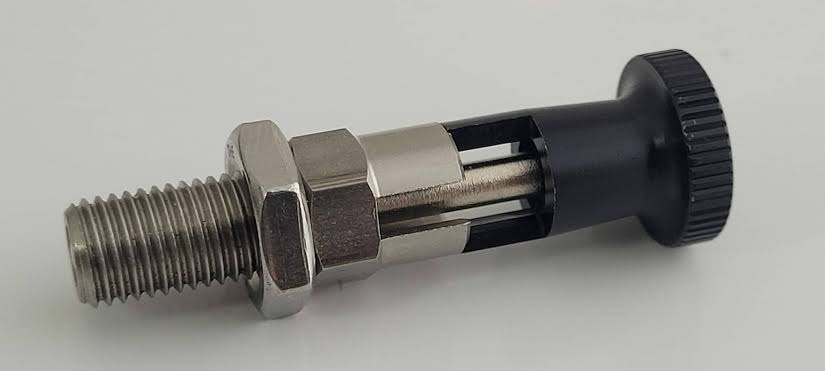
An indexing plunger pin is a small but essential mechanical component used to position, locate, and secure moving parts in machinery, fixtures, and industrial equipment. Although its design is relatively simple, choosing the wrong plunger can lead to alignment problems, inconsistent positioning, premature wear, or unnecessary production downtime. Understanding how these components work and where they perform best helps engineers, machine designers, and maintenance professionals make more reliable equipment decisions.
When designing a positioning mechanism or upgrading an existing assembly, selecting the right indexing plunger pin requires more than matching dimensions. Factors such as load requirements, engagement depth, operating frequency, mounting configuration, and environmental conditions all influence performance. A carefully selected component can simplify adjustments, improve repeatability, and make routine equipment changes safer and more efficient.
What Is an Indexing Plunger Pin?
An indexing plunger pin is a spring-loaded positioning device designed to engage with a hole, slot, or other locating feature. Its internal spring keeps the pin extended, allowing it to hold a component in a defined position until an operator or mechanism retracts it.
Most indexing plungers consist of a housing, a movable pin, a spring, and an operating mechanism such as a pull knob, ring, lever, or threaded handle. Some models include a locking feature that keeps the pin retracted when it is not needed.
Unlike a permanent fastener, an indexing plunger is intended to support repeated engagement and disengagement. This makes it particularly useful in equipment that requires frequent adjustments without removing bolts or using specialized tools.
It is important to distinguish indexing plungers from locking pins designed primarily to resist heavy structural loads. An indexing plunger may locate a component accurately, but its suitability for carrying substantial shear forces depends on its design, material, engagement geometry, and manufacturer-rated capacity.
Common Applications of Indexing Plunger Pins
Indexing plungers are used across manufacturing, automation, material handling, and equipment assembly. Their value comes from providing repeatable positioning through a compact, relatively simple mechanism.
Machine Tools and Manufacturing Fixtures
Manufacturing fixtures often require workpieces to occupy a consistent position during drilling, milling, inspection, or assembly. An indexing plunger can help locate a fixture plate or establish a repeatable stop position.
For example, a production line manufacturing several sizes of metal brackets might use a fixture with multiple indexed positions. The operator retracts the plunger, moves the fixture to the required location, and releases the handle. The spring pushes the pin into the corresponding locating hole.
This arrangement reduces setup time and helps minimize positioning variation between production runs. However, the fixture should still use appropriate locating surfaces and clamping mechanisms to resist machining forces.
Adjustable Equipment and Workstations
Industrial workstations frequently need adjustable guides, support arms, platforms, and component holders. Indexing plungers allow these parts to move between predefined positions without requiring tools for every adjustment.
Consider an assembly station that handles products of different widths. A sliding guide with several locating holes allows workers to change the guide position quickly. A properly engaged plunger maintains the selected setting during normal operation.
For equipment used throughout multiple shifts, the plunger’s operating convenience and resistance to repeated cycling become important selection criteria.
Automation and Robotic Systems
Automated equipment relies on predictable component positioning. Indexing plungers can secure adjustable sensors, tooling plates, inspection fixtures, and removable modules in designated positions.
They are particularly useful when technicians need to replace tooling or reconfigure equipment during product changeovers. Nevertheless, applications involving high-speed movement, vibration, or safety-critical locking may require a positively locked mechanism rather than a conventional spring-loaded plunger.
Packaging and Material-Handling Equipment
Packaging machines often accommodate containers, cartons, and products with different dimensions. Indexing plungers can provide repeatable adjustment points for guide rails, stops, and support assemblies.
In material-handling equipment, they may also help position adjustable brackets and removable fixtures. The component must be selected according to the expected vibration, contamination, adjustment frequency, and operating forces.
How to Select the Right Indexing Plunger Pin
A practical selection process starts with the equipment’s functional requirements rather than the component’s price or appearance.
Step 1: Define the Positioning Requirement
Determine exactly what the plunger needs to accomplish. Is it simply locating a sliding component, holding an adjustable fixture in place, or preventing movement under operational loads?
These functions are not interchangeable. A locating pin establishes position, while a load-bearing lock must withstand the forces acting on the assembly.
For example, a plunger used to position a camera mount on an inspection machine may experience relatively low forces. A plunger securing an adjustable machine guard may face vibration and additional safety requirements. The latter application may require a different locking arrangement.
Step 2: Choose the Correct Pin Diameter and Engagement Depth
The pin must fit the receiving hole or slot with suitable clearance. Excessive clearance can introduce unwanted movement, while insufficient clearance may cause binding, particularly when components are misaligned or exposed to temperature changes.
Engagement depth is equally important. A pin that only partially enters its locating hole may have reduced resistance to side loading and could disengage unexpectedly.
Check the manufacturer’s dimensional drawings for the pin diameter, extended length, stroke, mounting dimensions, and recommended hole geometry. Also verify that the receiving component provides enough material around the hole to avoid deformation.
Step 3: Select the Mounting Configuration
Indexing plungers are available with different mounting arrangements, including threaded bodies, flange-mounted designs, and press-fit configurations.
Threaded plungers are often suitable for adjustable machinery and fixtures because they can be installed in compatible tapped holes. Flanged designs can simplify alignment and provide additional mounting stability when the assembly accommodates the required fasteners.
Press-fit models may work well in purpose-designed housings, but installation tolerances are critical. Always follow the specified mounting procedure rather than assuming that similar-looking models are interchangeable.
Step 4: Evaluate Materials and Environmental Conditions
Material selection should reflect the operating environment and expected service life.
Steel plungers are commonly used in general industrial applications where strength and wear resistance are important. Stainless steel versions can be preferable in environments exposed to moisture, washdowns, or certain corrosive substances.
The housing, spring, and other internal components also matter. A corrosion-resistant pin paired with an unsuitable spring or housing may still fail in a demanding environment.
For dusty production areas, food-processing equipment, or outdoor machinery, consider contamination resistance, cleaning requirements, lubrication compatibility, and the manufacturer’s environmental recommendations.
Step 5: Check Operating Frequency and Retention Requirements
A plunger used a few times per week has different demands from one operated hundreds of times per shift. Frequent cycling increases the importance of spring durability, wear resistance, smooth retraction, and consistent engagement.
Also determine whether the pin must remain retracted during adjustment. A standard pull-type plunger may require continuous manual force, while a locking model can stay in the retracted position until deliberately released.
Where vibration could cause accidental movement, evaluate whether a positive locking feature is necessary. Never assume spring pressure alone guarantees secure retention under every operating condition.
Common Mistakes When Choosing Indexing Plungers
Several avoidable mistakes can compromise an otherwise well-designed assembly.
- Choosing by diameter alone: Two plungers with the same pin diameter may differ in stroke, spring force, mounting dimensions, and load capacity.
- Ignoring side loads: A component intended for positioning may not safely withstand substantial shear forces or repeated impact.
- Using inadequate engagement depth: Shallow engagement can increase wear and allow the pin to slip out of its locating feature.
- Overlooking contamination: Dust, metal chips, and dried residue can interfere with spring movement and prevent full engagement.
- Assuming every spring-loaded pin locks securely: Standard indexing plungers and positive-locking devices serve different purposes.
- Skipping installation checks: Misaligned holes, damaged threads, or incorrect mounting tolerances can cause binding and premature failure.
A common example occurs when a fixture is modified to accommodate a larger workpiece. If the receiving holes are relocated without checking the plunger’s stroke and alignment, the pin may engage inconsistently. Verifying the complete assembly after modifications helps prevent this problem.
Practical Tips for Reliable Performance
A few straightforward practices can improve reliability and reduce maintenance costs.
Test the mechanism before production. Retract and release the plunger several times to confirm smooth movement and full engagement. Check that the receiving hole aligns correctly across every intended position.
Inspect high-cycle applications regularly. Look for bent pins, damaged threads, corrosion, weakened spring action, and excessive wear around locating holes. Establish inspection intervals based on operating frequency and the consequences of failure.
Keep the mechanism suitable for its environment. Remove accumulated debris using an appropriate cleaning method. Apply lubricant only when permitted by the manufacturer’s instructions, especially where contamination control is important.
Document component specifications. Record the part number, dimensions, material, mounting requirements, and replacement criteria. This makes maintenance and future equipment modifications more consistent.
Validate the complete assembly. Test the mechanism under realistic operating conditions, including expected vibration and adjustment cycles. If the plunger contributes to personnel protection or another safety-critical function, use a suitably rated and validated locking system.
Conclusion
Indexing plunger pins provide a practical way to establish repeatable positions in machinery, fixtures, adjustable workstations, and automated equipment. Their effectiveness depends on selecting the right dimensions, mounting configuration, materials, engagement depth, and locking behavior for the intended application.
Before choosing a model, define the forces it must withstand, how frequently it will operate, and the conditions in which it will be used. Confirm the manufacturer’s specifications and test the assembled mechanism before putting it into regular service. These steps help improve positioning consistency, extend component life, and prevent avoidable equipment problems.