MLT full form is Medical Laboratory Technology. Learn DMLT vs BMLT, eligibility, colleges, careers, and how a medical writing diploma fits in.
MLT stands for Medical Laboratory Technology. It is a healthcare field where trained professionals test blood, urine, tissue, and other samples to help doctors diagnose disease. MLT courses include DMLT (diploma), BMLT (bachelor’s), and MSc MLT (master’s), and lead to roles in diagnostic labs, hospitals, blood banks, and research.
If you searched for the Meaning MLT Full Form, you probably want more than a definition. You want to know whether the course is worth your time, what it costs in effort, where it leads, and how it compares with newer options such as a diploma in medical writing. This guide covers all of that in plain language.
What Is the MLT Full Form?
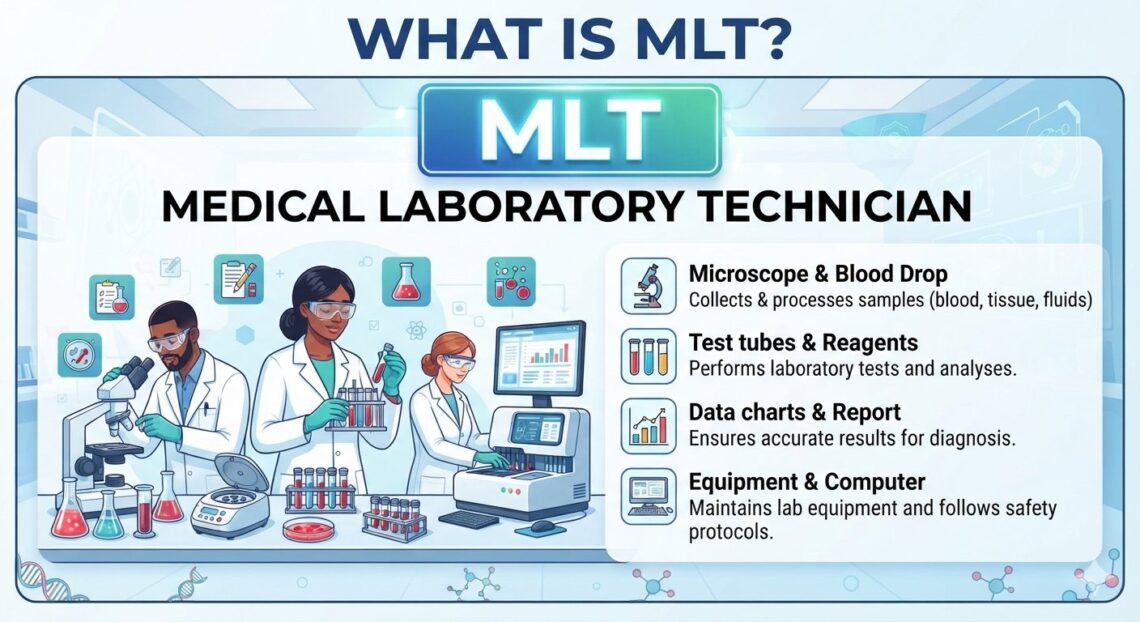
Meaning MLT Full Form = Medical Laboratory Technology. In a job context, it can also mean Medical Laboratory Technician (or Technologist), the person who does the work.
When a doctor orders a blood test, a urine culture, or a biopsy review, someone has to run it, check the quality, and report the result. That person is usually an MLT professional. Doctors rely heavily on these reports, which is why the field matters even though patients rarely see the lab.
MLT meaning in simple words
Think of MLT as the behind-the-scenes diagnostic team. Doctors treat patients; MLT professionals provide the evidence doctors use to decide how.
Is MLT the same everywhere?
Not exactly. In India, MLT usually refers to the DMLT and BMLT programmes. In the United States, “MLT” often means a technician with an associate degree, while “MLS” (Medical Laboratory Scientist) usually means a bachelor’s-level role. Titles and credentials vary by country, so always check local rules.
What Does an MLT Professional Do?
Daily work depends on the lab, but common tasks include:
- Collecting and labelling samples (in some roles, drawing blood)
- Running tests on blood, urine, stool, and body fluids
- Operating and calibrating lab equipment such as analysers and microscopes
- Checking results for errors and following quality-control steps
- Maintaining safety, biohazard, and record-keeping standards
- Reporting results to doctors or senior pathologists
Example: A patient with fever visits a clinic. The doctor orders a complete blood count and a malaria test. The MLT professional prepares the sample, runs the tests, verifies the readings, and sends the report, often within hours.
MLT Courses: Which One Should You Choose?
| Course | Full form | Typical duration* | Usual entry point |
|---|---|---|---|
| DMLT | Diploma in Medical Laboratory Technology | About 2 years | After Class 12 (science) |
| BMLT | Bachelor of Medical Laboratory Technology | About 3 years plus internship | After Class 12 (science) |
| MLT Certificate | Certificate in Medical Laboratory Technology | Several months to 1 year | After Class 10 or 12, varies |
| MSc MLT | Master of Science in Medical Laboratory Technology | About 2 years | After a relevant bachelor’s |
*Duration, structure, and eligibility differ by university and country. Confirm details on the official prospectus before applying.
DMLT vs BMLT: a quick comparison
- Choose DMLT if you want a shorter, lower-cost route into a lab job.
- Choose BMLT if you want better long-term growth, supervisory roles, or the option to pursue a master’s degree.
- Choose a certificate only as a starting point or for a specific skill, such as phlebotomy.
A practical tip: many students begin with DMLT, work for a year or two, and then pursue BMLT through lateral-entry options where universities allow it. Check each university’s policy, because lateral entry is not available everywhere.
Eligibility for MLT Courses
Requirements vary, but the most common pattern in India is:
- DMLT: Passed Class 12 with Physics, Chemistry, and Biology (some institutes accept Maths in place of Biology).
- BMLT: Passed Class 12 in the science stream, often with a minimum percentage set by the university.
- MSc MLT: A relevant bachelor’s degree such as BMLT or a related life-science degree.
Some institutions admit students through entrance exams or merit lists; others use direct admission. Always read the official admission notice rather than relying on third-party summaries.
How to Choose the Right MLT College
A good course on paper can still be a weak programme in practice. Before paying any fees, check:
- Recognition and approval: Is the institute affiliated with a recognised university or approved by the relevant regulator? In India, allied health education falls under the framework created by the National Commission for Allied and Healthcare Professions (NCAHP) Act, 2021. Verify the current status of any institute you are considering.
- Hands-on training: Does the college have a working lab, or a tie-up with a hospital where you can train on real samples?
- Internship: Is clinical or lab internship included and supervised?
- Faculty: Are instructors qualified in pathology, microbiology, or biochemistry?
- Placement support: Ask which labs or hospitals actually hire graduates. Request names, not just percentages.
- Total cost: Include tuition, lab fees, exam fees, and uniform or material costs.
Red flag: Any institute that guarantees a job or avoids showing its affiliation documents deserves extra caution.
MLT Career Path and Job Roles
MLT graduates typically find work in:
- Diagnostic and pathology laboratories
- Government and private hospitals
- Trending Diploma In Medical Writing
- Blood banks
- Public health and screening programmes
- Research laboratories and universities
- Pharmaceutical and biotechnology companies (quality control and testing)
Common job titles
- Medical Laboratory Technician
- Pathology Lab Technician
- Phlebotomist
- Blood Bank Technician
- Microbiology or Biochemistry Technician
- Quality Control Analyst
- Lab Supervisor (with experience and higher qualifications)
Growth over time
A realistic path looks like this:
Technician → Senior Technician → Lab Supervisor or Quality Manager → Lab Manager
Adding a bachelor’s or master’s degree, specialisations (such as microbiology or histopathology), or professional certification generally opens more senior roles. Pay varies widely by city, employer, and experience, so check current job listings instead of trusting a single figure.
Skills That Help You Succeed in MLT
- Attention to detail (small errors can change a diagnosis)
- Comfort with biology, chemistry, and basic maths
- Patience for repetitive but precise work
- Willingness to follow safety protocols strictly
- Basic computer skills for lab information systems
- Clear communication with doctors and patients
MLT vs Other Paramedical Courses
| Factor | MLT | Radiology/Imaging | Nursing |
|---|---|---|---|
| Main work | Testing samples | Operating imaging equipment | Direct patient care |
| Patient contact | Low to moderate | Moderate | High |
| Work style | Lab-based, technical | Technical, procedure-based | Ward and bedside |
| Best for | Detail-oriented, science-minded students | Technology-oriented students | People-focused students |
Where Does a Diploma in Medical Writing Fit In?
Medical writing has become a popular topic among science graduates, and it is worth understanding how it relates to MLT.
Medical writing means producing accurate, structured health and science content: clinical study reports, regulatory documents, patient information leaflets, journal manuscripts, and health education material. A diploma in medical writing (often offered as a PG diploma or a combined clinical research and medical writing programme) trains you in these skills.
Is it a replacement for MLT? No. They are different careers. MLT is a hands-on diagnostic role. Medical writing is a communication role built on scientific understanding.
Why MLT graduates sometimes explore it:
- Lab training gives you a real understanding of tests, terminology, and how results are interpreted.
- Some people prefer desk-based work after a few years in the lab.
- Pharma, clinical research organisations, and health publishers hire writers who can explain science clearly.
Be realistic: Medical writing usually requires strong English writing, familiarity with reporting guidelines, and a portfolio. A diploma alone does not guarantee a job. Before enrolling, check the course syllabus, trainer background, and whether recruiters in your region value the credential.
Step-by-Step: How to Start Your MLT Journey
- Confirm your stream. Science with biology is the safest base.
- Decide the level. DMLT for a faster start, BMLT for a stronger long-term base.
- Shortlist 3–5 institutes and verify affiliation on official websites.
- Visit the lab or ask for a virtual tour and sample timetable.
- Speak to current students or alumni about internships and placements.
- Compare total costs, then apply before deadlines.
- Plan beyond graduation: specialisation, certification, or higher study.
FAQ’s
1. What is the full form of MLT?
MLT stands for Medical Laboratory Technology. It can also mean Medical Laboratory Technician, the professional who performs diagnostic tests.
2. What is the difference between DMLT and BMLT?
DMLT is a diploma, usually about two years, focused on core lab skills. BMLT is a bachelor’s degree, usually longer, with deeper theory and better prospects for senior roles and further study.
3. Is MLT a good career?
It can be a stable option because diagnostic testing is central to healthcare. It suits people who enjoy science and precise work. Income and growth depend on your qualification, location, and employer.
4. Can I do MLT after Class 12 without biology?
Some institutes accept Maths in place of Biology for DMLT, but many require biology. Check each institute’s published eligibility.
5. How long does it take to become an MLT professional?
Typically about two years for a diploma and about three years plus internship for a bachelor’s degree, though this varies by institute.
6. Does MLT involve drawing blood?
Often yes, especially in smaller labs. In larger hospitals, a dedicated phlebotomist may handle collection while MLT staff run the tests.
7. What is the difference between MLT and MLS in the US?
MLT is generally a technician-level role, commonly with an associate degree. MLS (Medical Laboratory Scientist) is usually bachelor’s-level with broader responsibilities. Certification is commonly through bodies such as ASCP.
8. Can MLT graduates go abroad?
Possibly, but most countries require credential evaluation, licensing or certification exams, and sometimes language tests. Research the target country’s regulator early.
9. Is a diploma in medical writing useful for MLT graduates?
It can be, if you enjoy writing and want a non-lab pathway. It is a separate skill set, so treat it as a career pivot, not an extension of MLT.
10. Which is better: DMLT or a medical writing diploma?
They serve different goals. Choose DMLT for hands-on lab work. Choose medical writing only if you prefer writing and already have a science background.
Conclusion
The MLT full form, Medical Laboratory Technology, points to a practical, in-demand healthcare field built on accuracy and science. Start by matching the course level to your goals: DMLT for a quicker entry, BMLT for broader growth. Then verify the college’s recognition, lab access, and internship before you commit.