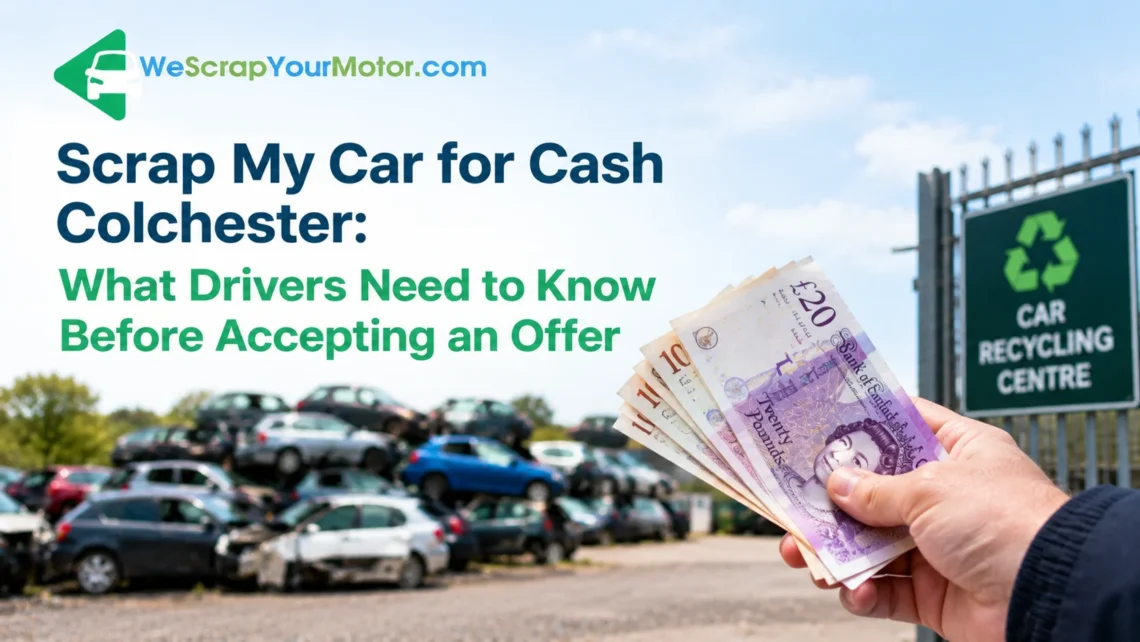
Searching scrap my car for cash Colchester may sound like a straightforward way to find someone who will collect an unwanted vehicle and pay for it.
But there is an important detail every vehicle owner in Colchester should understand.
If your car is genuinely being purchased as scrap and permanently destroyed in England, physical cash payment is not permitted.
That does not mean your scrap car has no value.
It means legitimate payment for a scrapped vehicle needs to be made through an approved, traceable method such as bank transfer or cheque.
Understanding this distinction can help you avoid questionable buyers and dispose of your car correctly.
Can You Legally Get Cash for a Scrap Car in Colchester?
For a vehicle that is genuinely being scrapped, the answer is no when “cash” means physical notes or coins.
UK guidance states that it is illegal to be paid in cash when a vehicle is scrapped in England or Wales.
The Authorised Treatment Facility can still pay you the vehicle’s scrap value, but payment must be made using an appropriate non-cash method such as bank transfer or cheque.
This rule creates a clear record of scrap-metal transactions.
Therefore, when people search scrap my car for cash Colchester, a better interpretation is usually:
How can I get paid for my scrap car in Colchester?
You can receive payment.
It simply should not be handed over as physical cash if the vehicle is being scrapped.
There Is an Important Distinction
Not every unwanted vehicle purchased by a motor trader necessarily ends up being destroyed.
If a vehicle is not actually treated as scrap and no Certificate of Destruction is issued, the circumstances can be different.
For example, a buyer might acquire a repairable vehicle to restore and resell.
But where a Certificate of Destruction is issued and the vehicle is genuinely scrap, physical cash payment is prohibited.
That distinction is one reason you should understand what the buyer intends to do with your car.
Why Do People Scrap Cars?
Vehicles reach the end of their useful life for many different reasons.
Common examples include:
- MOT failure
- Serious corrosion
- Engine failure
- Gearbox failure
- Accident damage
- Flood damage
- Electrical faults
- Repeated breakdowns
- Repair costs exceeding vehicle value
Sometimes there is nothing dramatically wrong with the car.
It may simply have reached the point where maintaining it no longer makes financial sense.
Work Out Whether Your Car Is Actually Ready for Scrap
Before accepting an offer, compare three options:
Repair
Sell in its current condition
Scrap or salvage
The highest immediate offer is not always the best financial result.
Imagine a vehicle worth £4,000 in good condition needs a confirmed £500 repair.
Scrapping it would probably make little sense.
Now imagine an older car worth £1,200 requires £1,500 of engine work plus extensive MOT repairs.
The economics are completely different.
Always understand the fault before making a final decision where practical.
How Is Scrap Car Value Calculated?
Several factors can influence the quotation.
Make and Model
Popular models may have stronger demand for reusable components.
Weight
Larger vehicles generally contain more recyclable material.
Completeness
Missing engines, gearboxes, catalytic converters, wheels or other major parts can affect value.
Condition
A complete non-runner may be worth more than a heavily dismantled shell.
Reusable Components
Some vehicles retain value as salvage or parts rather than simply as scrap material.
Market Conditions
Recycling and used-parts markets change, so quotations can vary over time.
Collection Requirements
A vehicle that rolls freely from an accessible driveway is easier to recover than one with locked wheels in a difficult location.
This is why accurate information is important when asking for a price.
Be Honest About Missing Parts
Removing parts before obtaining a quote can sometimes reduce the offer more than expected.
Before dismantling anything, consider requesting a whole-vehicle valuation first.
If components are already missing, tell the buyer.
This may include:
- Catalytic converter
- Engine
- Gearbox
- Wheels
- Battery
- Doors or panels
- Electronics
Trying to hide missing components may lead to a revised quotation when the collector arrives.
Free Collection Can Affect the Real Value of the Offer
Suppose one buyer offers £500 but charges £100 to recover the vehicle.
Another offers £470 with collection included.
The second offer is actually worth more to you.
Compare the amount you will genuinely receive after all costs.
For Colchester motorists, We Scrap Your Motor’s scrap my car in Colchester service provides a convenient option for unwanted, damaged and non-running vehicles, with collection forming an important part of the overall process.
This is the type of information worth confirming before accepting any quotation.
Questions to Ask Before Booking Collection
A reputable service should be able to explain the process clearly.
Ask:
- Is collection included in the quotation?
- What could cause the price to change?
- How will I be paid?
- When will payment arrive?
- Where will the vehicle be taken?
- Will it go through an Authorised Treatment Facility if it is scrapped?
- What documents do I need?
- What DVLA steps do I need to complete?
- Will I receive the appropriate destruction paperwork?
If the answers are vague or contradictory, consider another provider.
What Is an Authorised Treatment Facility?
An Authorised Treatment Facility, or ATF, is a licensed facility permitted to handle end-of-life vehicles.
UK government guidance says vehicles that have reached the end of their life must be scrapped through an ATF.
These sites deal with vehicles in a controlled way, including the removal of fluids and other materials before recycling or destruction.
If a qualifying car or light commercial vehicle is completely scrapped, a Certificate of Destruction can be issued.
Why the Certificate of Destruction Matters
A Certificate of Destruction is more than a receipt.
It confirms that an eligible vehicle has entered the official destruction process.
This matters because you do not want an end-of-life car continuing to appear connected to you after it has left your possession.
An ATF should provide the appropriate documentation when an eligible vehicle is permanently destroyed.
Keep the documentation safely.
Remember to Deal With DVLA
Do not assume the collector automatically removes every responsibility from you.
Make sure the registered-keeper records are dealt with correctly.
When permanently scrapping a vehicle, follow the relevant DVLA procedure and keep evidence of the transaction.
If you have a private registration number that you want to retain, arrange that before permanent destruction.
Warning Signs to Watch For
Be cautious if someone:
- Insists on paying physical cash for a vehicle that is clearly being scrapped
- Refuses to identify the business
- Cannot explain where the vehicle is going
- Refuses to discuss paperwork
- Unexpectedly reduces the agreed price without a clear reason
- Adds unmentioned collection charges
- Asks you to provide inaccurate vehicle information
A legitimate transaction should be transparent enough for you to understand who is collecting the car, how you will be paid and what happens next.
How to Improve the Accuracy of Your Quote
Before asking for a price, gather:
- Registration number
- Postcode
- Make and model
- Approximate mileage
- MOT status
- Details of damage
- Mechanical faults
- Missing components
- Whether the vehicle starts
- Whether it rolls and steers
- Key availability
- V5C status
- Access information
Photos may also be useful where the vehicle has significant accident or body damage.
The more accurately the car is described, the easier it is for a buyer to give a realistic quotation.
Should You Choose the Highest Offer?
Price is important, but compare the entire transaction.
Consider:
- Final amount after collection costs
- Payment method
- Quotation conditions
- Convenience
- Documentation
- Collection arrangements
- Legal disposal route
An offer that is slightly lower but clearly explained may be safer and ultimately more valuable than a suspiciously high headline figure that changes at collection.
Frequently Asked Questions
Can I receive physical cash when scrapping my car in Colchester?
Not if the vehicle is genuinely being treated as scrap. Physical cash payment for scrap vehicles is prohibited in England and Wales. A traceable payment method should be used.
Can I get paid by bank transfer?
Yes. Bank transfer is one of the normal ways a lawful scrap vehicle payment can be made.
Can a car without an MOT be scrapped?
Yes. A valid MOT is not required for an end-of-life vehicle to be collected for scrapping.
Can a non-running car still be collected?
Yes. Appropriate recovery equipment can be used, but describe the vehicle’s condition and accessibility beforehand.
Does a failed engine mean my car is worthless?
No. The car may still have recyclable-material, parts or salvage value.
Do I need the V5C?
The V5C is useful and should be provided where appropriate. If it is missing, discuss the circumstances with the buyer and make sure the DVLA requirements are still handled correctly.
Final Thoughts
The search phrase Scrap My Car Online UK can be misleading if it suggests that a legitimate scrapyard should arrive with physical cash.
When your vehicle is genuinely being scrapped in England, it should be handled through the correct legal process and paid for using an approved non-cash method.
Before accepting an offer, understand your vehicle’s actual condition, compare repair and disposal values, check whether collection is included and confirm where the vehicle will go.
A good scrap-car transaction should leave you with more than a payment.
It should also leave you with a clear record of the handover, correct DVLA administration and confidence that an end-of-life vehicle has been disposed of responsibly.