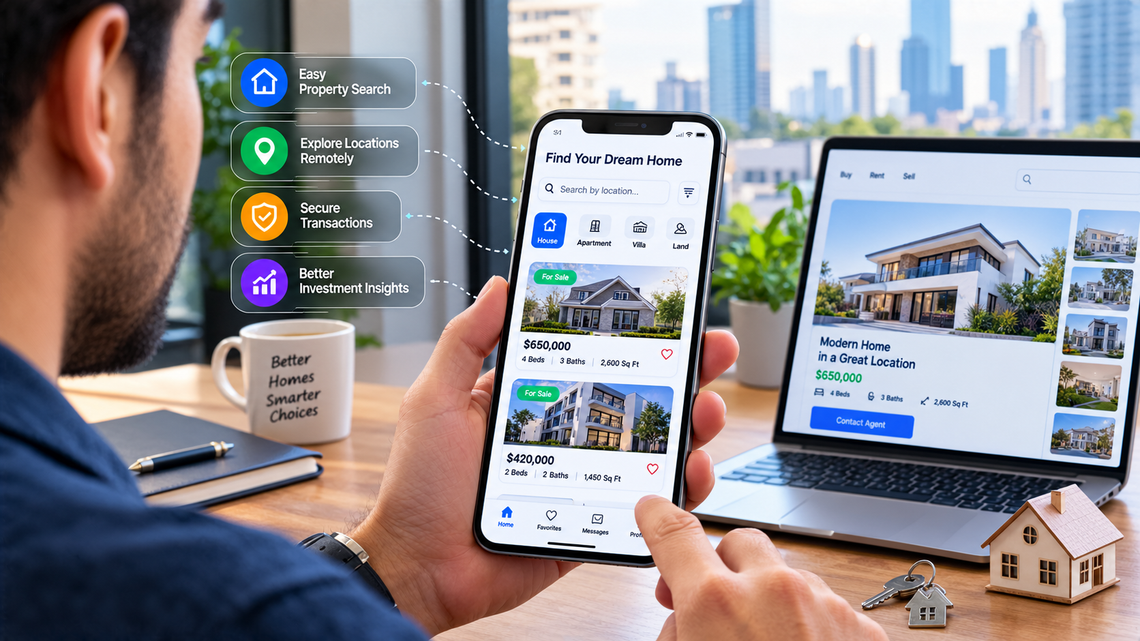
Omar and Sana Qureshi bought their first flat without visiting a single open house on a weekend. They found it on a Tuesday night, scrolling on the couch. By Thursday they’d watched a 3D walkthrough twice, checked the school catchment on a map layer, run a mortgage estimate, and sent an offer through the app. The viewing, when it finally happened, took twenty minutes and felt like a formality.
Ten years ago that story would’ve sounded invented. Today it’s ordinary, and it’s the reason every Real Estate App Development company is being asked the same thing by agencies, brokers, and developers: how do we build something buyers actually trust with the biggest purchase of their lives? This guide looks at what property apps have really changed, where they still stumble, and what buyers and builders should pay attention to.
From Newspaper Listings to Search in Your Pocket
Property hunting used to run on paper and phone calls. You circled ads in the weekend classifieds, rang an agent, waited for a callback, and drove across town to see a place that looked nothing like its photos. Agents controlled the information, and buyers had to ask nicely.
Apps broke that arrangement. Zillow, Redfin, and Realtor.com in the United States, Rightmove and Zoopla in the UK, and Zameen.com in Pakistan put listings, prices, and photos in front of anyone with a phone. The data that agents once guarded, like sold prices, price history, and days on market, is now a tap away.
That access changed the power balance. A buyer who walks into a negotiation having already studied five comparable sales speaks with a different kind of confidence. Agents still matter enormously, but the conversation starts further along.
Smarter Search Filters Save Weeks of Wasted Viewings
Early property portals gave you three filters: price, bedrooms, location. Modern apps give you dozens, and the good ones let you search the way people actually think.
You can draw a custom boundary on the map around the streets you like. You can filter by commute time to your office, by walkability score, by whether the garden faces south, by flood risk or noise levels. Save a search and the app alerts you the moment something matching appears, which matters in fast markets where a good home sells within days.
Saved-search alerts quietly became the most powerful feature in property tech. Buyers who used to check listings daily now let the app do the watching. The first person to see a new listing often becomes the first person to book a viewing, and in a tight market that gap decides who gets the keys.
Some platforms now accept plain-language queries too. Type “three-bed near a good primary school with off-street parking” and an AI layer translates that into filters. It isn’t flawless, but it spares buyers from learning a portal’s logic.
Virtual Tours and 3D Walkthroughs Changed What a Viewing Means
Before apps, a viewing was the first real look at a property. Now it’s often the last step.
Companies like Matterport scan interiors and build navigable 3D models. Buyers can walk through rooms, measure walls, and check how light falls at different hours without leaving home. Augmented reality takes it further: point your phone at an empty room and place a sofa in it to see whether it fits.
For overseas buyers and expatriates, this is a genuine shift. A Pakistani professional working in Dubai can shortlist homes in Lahore or Karachi and make informed decisions before a relative visits on their behalf. UK investors buy buy-to-let properties in other cities after a video call and a 3D scan. Distance used to kill deals. Now it only slows them down.
The side effect is that buyers arrive at viewings with sharper questions. They’ve already seen the layout, so they spend the visit checking what a camera can’t show: the smell of damp, the sound of traffic, the feel of the neighbourhood at six in the evening.
Price Transparency and Instant Valuations
Few features stirred more debate than automated valuations. Zillow’s Zestimate popularized the idea that a computer could estimate a home’s value in seconds, using public records, recent sales, and local trends.
These estimates aren’t appraisals. They can miss a renovated kitchen or overvalue a house backing onto a busy road. But as a starting point they give buyers something they never had: a reference number that doesn’t come from the seller.
Pair that with price history charts, neighbourhood trend graphs, and rental yield calculators, and a first-time buyer can sanity-check an asking price in minutes. Investors use the same tools to compare areas by return rather than by gut feeling.
Treat the figures as a compass, not a map. A smart buyer uses an app’s valuation to open a conversation, then confirms it with a proper survey and a local agent’s opinion.
Mortgage Tools and Financing Inside the App
Money is where most buyers lose sleep, and apps have gone straight at that anxiety.
Mortgage calculators let you see monthly payments at different deposit sizes and interest rates. Pre-approval tools connect to lenders, so you know your budget before you fall for a house you can’t afford. Some platforms track rate changes and nudge you when refinancing could save money.
In markets like the US, apps can now pull in your credit profile, income documents, and bank statements to speed up approval. In Pakistan and other developing markets, the picture is more mixed, but digital financing options and Islamic home finance comparisons are showing up in more apps each year.
The practical result is fewer nasty surprises. When you know your price ceiling and your likely closing costs before you start viewing, you stop wasting weekends on homes outside your range.
Digital Paperwork, E-Signatures, and Faster Closings
Property transactions have a reputation for paperwork mountains. Offers, disclosures, inspection reports, title documents, contracts. Each used to mean printing, signing, scanning, and emailing.
Integrations with DocuSign and similar e-signature tools moved much of that into the app. Buyers sign offers from their phone, upload ID documents by photo, and track each step of a transaction on a progress bar. Agents see exactly where a deal is stuck, whether it’s waiting on a surveyor, a lender, or a missing signature.
Faster paperwork doesn’t make buying simple, but it removes the dead time. Deals that used to drag for weeks over lost documents now move on a schedule you can watch.
Agents Haven’t Disappeared, They’ve Changed
Every few years someone predicts apps will kill the estate agent. It hasn’t happened, and it won’t.
What apps changed is the agent’s job. Basic information handling, like sending listings and answering “is it still available,” is automated. What’s left is the work that needs a human: negotiating, reading a seller’s motivation, spotting problems in a contract, calming a nervous buyer at 10 p.m.
Smart agents use apps as a CRM and a lead channel. They track which listings a buyer opened, how long they lingered on photos, and which neighbourhoods keep appearing in their saved searches. That behaviour tells them what the buyer wants before the buyer says it. Agents who ignore the tools lose ground. Agents who use them well look like they can read minds.
Where Real Estate Apps Still Fall Short
Honest coverage means naming the cracks.
Stale or inaccurate listings. Nothing infuriates a buyer faster than falling for a home that sold three weeks ago. Listings that aren’t updated in real time erode trust in an entire platform.
Photo and tour spin. Wide-angle lenses make small rooms look generous. A virtual tour shows what a seller wants you to see.
Data privacy. Property apps collect your budget, your income details, your location, and your browsing habits. Buyers should read permission requests carefully and prefer platforms that explain how data is stored and shared.
Algorithm bias. Automated valuations and recommendation engines can reflect historical patterns that disadvantage certain neighbourhoods. Regulators in several countries have started paying attention.
Information overload. Too many filters, alerts, and notifications can leave buyers paralysed. More options don’t always produce better decisions.
What Builders Should Know Before Launching a Property App
Plenty of agencies, developers, and proptech startups want their own app, and the reasons are sound. A branded app captures leads directly, builds loyalty, and avoids paying portal fees on every listing. But the market is crowded, and a generic clone won’t survive.
Start with one clear audience. Is the app for first-time buyers, landlords, off-plan investors, or overseas Pakistanis hunting for a home? Each group needs a different experience. Trying to serve everyone usually serves no one.
Identity matters more than most teams expect. Before screens get designed, write down your colour system, tone of voice, iconography, and how the app should feel when someone opens it at midnight with a mortgage worry. A solid Mobile App Branding Guide keeps designers, developers, and marketers pulling in the same direction, and it makes the product recognizable at a glance in a crowded app store.
Beyond branding, these features usually decide whether users stay:
- Fast, accurate search. Map-based browsing with saved searches and instant alerts is the baseline.
- Verified listings. A “verified” badge backed by real checks builds trust quickly.
- Offline and low-bandwidth modes. Many buyers browse on patchy connections.
- Chat and call scheduling. Direct messaging with agents beats a contact form.
- Mortgage and affordability tools. Keep buyers inside your app while they work out the numbers.
- Compliance. Respect GDPR for UK and EU users and local data rules elsewhere.
Launch lean. Ship a focused first version, watch where users drop off, and let real behaviour guide the next release.
Tips for Buyers Using Property Apps
If you’re on the buying side, a few habits make these tools work harder for you.
Set up saved searches on at least two platforms, since listings don’t always overlap. Use valuation estimates as a conversation starter, never as gospel. Book the viewing even after a great virtual tour, because no scan captures a street’s atmosphere. Check a listing’s history for price drops and relistings, which can hint at problems or flexible sellers. And keep a shortlist inside the app with notes, so you aren’t relying on memory when you’re comparing eight homes.
Frequently Asked Questions
Are real estate apps reliable for finding a home? They’re reliable for discovery and research, as long as you confirm key details with the agent. Always verify availability, price, and ownership documents before paying any deposit.
Can I buy a property entirely through an app? Some markets allow offers, document signing, and financing to happen digitally, but most transactions still involve a solicitor, conveyancer, or notary and a physical handover step.
How accurate are home value estimates in apps? They’re a rough guide. Accuracy varies by area and by how much recent sales data exists. A professional valuation or survey is more dependable for a final decision.
What’s the best app for first-time buyers? It depends on your country. Zillow and Redfin lead in the US, Rightmove and Zoopla in the UK, and Zameen.com in Pakistan. Pick the platform with the most listings in your target area.
Are virtual home tours safe from scams? A tour can be faked or outdated. Confirm that the listing agent is registered, ask for a live video call, and never transfer money before verifying the owner’s documents.
Do real estate apps help investors? Yes. Rental yield calculators, price trend charts, and neighbourhood comparisons help investors compare markets by numbers instead of hunches.
Final Thoughts
Property apps haven’t made buying a home painless. They’ve made it legible. Prices have history, neighbourhoods have data, paperwork has a progress bar, and distance has stopped being a dealbreaker. Buyers who learn to use these tools walk into negotiations better informed and less anxious.
Omar and Sana still laugh about their twenty-minute viewing. They’d done the real work on their phones, and the flat matched everything they’d seen. What the app couldn’t tell them, a neighbour supplied on move-in day: the lift is slow, but the rooftop is wonderful.
Use the tools, trust the numbers, and still go see the place. The best purchases happen when technology and your own eyes agree.