Gardeners looking for a tree that adds height without taking up excessive horizontal space often have to balance privacy, appearance, and available planting room. Broad-canopied trees can provide excellent screening, but they may not suit narrower gardens, pathways, borders, or entrances. Italian cypress is particularly distinctive because of its naturally upright, columnar form. Scientifically known as Cupressus sempervirens, it is a long-lived evergreen with dense, dark green, scale-like foliage and a narrow growth habit. The RHS lists it as capable of reaching more than 12 metres in height while maintaining a relatively narrow spread.
What Makes Italian Cypress Distinctive?
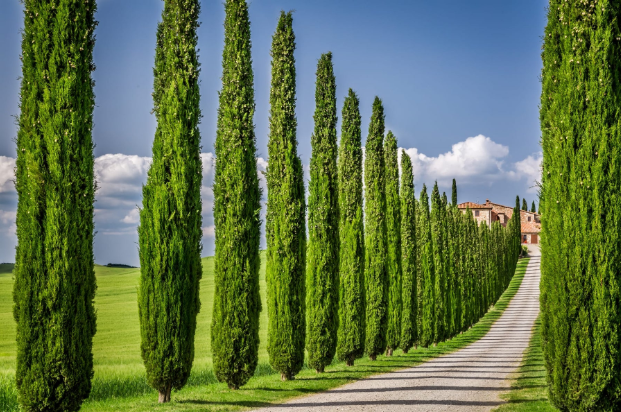
The first feature most people notice is its silhouette. Unlike trees that develop a wide, rounded crown, Italian Cypress grows vertically, creating a strong architectural shape in the landscape.
This makes it useful where height is desirable but available ground space is limited. The RHS describes the species as medium-sized, evergreen, and columnar, with a potential spread of approximately 2.5 to 4 metres depending on the plant and growing conditions.
Its evergreen foliage also provides year-round structure. Rather than disappearing during winter, the tree maintains its green appearance and continues to contribute vertical interest when many deciduous plants have lost their leaves.
A Natural Choice for Privacy Screening
Privacy planting often requires a combination of height, density, and year-round foliage. Italian Cypress can contribute to all three, particularly when several trees are positioned strategically along a boundary or around a garden area.
Its narrow form can be useful for screening patios, creating separation between different sections of a garden, or adding privacy along longer boundaries. However, spacing should be planned according to the mature size of the selected variety rather than simply placing young trees close together.
The RHS also identifies as a plant suited to architectural planting, where its strong vertical shape can be used deliberately within a landscape design.
Watering Young Trees
Established trees can tolerate relatively dry conditions, but newly planted trees need more attention while their root systems develop.
North Carolina State University Extension notes that it becomes highly drought tolerant as it matures, while young plants should receive adequate water until established.
The goal is to encourage healthy root development rather than keeping the soil permanently saturated. Gardeners should take local weather, soil conditions, and drainage into account when determining how frequently newly planted trees require water.
Using Cypress in Garden Design
Its vertical shape can introduce contrast among lower-growing shrubs, ornamental grasses, groundcovers, and flowering plants.
It can also be positioned beside entrances, paths, patios, driveways, or garden features where a strong vertical accent is desirable. The RHS specifically describes cypresses as striking evergreens that can create imposing features around gateways and provide structure in Mediterranean-style gardens.
Planting several trees in a row can create repetition and rhythm, while individual specimens can act as focal points.
Planning the Spacing
Spacing deserves attention when planting trees for screening. Young plants may initially appear far apart, but their eventual dimensions should guide the layout.
Planting too closely can create unnecessary competition as the trees mature. Conversely, excessive spacing may leave gaps that reduce the desired screening effect.
The appropriate distance depends on the specific cultivar, expected mature size, and whether the goal is individual architectural specimens or a continuous visual screen.
What About Pests and Diseases?
is generally considered a relatively low-maintenance tree, but it is not completely free from potential problems. The RHS lists cypress aphid among possible pests and identifies diseases including coryneum canker and honey fungus.
Regular observation can help gardeners notice changes in foliage, branches, or overall growth early. Problems should be assessed according to the symptoms and local growing conditions rather than assuming that every change is caused by the same issue.
Good planting conditions, particularly adequate drainage and an appropriate site, are also important parts of maintaining healthy growth.
Choosing Trees for a Long-Term Landscape
Trees are long-term additions to a garden, so selecting one based solely on its size at purchase can lead to problems later. Mature height, spread, sunlight requirements, soil conditions, watering needs, and proximity to buildings or boundaries should all be considered.
can eventually become a substantial tree. The RHS records a potential height exceeding 12 metres for the species, with maturity potentially taking decades depending on the plant and conditions.
Planning around its eventual dimensions helps ensure that the tree remains appropriate for its location as it develops.
Conclusion
It offers a distinctive combination of evergreen foliage, strong vertical growth, and relatively narrow form. These characteristics make it suitable for gardens where height, structure, and screening are important but space is limited. For gardeners comparing privacy trees, it is worth considering when the goal is to create an evergreen screen or architectural accent without the broad footprint of many other trees. With a sunny position, well-drained soil, appropriate establishment watering, and enough room for mature growth, it can become a long-lasting landscape feature.